Should you choose Crazy Egg or Mixpanel?
Crazy Egg is the better choice for marketers and CRO experts who want to analyze visitor behavior, collect feedback, and run A/B tests to optimize their website performance with one platform and one predictable subscription.
Mixpanel is a better analytics tool for SaaS product managers, product marketers, and customer success teams who want to understand how people engage with digital products to improve product adoption and customer retention.
Crazy Egg vs Mixpanel: A Quick Snapshot
Short on time? Here’s what you need to know.
| Feature | Crazy Egg | Mixpanel |
|---|---|---|
| Heatmaps | ✅ 5 report types: heatmap, scrollmap, confetti, overlay, list ✅ Confetti plots every individual click, colour-coded by 17+ attributes ✅ 20+ audience and traffic filters ✅ No traffic sampling by default ✅ Free Instant Heatmaps across all pages | ✅ Click maps ✅ Goal Mode ranks elements by conversion contribution, not raw clicks ✅ UI States capture modals and expanded menus at one URL ⚠️ Requires session replay switched on ⚠️ Covers only recorded sessions ❌ No Confetti equivalent |
| Session Replay | ✅ Auto-tagged with behavioral, ecommerce, form and account events ✅ Record a set share of traffic on the pages you choose ✅ 6 months to 2 years retention ❌ No mobile app recording | ✅ Native mobile replay: iOS, Android, React Native, Flutter ✅ Rage click and dead click detection ✅ Jump from a report into the matching replays ✅ Sensitive content masked by default ⚠️ 30-day default retention |
| Analytics | ✅ Conversion funnels, retroactive to traffic already captured ✅ Web analytics free on every plan ✅ GA4 import, including historical data, custom events and segments ✅ Segment by device, country, UTM, landing page, referrer | ✅ Event-based funnels with conversion windows and exclusion steps ✅ Retention and cohort analysis across months ✅ Flows, root cause and signal correlation analysis ✅ Cart analysis and campaign reporting ✅ Warehouse connectors: Snowflake, BigQuery, Databricks, Redshift, Postgres |
| A/B Testing | ✅ Visual editor and URL redirect, no developer needed ✅ Choice of 50/50 split or multi-armed bandit ✅ Statistical significance calculated for you ✅ Heatmaps and recordings per variant ✅ Variant data sent to GA4 | ✅ Sequential and fixed-sample models, variance reduction, guardrail metrics ✅ Sample-ratio checks catch a broken split ⚠️ Enterprise-only paid add-on ❌ No visual editor, variants are built in code |
| AI Analysis | ✅ Automatic analysis of heatmaps, recordings, web analytics and surveys ✅ Surfaces the recordings worth watching and summarizes them ✅ In-session analysis with timestamps for key events ✅ AI-ready JSON exports for Claude, ChatGPT or Gemini ✅ MCP server for conversational queries and agentic workflows ✅ Tasks runs the optimization loop and drafts the changes, in early access | ✅ Mixpanel Agent runs root-cause analysis when a metric moves ✅ Spark AI builds a custom report from a plain-language question ✅ MCP server ✅ Automatic session replay summaries |
| Error Tracking | ✅ Automatic JavaScript error detection ✅ Full stack trace, device, browser, and app version per occurrence ✅ Watch the recording of the error firing ✅ Status tracking, so you know what is fixed and what to prioritize ✅ Share the error details and the video together ❌ No network recording | ✅ Console logs, warnings, and errors on the replay timeline by default ✅ Network recording catches failed and slow API calls ⚠️ Network recording off by default ❌ No error inbox or resolved/ignored status |
| Other features | ✅ Surveys with branching, templates and granular targeting ✅ No-code popup CTAs | ✅ Mobile app analytics ✅ Account-level (company) analytics (Add-on) ✅ Feature flags (Enterprise add-on) ✅ Metric trees (Enterprise add-on) ❌ No surveys or popup CTAs |
| Pricing | ✅ Free plan (Instant Heatmaps, Surveys, Web Analytics, Conversion Analytics) ✅ Four published tiers, $29–$599/mo billed annually ✅ Billed on tracked pageviews, which you can estimate up front ✅ No overages: collection pauses at your cap | ✅ Free plan up to 1M events/mo ✅ Growth by event volume: $140/mo at 1.5M, $612.50 at 5M, $2,289 at 20M ✅ First year free for qualifying startups ⚠️ Billed on events, with no cap you can set ⚠️ Enterprise is quote-only |
Feature Breakdown: Crazy Egg vs Mixpanel
1. Heatmaps
Crazy Egg and Mixpanel both offer click maps, and both let you filter them. However, only Crazy Egg reports on every tracked visitor by default. Mixpanel builds its heatmaps out of recorded sessions, so they show you the visitors it happened to record.
Crazy Egg
Every Heatmap Report gives you five visualizations, each answering a different question:
- Click Map: where visitors click (an aggregate view)
- Scroll Map: how far down the page people get before they drop off.
- Confetti Map: where every individual user clicks, color-coded by 17+ attributes, like traffic source, device, campaign, or conversion status.
- Overlay Map: how many people click on different page elements, segmentable the same way as Confetti.
- List Map: a table view with raw numerical click data per element, great for analyzing moving parts like popups and sticky buttons.
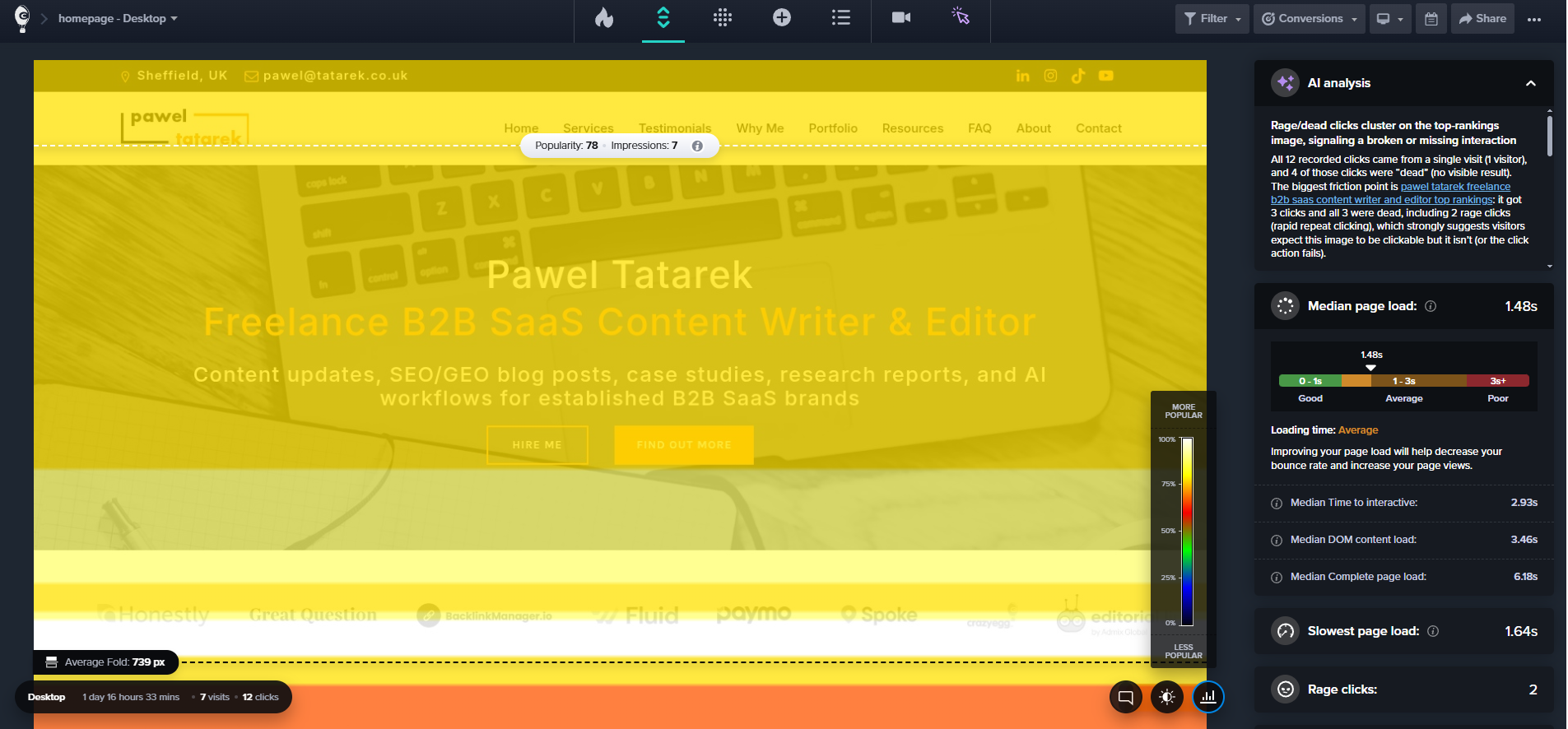
More than 20 filters let you cut the data by date range, traffic source, UTM parameters, device, new versus returning visitors, and conversion status.
There is no traffic sampling by default, but you can enable sampling manually to stretch your tracked pageview allowance further.
There are also Instant Heatmaps, which auto-generate across your whole site — a fast way to identify which pages deserve a full report.
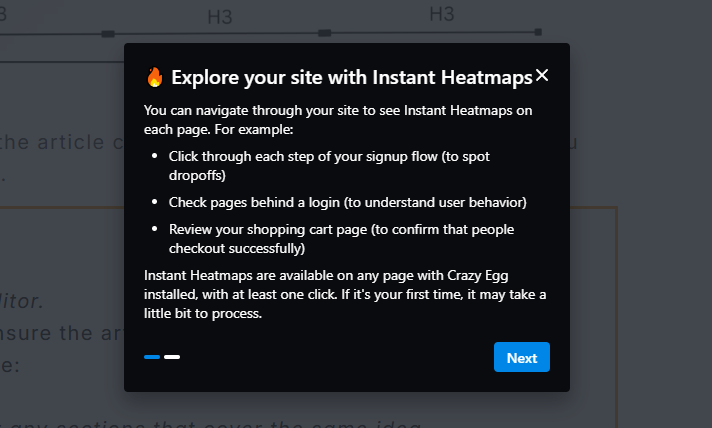
You can export any report to PDF, PNG, CSV, or an AI-ready JSON file.
Mixpanel
Mixpanel offers click heatmaps, just like Crazy Egg, but there’s no Scroll Map or Confetti equivalent.
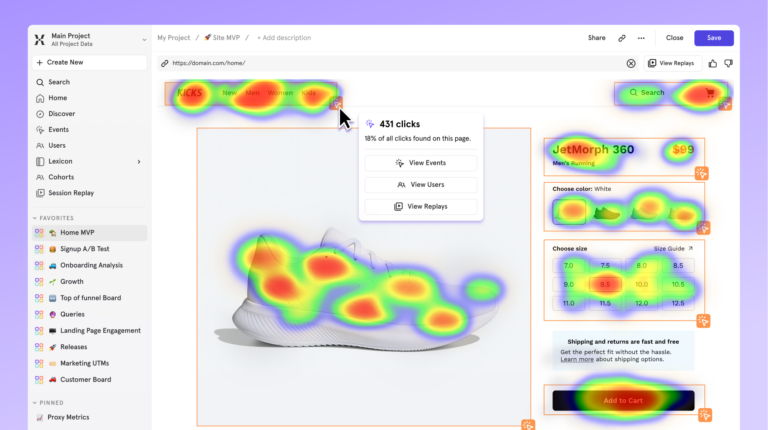
Two heatmap features that stand out:
- Goal Mode: weights the heatmap by a conversion event you choose or by a value property like order total, so elements rank by the outcomes they drive rather than by raw click count. Crazy Egg lets you segment confetti by conversion status, but doesn’t quantify how different elements contribute.
- UI States: let you view one URL in several different states, for example, a modal open or a menu expanded, pulled from session replays that match that page. In Crazy Egg, you see how many people interacted with such mobile elements, but can’t visualize it like this.
The limitation is that Mixpanel heatmaps require session replay to be on, and their coverage tracks your replay sampling rate. So, a page with limited replay coverage may produce limited insights.
2. Session replay
Both tools record sessions, and both automatically flag frustration signals like rage clicks and dead clicks on web pages and apps, and Mixpanel also on native mobile apps. Crazy Egg keeps recordings far longer by default.
Crazy Egg
Session recordings capture mouse movement, clicks, scrolls, and page transitions.
Crazy Egg labels them automatically with behavioral signals like rage clicks and dead clicks, e-commerce actions like add to cart and checkout start, form interactions like submit and abandon, and account events like signup and login.
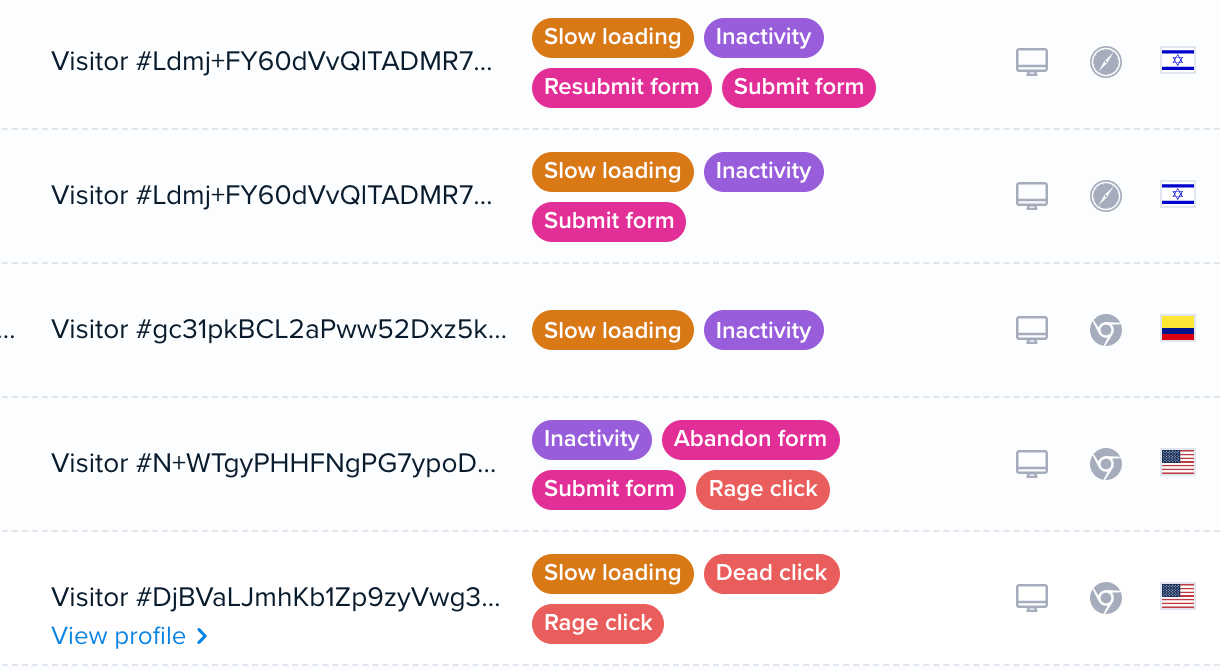
Those tags double as filters. You can narrow further by conversion status, pages visited, device, and referral source.
Just like with heatmaps, Crazy Egg records only tracked pages and lets you set a percentage of traffic to record, so you spend your budget on the pages that matter.
Crazy Egg keeps the recordings for 6 months on Starter and 2 years on Plus. That is considerably longer than Mixpanel’s 30-day default.
Mixpanel
Similar to Crazy Egg, Mixpanel records sessions, detects rage clicks and dead clicks, and lets you jump from an analytics report into the matching replays. It also masks sensitive content by default, which is an industry standard.
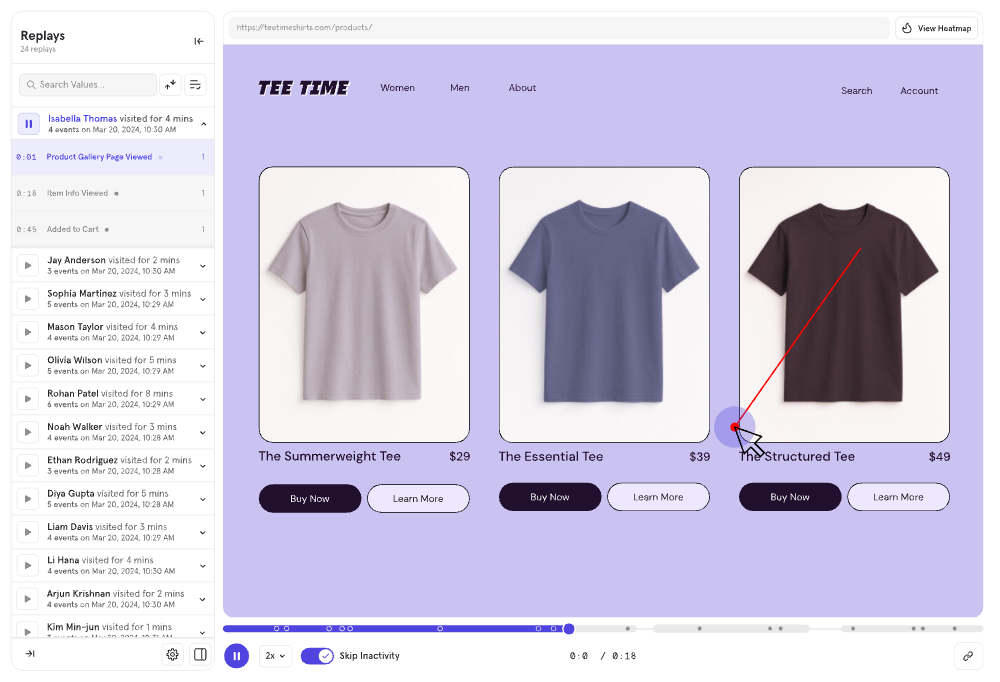
The real difference is Mixpanel has native session replay for mobile apps across iOS, Android, React Native, and Flutter. Crazy Egg has no mobile app recording, so it won’t work for product or customer success managers.
3. Analytics
Both tools offer analytics, and some features, like funnels, overlap, but they serve different purposes. Crazy Egg focuses on tracking web visitor behavior, often during one session. Mixpanel analytics focus on user behavior within digital products, often over weeks and months.
Crazy Egg
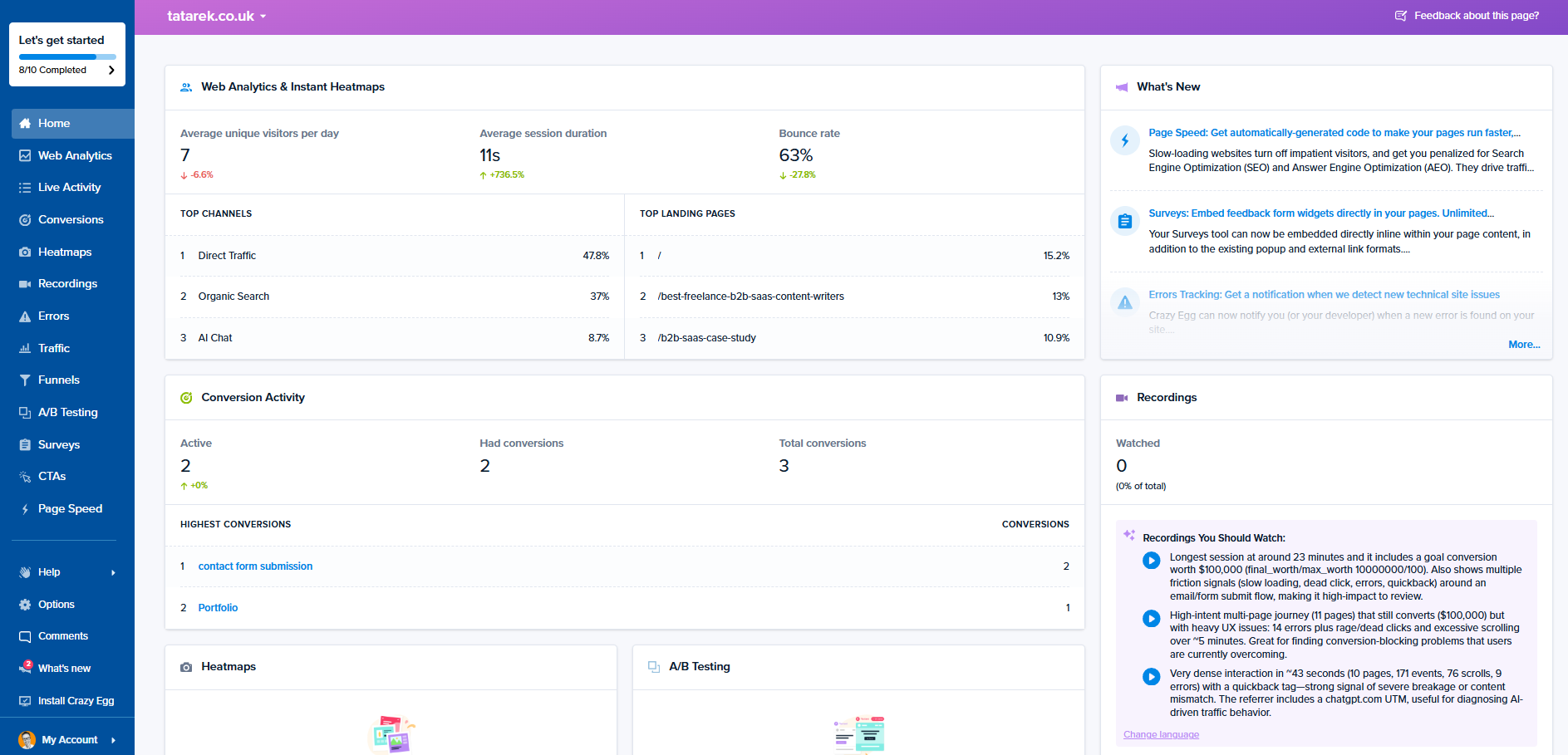
Crazy Egg gives you conversion funnels, conversion analytics, and web analytics built around website conversion paths. You see how many people visit your site, how many complete conversion events, and if they drop off — where.
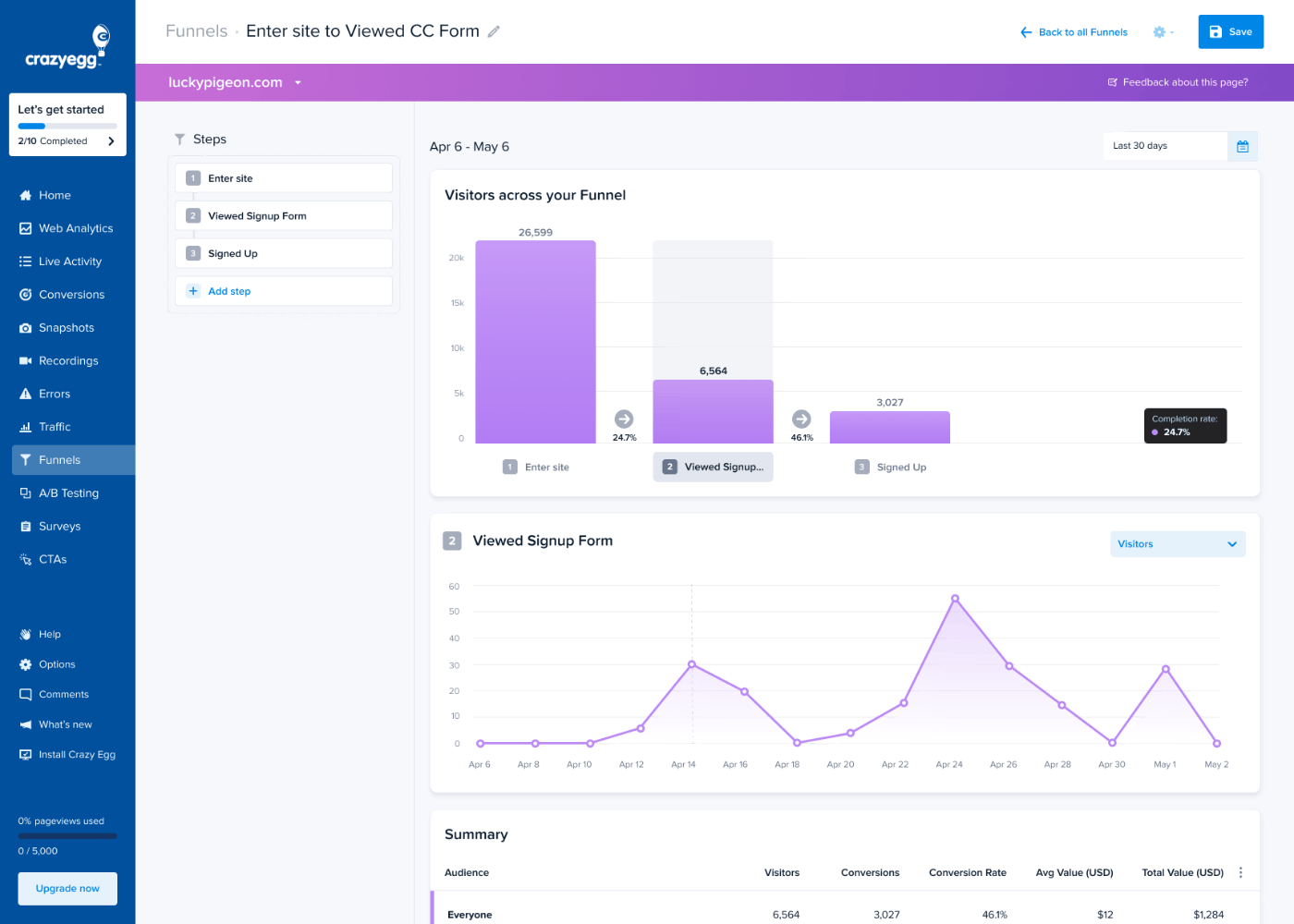
Crazy Egg collects data via its own tracking script, or you hook it up to Google Analytics 4 and import all your historical data, along with custom events and segments, so you don’t have to log into GA4 again.
Funnels are retroactive. If you add steps, Crazy Egg rebuilds the funnel from historical data as long as you’ve been tracking the conversion events.
You can segment traffic and conversions by device, country, new versus returning, landing page, referrer, and UTM parameters, and more.
Mixpanel
Like Crazy Egg, Mixpanel offers web analytics and funnel analysis and lets you track conversions across the user journey. There’s also cart analysis and campaign reporting.
There are also several other reports:
- Flows: traces the paths people take before or after the conversion event.
- Retention analysis: shows how many users come back to use the app again and when.
- Cohort analysis: segments and monitors user groups by behavior over months.
- Root cause analysis: identifies factors that move target metrics (Enterprise only).
- Signal correlation analysis: Discovers links between user actions (Enterprise only).
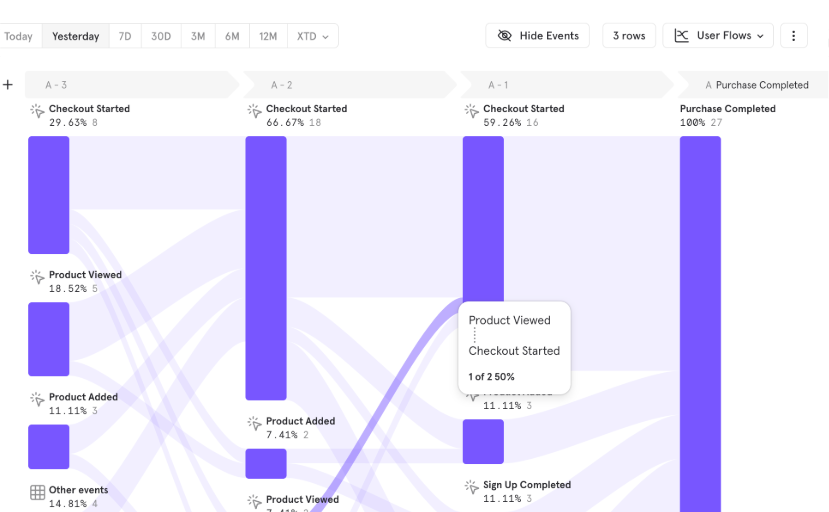
Mixpanel integrates with data warehouses, like Snowflake or BigQuery, letting you centralize product and business intelligence data analysis in one place.
Overall, Mixpanel offers more potent and diverse analytics than Crazy Egg, but many of the features are only relevant for product development, not CRO.
4. A/B testing
Both tools can run experiments and report on the results. Crazy Egg includes testing in the subscription and lets you build the variant in a visual editor. Mixpanel sells experimentation as an enterprise add-on, and the test must be wired through feature flags in code.
Crazy Egg
In Crazy Egg, you run tests by URL redirect or build variants in the Visual Page Editor, so you can launch one without waiting on a developer.
You choose between a regular A/B test with a 50/50 traffic allocation, or a multi-armed bandit test, which shifts traffic toward the leading variant while the test is still running rather than splitting it evenly to the end. Crazy Egg automatically calculates statistical significance, so you know when the test results are valid.
You can target specific visitor segments, and Crazy Egg sends the variant data to GA4 for in-depth analysis. You also get heatmaps for each variant and can jump directly into session recordings.
The targeting also lets you personalize the full website experience. Just send 100% of the traffic to the target audience.
Mixpanel
Mixpanel also runs A/B tests and reports statistical significance on the results.
You get sequential and fixed-sample test models, variance reduction, sample-ratio checks that catch a broken traffic split, and guardrail metrics that watch for damage elsewhere while a test runs.
So, its testing engine is more rigorous. But also, harder to set up because Mixpanel has no visual editor, so you need engineering skills to design the variants.
Another downside is that Mixpanel caps experiments at 3 per project. To run more, you need the Experimentation add-on (Enterprise only).
5. AI analysis
Both tools have invested heavily in their AI capabilities over the past year.
Crazy Egg
Crazy Egg’s AI automatically analyzes heatmaps, recordings, web analytics, and survey responses, and identifies trends and patterns.
For example, it shows you the top 3 session recordings you must watch and summarizes the key insights.

And once you’re inside the session, it carries out an in-depth analysis of the recording, with timestamps for key events.
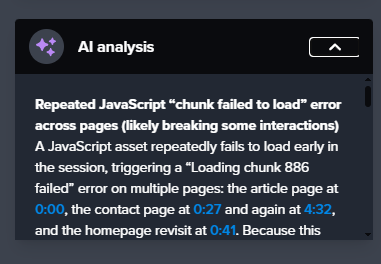
In addition, Crazy Egg allows you to analyze the data with an external AI chatbot via:
- AI-ready exports: heatmap and web analytics data exports as JSON, which you can drop straight into Claude, ChatGPT, Gemini, or whatever your team already uses.
- MCP (Model Context Protocol) server: connects an AI assistant to your Crazy Egg account, so you ask a question in conversation and get an answer back from your own data.
The latest AI feature, called Tasks and available in early access, runs the whole optimization loop. It manages the setup, reads the data, works out what is worth fixing, and produces an executive-ready report with a prioritized list of recommendations. It will also draft the changes to your site.

Mixpanel
Mixpanel runs an MCP server and summarizes session replays automatically like Crazy Egg.
In addition, there’s a Mixpanel Agent, which watches your metrics and runs root-cause analysis when one of them moves, so you know what drove the change. It’s to replace Spark AI, a conversational AI agent that creates a custom report to answer user questions in plain language.
6. Error tracking
Both tools show you JavaScript errors that real visitors are hitting, and both let you watch a recording of the error happening. Mixpanel also catches failed or slow API calls.
Crazy Egg
Crazy Egg’s Errors Tracking detects JavaScript errors automatically and tells you which visitors hit them.
Each occurrence comes with a raw stack trace, the visitor’s device and browser details, and your app version.
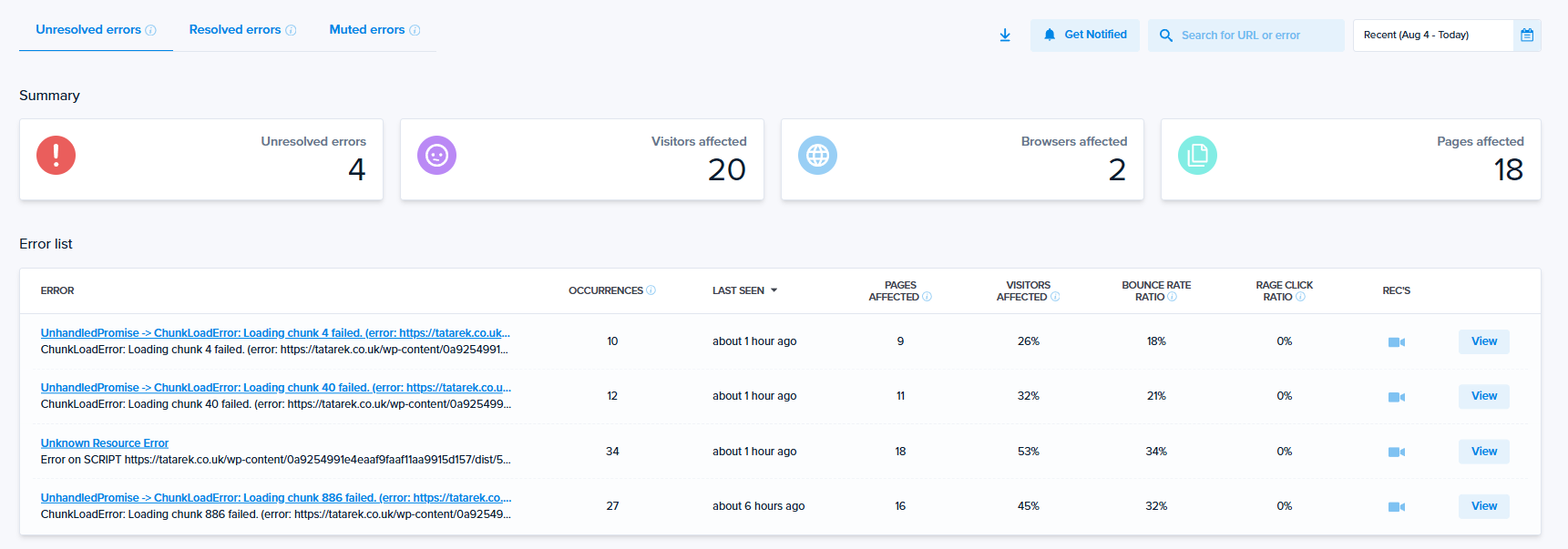
You can watch the recording of the session where the error fired, so you see what the visitor was doing when it broke, and share the error details and the video together.
Errors carry a status, so you know which ones have been resolved and which ones to prioritize next.
Mixpanel
Mixpanel also surfaces JavaScript errors from a session. Console recording is on by default, so errors, warnings, and logs appear on the replay timeline as you watch.
When you switch on network recording, Mixpanel also captures the requests made during the session for catching API call issues. Important for software development, but not for website optimization, which is why Crazy Egg doesn’t have it.
On the flipside, Mixpanel doesn’t have the workflow around any of it. There is no error inbox, and no resolved or ignored status. So you must keep track of them in Jira.
What Crazy Egg Has That Mixpanel Doesn’t
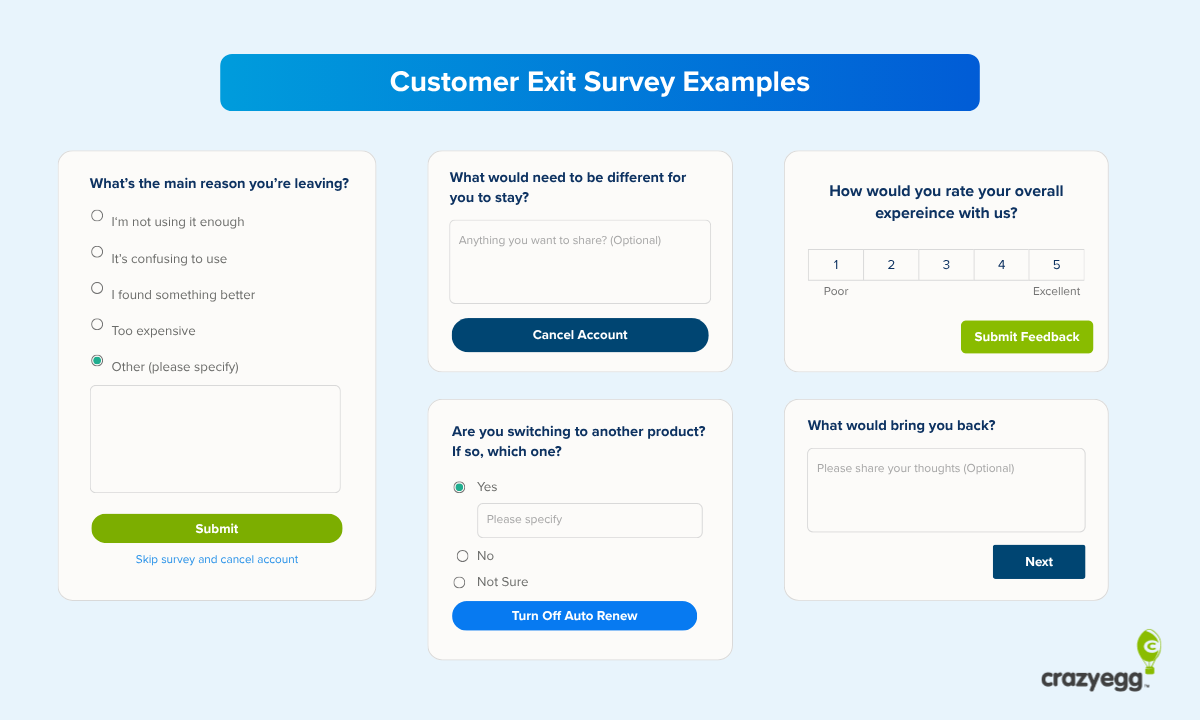
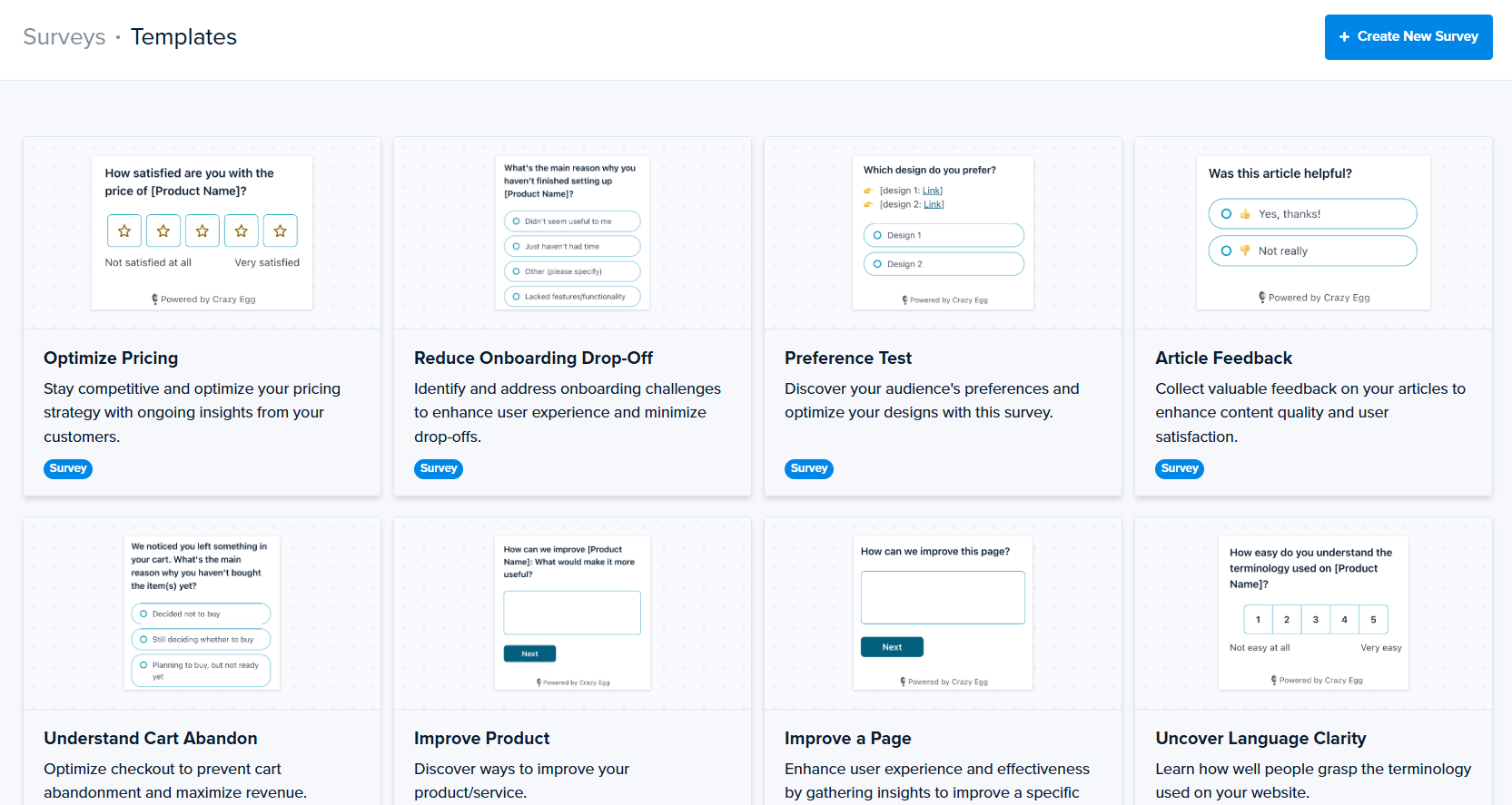
- Surveys with conditional branching, a visual editor, a template library, multiple trigger types, and granular targeting, for personalized feedback collection. Survey responses link to recordings, so you see what the respondent did before giving feedback. Mixpanel has no feedback capabilities.
- Popup CTAs let you engage specific users and drive conversions on specific pages. Mixpanel has no such feature.

Combined with heatmaps, session recordings, web analytics, error tracking, and A/B testing, these features let you diagnose issues with your website, investigate them in depth, form hypotheses, design solutions, and test them.
What Mixpanel Has That Crazy Egg Doesn’t
- Mobile app analytics. Mixpanel tracks what happens inside native iOS or Android apps. Crazy Egg only works on websites and web apps.
- Account-level analytics. Mixpanel can analyze behavior by company, so you see which accounts are engaged and which are going quiet, with health metrics and retention per account.
- Feature flags: You switch features on and off for specific user segments, for example, for beta testing, experimentation, or gradual rollout.
- Metric trees: Maps how your input metrics translate into revenue, showing which lever moves the needle.
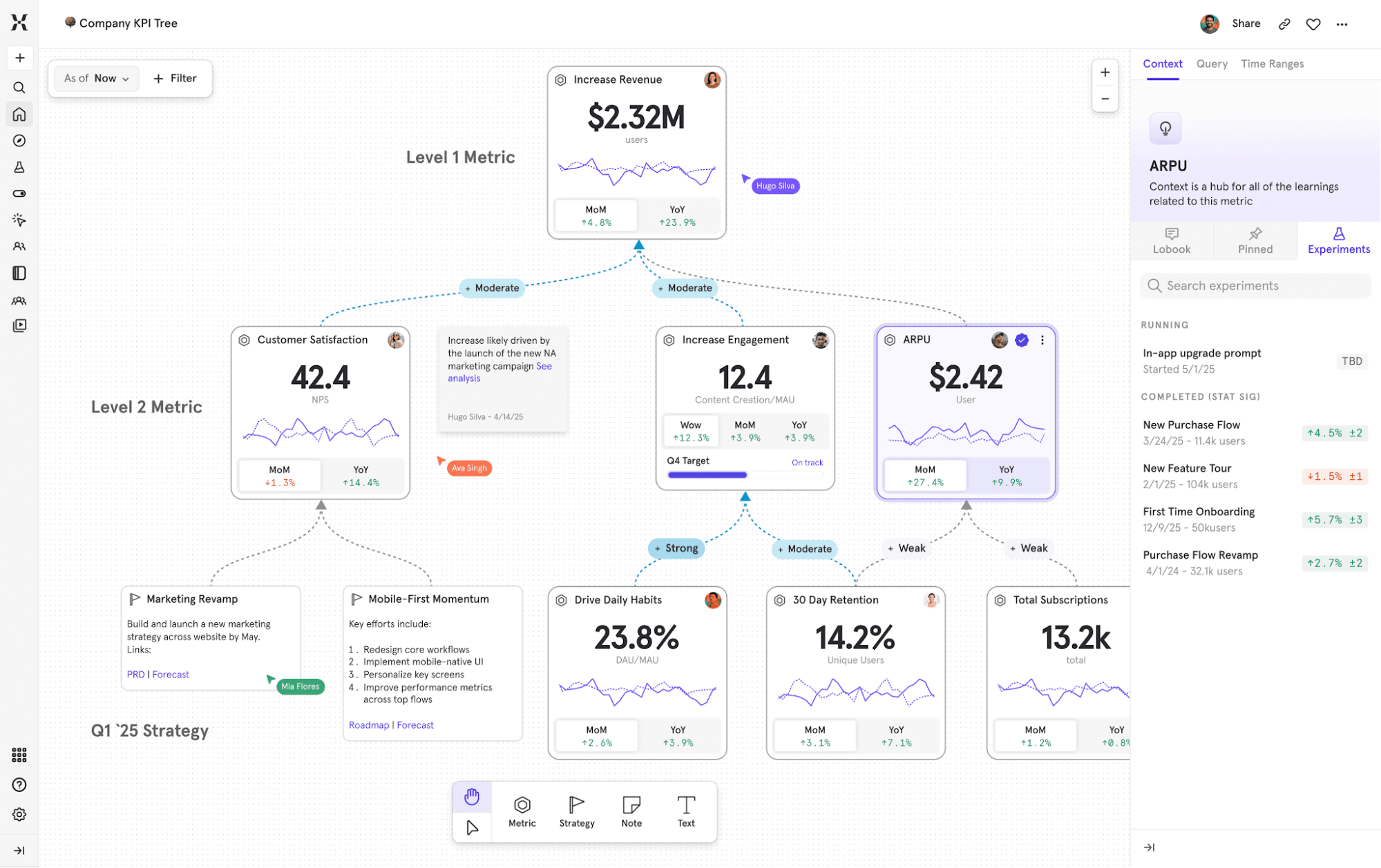
These are the tools of a dedicated product analytics platform, invaluable for product teams. For marketers or CRO specialists, they bring no additional value.
Pricing Breakdown: Which Has the Best Value?
| Crazy Egg | Mixpanel | |
|---|---|---|
| Entry price | Free plan, paid from $29/mo billed annually | Free plan up to 1M events per month |
| Paid pricing | $29 Starter, $99 Plus, $249 Pro, $599 Enterprise | Growth by event volume: $140/mo at 1.5M, $612.50 at 5M, $2,289 at 20M. Enterprise quote-only |
| What drives cost | Tracked pageviews | Events |
| Overages | None. Collection pauses and resumes on the 1st | Charged the following month, with no cap you can set |
| Free trial | 30 days on all paid plans | Free plan. Startups under 5 years old with under $8M raised get a year free |
The difference is the billing model, and it decides which tool costs you less.
Crazy Egg bills on tracked pageviews, which you can estimate before you buy, and it caps your spend: hit the limit and collection pauses until the 1st. Mixpanel bills on events, where one visitor might trigger five and another twenty, and there is no cap you can set, so overages land on the following month’s invoice.
At the bottom of the range, Mixpanel wins. A million free events a month beats Crazy Egg’s Starter plan if you don’t need surveys or A/B testing.
The math flips as you grow. Crazy Egg’s Enterprise plan covers 1M tracked pageviews for $599, less than Mixpanel’s $612.50 for 5M events. So once your visitors trigger more than about five events each, Crazy Egg costs less, and sampling on lower-priority pages stretches that further.
Final Verdict: Is Crazy Egg or Mixpanel Right for You?
Choose Mixpanel if your primary focus is digital product growth. It has deeper analytics capabilities and offers reports that are essential for product teams driving long-term product adoption and user retention.
However, most of them aren’t necessary for CRO and are likely to be more expensive than Crazy Egg if you consider their billing model and paid add-ons.
Choose Crazy Egg if you want to optimize your website performance and improve conversion rates. Crazy Egg analytics, surveys, CTAs, and A/B testing let you find out where you’re losing visitors and why exactly they’re dropping off, and find and test solutions. Within one subscription with predictable pricing.
If Crazy Egg sounds like a better fit, contact Sales today to chat about your needs and choose the best plan.