B2B lead generation is full of shortcuts: buy some ads, hire an agency, or plug in a tool.
Leads appear. Great. But then cost per lead spikes, quality drops, and no one is sure what’s wrong.
The safer path is building a lead gen process you understand and control. This post shows you how.
What Is B2B Lead Generation and Why Is It So Hard?
Lead generation is the process of finding, attracting, and encouraging the right potential buyers to start a relationship with your company.
In business-to-business (B2B), that usually means getting someone who has never heard of your brand to make an inquiry, book a demo, or schedule a call.
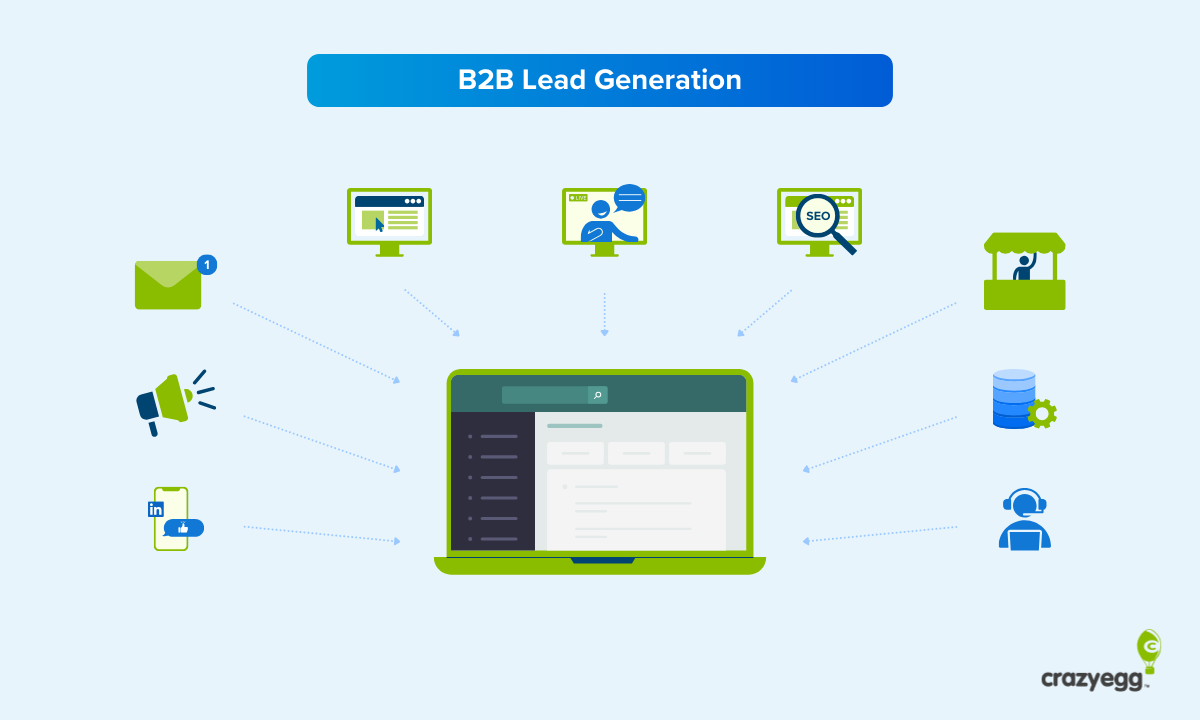
B2B lead generation is setting the table for your sales team, giving them the best chance of talking with someone who needs your product now and will become a customer for a long time.
First off, I want to acknowledge that this is really difficult. Generating leads at a profitable rate, over time, as your target market evolves is not easy.
Any company that advertises a simple solution to “fill your sales pipeline with deal-ready leads” is full of it.
If the agency can get you good leads, it’s because they are going through a very laborious process themselves, and they will make you pay a lot of money per lead.
And if they wind up providing garbage leads, don’t worry, the firm will still charge you a lot.
Challenges of B2B lead generation
Here’s the reality for brands looking to acquire new business customers:
- Only a small fraction of your target market is active. Maybe 3-5% of people who could use your product are looking for a new solution.
- Products cost a lot. Deals are usually 5-6 figures per year, with annual or multi-year contracts that are hard to undo.
- Timelines are long. Sales cycles are measured in months, and in regulated industries, 10+ months is not that rare.
- Multiple people are involved. You have to win over users, managers, legal, IT, procurement, and often the C-suite.
- Switching vendors is risky and disruptive. Retraining staff, rebuilding workflows, and integrating your product into their system is expensive and rarely goes according to plan.
- Prospects are relentlessly bothered by salespeople. Employees who can authorize purchases are spammed by cold emails, LinkedIn DMs, and more intrusive outreach.
B2B buyers are cautious. Nobody reads a case study and then impulse buys a new solution that ties into their business.
The vast majority of potential buyers are willing to stay with a product that’s not as good as yours simply to avoid all of the hassles that come with switching.
And yet, in spite of all this, growing B2B brands are able to fill their sales teams’ calendars with appointments.
They win because these brands understand and respect their buyers. They know what will cut through all of the inertia to open a door in the buyer’s mind.
Lead gen from a buyer’s perspective
Put yourself in their shoes for a second.
People don’t think of themselves as leads. They’re busy humans with their own goals, desires, fears, and conceptions of the world.
From their perspective, the buyer journey looks something like this:
- Unaware: This is the status quo. They’re not looking for a solution. Maybe they see your ads, but they don’t register because nothing in their current way of doing business makes them care about what you offer.
- Problem aware: They’re paying attention because something breaks or costs more than they expected. Maybe their boss complains or their competitors leap-frog ahead. Whatever happened, the status quo has been broken, and they are more alert to solutions like yours, even if they don’t know your brand.
- Solution curious: The problem didn’t go away. Maybe it intensified. Now they are actively searching, talking with peers, and trying to understand what services and products address their needs.
- Evaluating options: They are comparing a short list of vendors, getting a feel for pricing, and thinking through the potential risks of implementation.
- Ready to talk: They have a real use case, internal support, and an idea of the budget. They’re looking for detailed answers about their most pressing questions and fears.
Most articles about lead gen treat the market as if it is full of people who are eager to hop on a call and spend money.
It’s so far from the truth.
These are people with reasonable doubts and reservations. They have long-term plans and need to be able to see how your product fits in.
This is why a strong B2B lead gen strategy gives people the information and reassurance they need to justify making a change. They need to be confident about your solution themselves, and be able to articulate the use case clearly during internal discussions.
Your marketing and sales assets need to support this type of knowledge-building and decision making. Generating clicks and form submissions is one tiny aspect of a much larger battle.
Lead gen from a brand’s perspective
Now we can talk about the process from your side of the table in a way that honors the cautious headspace of your potential customers.
From the point of view of an organization, new customers enter the sales funnel from a (usually) fuzzy mix of marketing, brand, demand gen, and business development efforts.
The goal of lead generation is to bring some order to that chaotic mix so you can see what’s working, what’s not, and where deals are getting stuck.
Here are the basic stages:
- Get attention: Buyers first encounter you through ads, content, events, outreach, and other channels.
- Capture interest: Buyers first engage with you via landing pages, contact forms, and useful resources on your site.
- Nurture and educate: Buyers start to trust you through email marketing, webinars, detailed content, and repeated exposure to your brand.
- Qualify and prioritize: Good fit buyers are separated from poor fit ones through discovery calls, lead scoring, and research.
- Hand off to sales: Good fit buyers are given a smooth transition into a sales process that is supported by accurate context and shared expectations.
The point of defining this process is not to force buyers through. They are going to go at their own pace, which is determined by many factors outside your control.
No, the payoff of a well-defined lead gen process is that you are able to measure your organization’s performance at each stage.
How successful are we attracting leads that turn into revenue?
How good are we at ensuring bad-fit leads aren’t passed through?
You can only answer these questions if there’s a system that everyone understands and a reliable feedback loop from sales to marketing.
The Ground Work for Successful B2B Lead Gen
Because the customer acquisition process spans multiple teams, you want to be as sure as possible that everyone involved:
- Is targeting the right people
- Is telling a consistent story about your brand
- Agrees on what counts as a lead
- Has visibility across the buyer journey
Alignment on these points is the basis for a well-functioning lead generation system. Let’s walk through each one.
Target the right people
Good leads have:
- A real problem that your product can solve
- The budget to be able to afford your product
- Authority or internal backing to approve a purchase
- Real pressure that makes now an opportune time to buy
When you hand off a lead who checks these boxes, any sales person is stoked. They’re going to meet with someone who understands what you do, has a real use case, and is open to having a serious conversation.
All of your efforts should be focused on appealing to a target audience that meets these criteria.
Most brands have some version of this in their heads, but it’s not always spelled out, and it’s not always consistent across teams.
There is a lot of value in creating a simple document that clearly articulates who your buyers are, what kinds of companies they work at, and why they end up choosing you.
It doesn’t have to be pretty, and it’s never going to be perfect. That’s fine.
In B2B, teams often use:
- Ideal Customer Profiles (ICPs) to capture the types of companies that get the most value from your product. An ICP includes firmographics, like company type, size, maturity, budget, and technographics about the software, hardware, and IT systems a company uses.
- Buyer personas to describe the specific people involved in the purchase decision.Buyer personas include roles, responsibilities, goals, pressures, buying triggers, decision criteria, and common objections. Demographic and psychographic traits tend to be less valuable for B2B buyer personas than for B2C ones, but be sure to account for those if you think they are important signals.
Adjust these frameworks to fit your needs. The key is getting this description into a concise document that everyone involved with lead generation can agree to.
A practical way to start this process is by pulling in your last 50-100 closed deals and looking for patterns. Which types of customers closed quickly, paid full price, and seem to be happiest using your product?
Listen to what they say, as well. If you have sales call recordings, I would look for common themes about how buyers describe their problems and what made them reach out. Tools like Gong are great for this, but you can also have Claude or Chat GPT analyze call transcripts.
Also consider using simple surveys on landing pages, product pages, and pricing pages to get feedback from the potential customers on your site. What made you visit? Did you find what you are looking for?
I think general market research is all well and good, but nothing beats data from your customers.
Tell a consistent story
By the time that someone talks to sales, they have encountered your brand in a few different places: search results, micro content on social media, reviews on third-party sites, and LinkedIn posts.
Are your potential customers getting the same story at all of those touchpoints?
By story, I’m talking about who you are, what you do, who you serve, and what differentiates your products from other solutions on the market.
Maintaining a consistent story builds trust and credibility with potential buyers, who aren’t getting mixed messages across channels. It’s easier for them to explain your product to colleagues, which really matters in B2B.
Consistency also matters for showing up in search results, where AI-driven systems scour the internet looking for an external consensus about your brand. Search engines using these models are going to be more confident recommending and linking to your brand when the value proposition and messaging strategy are the same everywhere.
As companies grow, teams naturally specialize, and their stories start to drift. SEO wants to win particular keywords. Brand wants to win specific partnerships. Sales adapts messaging to close certain deals.
None of this is wrong, but chasing these different objectives can result in your company putting out conflicting stories.
Helpful alignment documents include:
- Mission statement
- Positioning statement
- Messaging hierarchy
- Brand book or guidelines
You probably have some of these assets already. Making sure they are up-to-date and easily referenced by all teams. This helps ensure that leads get a consistent picture of your brand, no matter where they encounter you.
Agree on what counts as a lead
A marketer, business development rep, and account executive should all talk about leads using the same criteria.
It doesn’t have to be complicated, but it must be explicit. Fuzzy definitions cause all sorts of problems down the line.
Be clear on questions like:
- What qualifies as a sales-ready lead?
- What disqualifies a lead?
- How are leads routed and followed up on?
- What happens to a prospect who isn’t ready right now?
- How does feedback from sales flow to marketing and brand?
Some teams use labels like SQLs, MQLs, PQLs, and set up an intricate lead scoring system.
Do whatever makes sense for you.
The terminology itself is not as important as having agreement on the definitions.
If everyone can explain in objective terms what a qualified lead is, you are in good shape.
Create visibility across the buyer journey
This is where B2B lead gen strategies get killed on complexity and costs.
Either they don’t have enough visibility to measure and improve lead gen efforts, or they buy so many tools that the cost of leads shoots through the roof.
The core problem is that relevant data for lead gen lives in different platforms.
Ad performance, website activity, webinar registrations, email click throughs, and conference booth visits all capture parts of the customer journey in their own system.
Each one has its own dashboard, metrics, and version of success.
Unifying that data within a single source of truth is crucial.
I’m not going to pretend to offer you a technical approach for how to do this. It’s going to vary based on your tech stack, channel preferences, and which metrics are valuable.
Some teams use their CRM software as the hub, others will use a data warehouse and business intelligence tools.
My advice is to start in the most simple fashion possible that gives you a complete journey overview. Aim to capture the major beats of the journey, and then build in tracking for the finer details at each stage.
Look at your most recent closed deals to see how complete your view of their journey was. Can you track them from acquisition sources all the way through? Where you find gaps in the chain of custody are places where you can focus on improving visibility.
Generating Good-Fit B2B Leads: Acquisition
Once you have clarified who you are targeting, your messaging, and how you are going to track progress, it’s going to be much easier to select appropriate channels to acquire leads.
There is no one right way to do this.
Most teams settle on a mix of channels that allow them to cast wide nets (content marketing, paid media) and conduct more targeted outreach (email, DMs). Over time, you’ll be able to see which channels and strategies are bringing in the most valuable new clients.
This section walks through the main inbound and outbound channels with a special emphasis on how they are used in B2B.
Inbound channels
Getting people to reach out to your business is the core goal of every inbound marketing strategy.
In practice, that looks like publishing content and running campaigns that bring people to your site or a landing page while they’re actively researching products and solutions.
In B2B, there’s no expectation that people are going to buy the first time they visit. Instead, the goal is to get them acquainted with your brand and how you can help them.
Ideally, you can encourage them to provide their contact info with a lead magnet that offers access to tools, exclusive content (white papers, case studies, industry statistics), or a freemium version of your product.
But even if they don’t convert right away, you can use remarketing after they visit to keep your brand top of mind.
Occasionally, someone will arrive that’s urgently looking to talk to sales. A good inbound system is built to capture that person, but it’s not dependent on it.
Let’s walk through the major inbound channels for B2B that will help drive the right people to your site.
Paid and Organic Search
Search engines (like Google and Bing) are one of the most reliable sources of high-intent leads.
Buyers are in research mode, typing questions into the search bar, which makes the lead quality much higher than other channels like social media, where people are having fun and killing time.
To gain visibility in search, you conduct keyword research to figure out which phrases your audience is typing into search engines, and then get in front of them with:
- Paid search, aka: search engine marketing (SEM), where you pay to have your site or products shown in search results.
- Organic search, aka search engine optimization (SEO), where you build great content that ranks highly in search results.
Both of these options can be excellent channels for B2B lead gen because your buyers are actively trying to discover information. They don’t want to make a bad decision on behalf of their company, and search engines are one of the key places where they do their homework.
You may have heard that SEO is dead, thanks to AI, and it’s being replaced by answer engine optimization (AEO).
It’s not true… yet. At the time of writing this post, AI overviews and Chat GPT account for less than 2% of website traffic for most brands.
So driving organic traffic to your site still matters, and the lion’s share of most AEO strategies I’ve seen overlap considerably with SEO best practices.
But AEO is where we are headed. And even today, that ≈1-2% of traffic coming from AI-mediated search is really high intent, based on what I have heard from clients and experts who work in B2B marketing.
Brands are seeing really good conversion rates from Chat GPT traffic compared to traditional organic search. More importantly, they are hearing from prospects during sales calls that they relied heavily on Chat GPT (and other AI tools) during their research process.
So yes, you are going to have to research prompts your buyers are using and track your visibility in AI search. The best SEO tools have features to do this, which they are updating as fast as the search landscape changes.
On the traditional search marketing front, definitely go after competitor keywords but try to find some greenfield opportunities where you can win new topics that aren’t already dominated by large players.
And be attuned to how semantic search and fan-out queries are influencing what search engines recommend. Keywords and domain authority are not the only factors at play.
Content marketing
You need high quality content at multiple points in the lead gen process. It brings people in by increasing your visibility in search, gives them concrete information to grab on to when they arrive from other channels, and provides your reps credible info to reference on sales calls.
Another way to think about this is that content needs to support your conversion funnel at each stage:
- Top: Speak to people who are new to the problems and category. Educational content works great: Explainers, guides, and short videos can help people orient themselves and start associating your brand as a player in the space.
- Middle: Show people how your product solves their problems. They need proof. Publish comparison content like case studies and pillar pages that really solidify your brand’s position as a trusted expert in the space.
- Bottom: Make it easy for people to take action. Publish helpful pricing pages, FAQs, security docs, and technical overviews that answer last-mile questions and reduce hesitation.
It’s worth noting that leads may encounter your content at any stage.
Your beginner-friendly top-of-funnel content needs to also resonate with hyper-aware buyers, linking clearly to resources that will encourage them. On the other hand, a pricing page should be able to helpfully direct an early-stage lead who wants to know more about what your brand does.
Many buyers are very sophisticated, even if they are relatively new to the product category, and they are skeptical of claims. Case studies, testimonials, and other types of social proof from businesses that match your target buyers are a must..
Videos of your product in action are great because they show rather than tell. It’s easier to believe their eyes than your claims.
Webinars where people can engage live or view on-demand are also helpful. In either case, you can follow up with them quickly after they attend.
As you push out new content, make sure you keep it consistent with your messaging strategy. Budget in time and money to update existing content. You want everything that people read on your site to reinforce their view of your brand. Aged content is a liability.
Social media, forums, and communities
Let’s start with LinkedIn because it is far and away the most important platform for most B2B businesses.
You need a solid LinkedIn page for your brand that shows you are active, knowledgeable, and trusted within your industry. Key employees need a LinkedIn headline and profile that exudes credibility.
No buyer wants to be a guinea pig, so if you can show people that you have relationships with other buyers, vendors, and thought leaders in the space, it’s going to make people more confident about taking the next step with your brand.
LinkedIn matters, but beyond that, for many B2B brands, social media is more of a credibility signal than a true lead gen channel. If you’re in B2B SaaS, a solid Crunchbase profile is required, but you don’t exactly have to be super active.
On 𝕏 (fka: Twitter), Facebook, or Instagram, most B2B brands simply need to show that you are a real company with real people, posting enough to demonstrate proof of life. If you only get 4 likes on every post, it’s probably not a strike against you.
This isn’t always true, so if you have good reason to believe that your brand needs to be active on Facebook or 𝕏, then make sure you are re-purposing your content from LinkedIn and making it work for the style of those channels.
That said, particular groups or niches on Facebook, Reddit, Quora or other communities might be very fertile ground for lead gen. Just be careful promoting your brand in these groups, as they are constantly targeted and spammed with offers. So if you are marketing on Quora, Reddit, or Facebook Groups, try to be a helpful community member, not just a shill.
It’s up to you whether or not you think that non-LinkedIn social media is worth a serious investment.
Look at your competitors. If they care, it might be worth it. If not, it could potentially still be worth it, but I would come back to your buyer personas. Are these channels they use and trust?
One thing to keep in mind is that a healthy presence on social media and forums (especially Reddit and Quora) can positively influence your chances of showing up in organic search and being referenced in AI overviews.
Partner, influencer, and affiliate marketing
Partner-led channels are a great source of leads. Your audience already follows these people and orgs, trusting their recommendation.
In B2B, this is less celebrity endorsements, and more industry blogs, sites, and newsletters that speak to a niche professional audience. For example, I subscribe to Eli Schwartz’s newsletter to stay up to date on SEO, and he’s always got a sponsored brand near the top.
I trust Eli not to work with bad brands, and so when I see one featured in his newsletter, it carries more weight than when I see the same brand in a paid search result.
Affiliate programs work in a similar way, where partners earn a commission for sending traffic to brands. I used to write for TechRepublic, for example, and we’d include links to relevant brands in posts about technical topics.
There are lots of opportunities to find partners in your niche who can get your brand in front of their audience. Whether this is starting an affiliate program on your end, or looking for partners who can place your brand in a great spot, it’s certainly something you should explore.
Partner-led channels require oversight. Attribution can be messy. Fraud is a real risk. But when managed carefully, these channels can become a steady source of high-intent leads.
Ad networks
Ad networks are great for getting your brand in front of the right people without a tremendous amount of work on your end. You’re basically buying attention at scale in places where your buyers already spend time.
These channels are not necessarily used for driving B2B leads directly so much as supporting your other acquisition efforts by keeping awareness high and improving brand recall over a long buying cycle.
The largest ad networks are run by Google, Microsoft, Meta, and demand-side platforms (DSPs) like The Trade Desk. All of these platforms have targeting tools to get your ads in front of specific job titles, company sizes, industries, and so on.
I’d definitely give the platform the information it needs, but focus more on crafting compelling, relevant creative that speaks to your buyer personas and journey stage.
For example, ads targeting early-stage buyers shouldn’t go right to a landing page urging people to book a demo. It’s fine to include a CTA button with that option, but focusing on educational content that an early-stage buyer will value is probably a better long-term play.
Outbound B2B lead generation
With outbound, the goal is to start a conversation instead of getting someone to come to you.
It works best when you know exactly who you are targeting, why, and you can offer a clear next step, such as a meeting or discovery call.
You can purchase lists of contacts to reach out to or run your own list building program to generate them yourself.
Here are a few of the major outbound channels
Email and direct messaging
Cold email and DMs can work when you send short, thoughtful, relevant messages that speak to individual people.
Email blasts and obviously templated DMs are not going to fly. Anyone with a job title that fits a common B2B buyer persona is already flooded with cookie cutter outreach attempts..
You can break through by:
- Writing hyper-personalized messages that reference recent company news or shared connections.
- Keeping the subject line and body copy concise and to the point. The message should look short on desktop or mobile.
- Focusing on value by offering ways to solve specific challenges instead of parading your best features.
- Offering a clear next step, typically a low-effort, zero-friction call to action like a question or brief conversation.
- Following up a sequence of additional value-driven messages.
Where you are direct messaging, be sure to engage with the prospects’ content ahead of outreach. Build some familiarity that assumes they’ll dig into your account if they are interested.
Phone
Cold calling still works. You have to be smart about it, and a warm introduction is more likely to pay off than a truly cold call.
Researching the prospect ahead of the call is a must. Getting valid phone numbers that are worth trying to reach is not easy and there may be gatekeepers standing between you and the prospect. So when you can connect, you need to know exactly what you are going to say.
Have a specific, relevant reason for your call. Tie it to a recent trend, some company news, or a product launch. They should not be wondering why you are calling.
Within the first sentence or two, you should be able to convey that you understand their needs, but ultimately the goal is to get them talking as soon as possible. By listening, you can start to understand their pain points and couch all of your sales language in their day-to-day problems.
In the US and other countries, there are regulations and fines to be aware of when you are using cold outreach by phone. See this guidance from the Federal Trade Commission on complying with the Telemarketing Sales Rule to ensure that you steer clear of fines.
Events and conferences
I suppose if you just sit at your booth and wait for people to come chat you up, you could consider event-marketing a form of inbound marketing, but in B2B, successful reps tend to line up meetings and dinners ahead of time.
You can do this by running targeted ads and email/DM outreach in the months leading up to the event. Frame the ads and messages around a specific topic that aligns with the event, and offer a resource like a guide or video that addresses industry trends.
During the event, staff need to be capturing fresh interest through conversation. Ideally, they can be running meetings and demos that were pre-booked, but they also should be walking the floor, attending sessions, introducing prospects, and getting a sense of what your closest competitors are doing.
When the event is over, the real work begins. Contact leads within 1-2 days, while the interaction is still fresh and references the specific topics discussed. Propose clear next steps that maintain the momentum.
Filtering Out Poor-Fit B2B Leads: Qualification
Qualification is how you protect sales people from spending time on leads that look promising but won’t buy.
Much of the qualification process is accomplished through intelligent targeting and using lead generation tactics that resonate with the types of buyers who truly can use your product. But even the best acquisition process is going to net leads that ultimately have no chance of panning out.
For example, a lead may work for an organization that fits your ICP perfectly, they have a compelling use case, and they are dying to speak with your sales team.
Sounds great, but if they lack the budget to make a purchase, or they have zero authority to do so, then setting up a meeting is likely a waste of your sales resources.
And even if they have the authority and the budget, if it’s not the right time for the business to make this purchase, no amount of salesmanship will close the deal.
To ensure that sales is only talking to good-fit buyers, most teams use a mix of automated and hands-on methods .
Automated lead qualification
- Lead scoring: Assign points based on actions like downloads and page views to flag leads likely to be good-fit.
- Form validation: Require information like company size, role, and use case at key conversion points to filter out irrelevant inquiries. Run automated checks to ensure emails, phone numbers, and identities are valid.
- Data enrichment: Add firmographic or technographic data from third-party tools to fill in missing details for accounts.
- Intent signals: Use first and third-party data to identify when people are actively researching solutions you can provide.
- Routing and suppression: Divert students, consultants, competitors, and non-fit businesses away.
Hands-on lead qualification
- Discovery calls: Hold brief, structured conversations that cover a potential client’s challenges, needs, urgency, and whether getting into a longer call makes sense for both parties.
- Account research: Gather intel and review data on a potential client’s firmographic and technographic fit, as well as funding, competitors, and other factors that signal whether they are a decent prospect.
- Pre-call surveys: Use a brief questionnaire to capture budget, timeline, and other relevant information.
The automated methods are great for qualifying leads at scale, but they don’t get you 100% of the way there. They are going to miss some nuance, potentially pushing bad-fit leads forward or accidentally suppressing a good-fit lead
Manual reviews are great, provided your team knows what they are looking for, but it’s impossible to do at scale.
Increasing B2B Lead Quality and Decreasing Costs
The goal over time is to improve every part of your lead gen process, from tightening how you target to speeding up the feedback loop from sales to marketing.
When everything is working together, you’re able to integrate new information quickly, which is critical.
Your competitors are going to shift their strategy in response to what you are doing. New tools and technology will enter the market. You cannot stick with the same strategy for long.
To keep tabs on performance and know when you need to make a change, there are a few critical metrics to track:
- Cost per lead (CPL) shows how expensive it is to generate interest.
- Customer acquisition cost (CAC) shows you how expensive it is to win a customer
- Lifetime value (LTV) gives you a historic measure of how much value a customer brings in over their entire relationship with your brand.
- Lead-to-customer conversion rate measures the percentage of leads who become paying customers.
- Close rate measures how often qualified leads become customers
- Time to close shows how efficiently leads move through your sales process
There may be other metrics that matter to your business specifically because they give you insight into which channels are working well and where your marketing dollars are best spent.
Whatever you measure, the metrics are most useful when you can segment them by channel, campaign, and customer types.
Your blended average CPL can’t tell you much about which channels are working best, for example, and the ones with the highest CPL might still be the most profitable if they also have a high lead-to-customer conversion rate or LTV.
In addition to tracking lead volume and quality, teams will also use controlled testing to find the best offers and messaging. A/B testing a landing page you use to generate leads can help you figure out what incentives convince the highest percentage of people to sign up.
Filling In the Gaps with B2B Lead Generation Services
There is zero shame in getting outside help with lead gen. Doing everything in-house is hard to staff and expensive to maintain.
You can hire full-service firms that will get you a database full of leads or even set appointments for your sales team. There are also specialists that can help with SEO, content production, list building, and marketing attribution.
If you have done the ground work, then you know where your biggest weaknesses lie. Help from agencies or contractors to get your system up and running is well worth it.
The issues arise when outsourcing turns customer acquisition into a black box, where no one at your company really understands where leads came from and why they converted.
This scenario is not healthy, because understanding how you acquire customers affects budgeting, hiring, and other decisions about your product.
I’m all for bringing in specialists to fill specific gaps in your lead gen pipeline, but you don’t want to find yourself in a situation where you are completely dependent on contractors or a single agency.
When they under-deliver or over-charge, are you going to have to start from scratch again?