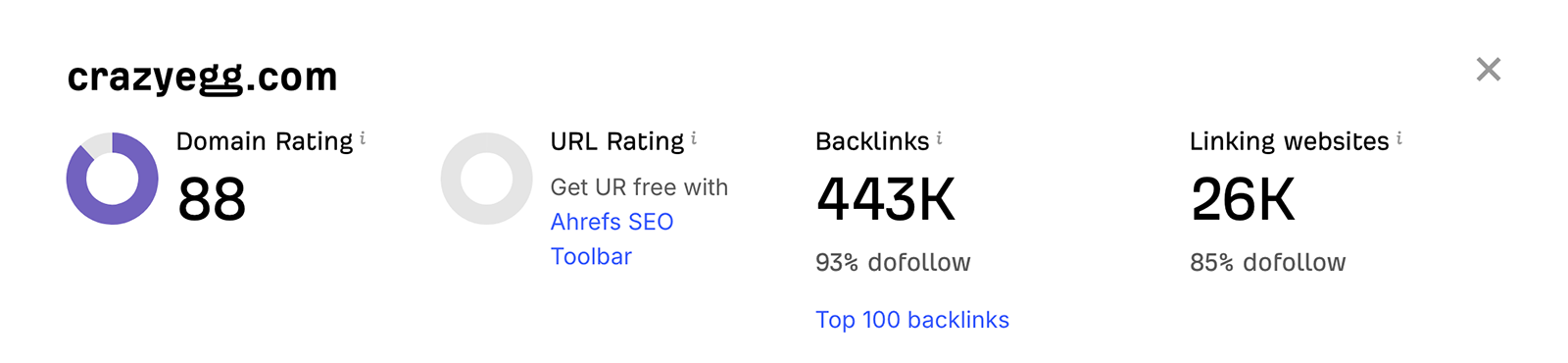
For most businesses, white hat link building is the most reliable way to grow traffic over time.
If you are tempted to take shortcuts: don’t do it.
I know that big brands can get away with sketchy link schemes and parasite SEO. I know. But unless you work for one of them, a single mistake can trigger a penalty from Google that wipes out years of work.
It’s not fair, but that’s the reality. This guide shows you how to build legitimate links that improve your rankings, support your presence in AI search results, and won’t blow up a few months from now.
White Hat Link Building: A Quick Overview
This section is a quick read for beginners where I’ll cover the basics of link building, backlinks, white hat vs black hat tactics, and how to determine the quality of a backlink.
If you already understand the role backlinks play in domain authority and increasing search traffic to your site, then feel free to skip ahead to the white hat link building strategies.
Link building is the process of getting more websites to link to your site. From your perspective, these links are known as “backlinks”, because they link back to your site.
When another site links to yours, it’s great for two reasons:
- Backlinks drive referral traffic: People on that site may come to your site via the new link, which means more traffic to your site.
- Backlinks improve search rankings: The new link to your site sends a positive signal to search engines, which increases the chances your site ranks higher in search results, resulting in increased organic traffic to your site.
The first reason is easy enough to understand. If you are a website that talks about celebrity gossip, and TMZ links to your site, it’s going to refer to a lot of traffic that’s interested in your content.
Great. Same goes for a SaaS company getting a link from Crunchbase, or a sports blog getting a link from ESPN.
But why does a new link improve your rank in search?
Because links are a big part of how Google, Bing, and other search engines understand the relationship between websites on the internet. They treat a link like a vote of confidence.
When a site has a lot of links pointing to it from reputable sites, it signals that the site’s content is useful and valuable. Search engines will be more confident recommending the site in search results and referencing it in AI overviews.
On the other hand, if a site has relatively few backlinks or only has backlinks from sites with low domain authority, search engines are going to be more cautious about showing the site to users.
For example, I asked SEMRush to show a network graph that visualized all of the sites linking to CrazyEgg.
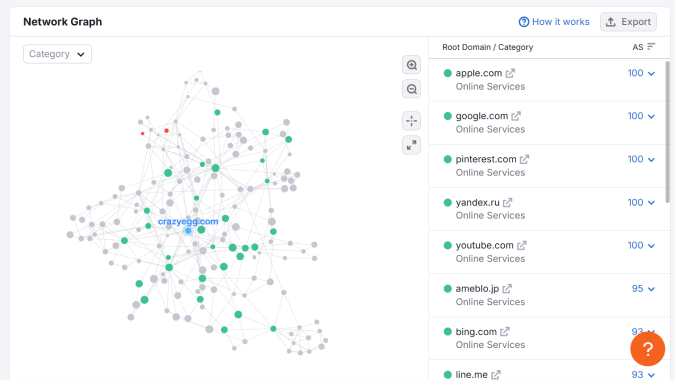
It looks very healthy, with backlinks from Apple, Google, WordPress, HubSpot, and other very trusted websites.
Compare that with the network graph for another website I own that I haven’t worked on in several years:
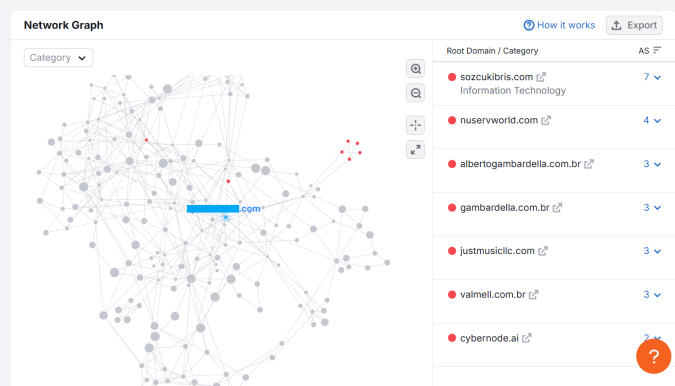
There are far fewer links, and none of them are from reputable websites. SEMRush actually categorizes my old site as “Dangerous,” and says a backlink from here will actually hurt another site. Yikes.
This gives you some sense of how important getting a lot of reputable backlinks is in terms of how search engines judge your site.
There are other factors besides backlinks that impact how Google search works or how Bing delivers search results. You should have a good understanding of all the mechanics at play if you are responsible for making your website or brand visible online.
That said, building high-quality backlinks to your site is one of the most important parts of search engine optimization (SEO). This has been true for years.
But even today, as AI changes the way that people find information online, backlinks continue to be a key factor. White hat link building is a crucial component of every successful answer engine optimization (AEO) or generative engine optimization (GEO) strategy I have seen so far.
Relevant, ethically-sourced backlinks will help your brand to show up in AI overviews and get referenced by ChatGPT.
This is why everyone wants to build links to their site. Some are willing to put in the hard work required to earn backlinks. Others look for easier methods to get backlinks as fast as possible.
White hat vs. black hat link building
When you engage in link building in an honest way that conforms with Google’s guidelines, it’s called white hat link building. Some typical examples of white hat link building include:
- Publishing awesome content people want to link to
- Asking a website to fix a broken backlink on their site
- Promoting new content in hopes of getting more backlinks
All of these examples are labor-intensive. If you are serious about building links on a high-performance website, it’s truly a full-time job. A quick Google search “link building jobs” showed me more than 500 open roles:
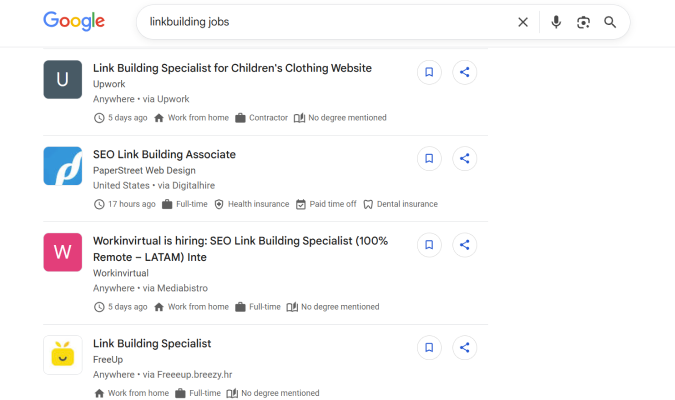
Having been a part of link building teams, I can tell you first-hand that it is challenging, gritty work when you go the white hat route. It’s hard to convince people to link to your site, even when you have great content, original research, and useful tools to share.
But white hat link building is not the only way that people get more backlinks for their site.
When you use deceptive or manipulative schemes to gain links, it’s known as black hat link building. Some typical examples:
- Offering money another publisher in exchange of a backlink
- Engaging in link schemes like exchanges or private blog networks
- Buying an expired domain and pointing a bunch of links to your site
The examples above are considered link spam by Google (and other search engines), and if they catch you, your site will get penalized.
And yet, a simple online search for “buy backlinks” showed me dozens of paid ads and hundreds of search results for companies selling links:
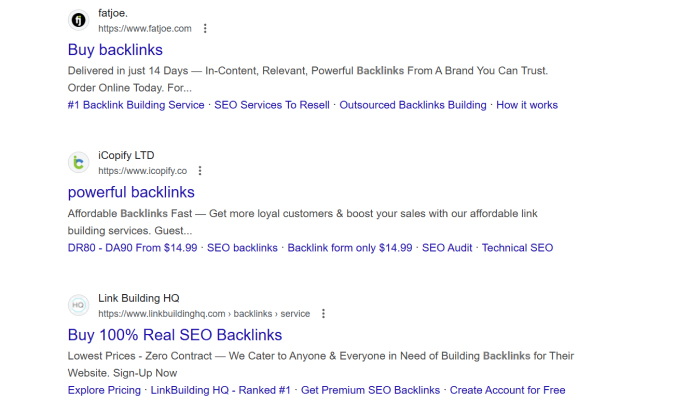
I strongly recommend against buying backlinks. Any positive bump you get in search results or traffic from a paid backlink is not worth the risk of being penalized.
Yes, white hat link building is hard and often thankless work. But if you pursue it ethically and have a website with valuable content, you will build good links over time. Engaging in some shady link scheme or outright buying links is not a long-term winning strategy.
The importance of building quality backlinks
If you are going to go to the trouble of white hat link building, you need to know what links are worth pursuing. Some backlinks are worth a lot more than others.
For example, Google is going to value a backlink from The New York Times more than one from a no-name blogger.
From a search engine perspective The New York Times website has a much higher domain authority than the blogger, so it sends a much stronger signal to Google that your site is valuable. Check out this post on link juice for a much more in-depth look at how sites transfer their authority to other sites via links.
Search engines also care a lot about relevance. For example, if I own a site about tech startups, Google is going to value a backlink from Crunchbase very highly because it’s a site with a lot of authority about startups and private companies.
For the purposes of building links to your site, authority and relevance are critical to consider.
Links from low authority sites won’t help you rank higher. They might even be a red flag for Google.
Links from irrelevant sites will bring traffic that isn’t interested in what you offer, leading to a high bounce rate. That’s going to send a negative signal to Google, even if the backlink is on an authoritative site.
Some other factors that make a link more valuable are:
- Website traffic: Is the backlink on a site with lots of traffic? The more traffic on the site the higher potential amount of traffic could come to yours via the link.
- Link placement: Is your link embedded naturally within the main text of the site? That signals that the link is a genuine, helpful recommendation.
- Anchor text: Is the clickable text of the link relevant to the topic of the page and descriptive about where the link leads? Contextually relevant, clear anchor text is most helpful to users and sends the strongest positive signal to search engines.
It’s not easy to engage in white hat link building strategies that yield backlinks that satisfy all these quality factors. But it is possible, and done right it’s one of the most durable ways to get your site found by more of the right people.
8 Safe and Effective White Hat Link Building Strategies
The following methods outline the best possible ways for you to build high-quality backlinks in a way that aligns with Google’s guidelines.
I’ll explain each strategy, how it works, and give you a few options for pursuing it. I’ll close each section with a few examples of where you can push this strategy too far, drifting into gray hat or black hat territory.
1. Create naturally linkable content
This should be the core of your white hat strategy to gain valuable backlinks. It takes real time and effort to build content that people will naturally want to link to, but it is the most durable and meaningful way you can build links over the long term.
So what is naturally linkable content?
For one thing, it needs to be high quality content. Think of Google’s EEAT framework as a good set of guiding principles to follow. Your content should demonstrate expertise, first-hand experience, and accuracy.
The other key aspect of linkable content is relevance to your target market. You have to create the type of content that these people want answers about. Research questions like:
- What are the pages that journalists, bloggers, and industry websites link to?
- What are the keywords your audience searches for?
- What sites are displayed in search results or linked to in AI overviews?
If you can build a high quality page that can serve as a reputable reference for humans and AI tools, you are going to earn really high-value backlinks. Common types of content that consistently earn backlinks include:
- Clear explainers and definition posts
- New and original data and statistics
- Infographics and simple visual summaries
- Tools, templates, and calculators
- Original reporting
- Proprietary research
- How-To’s and walkthroughs with first-hand experience
- Podcast or video transcripts with unique insights
- Thought leadership posts
For example, the security firm Hoxhunt helps businesses protect themselves from hackers, so they published a listicle about different types of phishing scams that companies need to know about.
When I checked, Hoxhunt was ranked third in search results and linked in the AI overview along with Experian (the credit bureau) and the Federal Trade Commission (FTC).
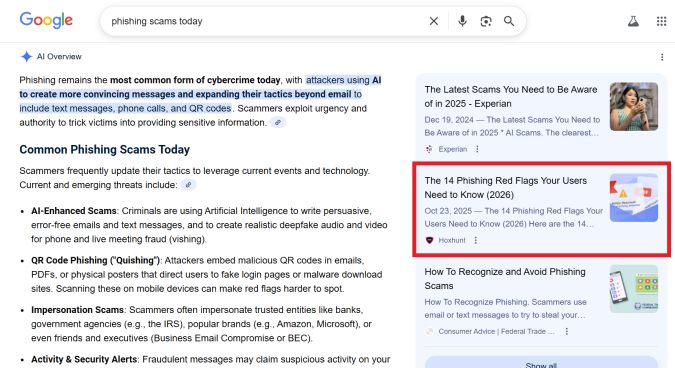
If you have never heard of Hoxhunt, but you see their site served alongside the FTC and one of the “big three” credit bureaus, that’s going to build serious trust.
I clicked through and found a very helpful page for anyone who wants to know the red flags of phishing scams and understand how to defend against them. It was scannable, loaded with information, and had a helpful table that outlined the biggest risks and how to spot them.
To generate your own naturally linkable content, write posts that are easy to scan for both humans and AI tools. Show examples, demonstrate your experience, and update the content over time to keep it fresh.
To ensure you stay white hat as you create linkable content, avoid:
- Over-promising insights or data in the headline that aren’t delivered in the content
- Keyword stuffing your content or using hidden keywords to try to gain visibility
- Crafting content for AI-search at the expense of human readers (e.g. excessive “chunking”)
2. Turn brand mentions into links
When someone mentions your brand but doesn’t link to your site, it may be worth your time to try and get a link.
To find unlinked brand mentions, you can:
- Set up Google Alerts for your brand and product names
- Use social listening tools, like Awario or Brand24
- Use brand monitoring features from tools like SproutSocial, SEMRush, and Aherfs
Once you have a good list of unlinked brand mentions, prioritize them based on how much value a link is likely to provide. This will depend on the site’s domain authority, how much traffic the page gets, and how relevant the content is for your target audience. If the mention has a negative connotation, I would not pursue it at all.
Then craft a simple outreach email that introduces you and your brand to the site owner and asks for a link.
Be sure to specify exactly where the mention occurs and the URL they should link to. Also explain why there is value for their site’s readers by linking to the content. “By linking to our site, your readers will get more insights, important context, etc.” If you don’t hear back, follow up with an email a few days later.
Be polite. You will not get a link for every mention. That’s life.
To ensure you stay white hat trying to turn brand mentions into links, avoid:
- Requesting links for mentions in user-generated content
- Pursuing mentions where a link won’t add value for users
- Asking links to every mention on a particular site
3. Tap into your business network
One of the easiest ways to win white hat links comes from working with people you already know. In every market, there is a long list of opportunities to get high-trust, credible backlinks by tapping into your existing business relationships. Think: partners, vendors, clients, and trade associations.
Some ideas for where to build links:
- Chamber of Commerce directories
- Trade association membership profiles
- Marketplace profiles (like Shopify or Houzz)
- Supplier or vendor pages (like “partners”)
- Exhibitor or sponsor profiles for conferences and tradeshows
- Industry certification and accreditation directories
These links carry real weight because they reflect a real commercial relationship between you and another organization. There’s nothing manipulative about building these links.
You can take it a step further and write joint announcements with partners, try to get featured in a vendor case study, or participate in industry roundups. All of these types of publications will yield high-quality, ultra-relevant backlinks.
To ensure you stay white hat by tapping into your business network, avoid:
- Asking partners for links where it’s not a logical fit.
- Registering for irrelevant directories just for the link.
- Requesting keyword-stuffed anchor text in partner links.
4. Engage in digital PR
If you can get an authoritative website to use your content as a reference or source, it can generate a really valuable link.
Journalists, bloggers, experts, and content creators that work for important organizations in your space are all good potential opportunities for digital PR. When these folks make an editorial decision to cite your brand or content, the resulting links look great in the eyes of Google.
Now, you can create newsworthy, data-rich, and high quality blog content and hope that journalists cite your work. That’s a solid strategy, but digital PR is where you take an active role in promoting your content, and there are a few good ways to do this:
- Sign up for source request platforms like Qwoted, Featured (fka: Terkel), HARO, and others. These platforms send daily emails with journalist requests for expert quotes and insights.
- Pitch story ideas proactively to journalists and bloggers working in your industry, especially if you have proprietary data, relevant case studies, or a contrarian take on a trending topic.
- Create expert roundups featuring quotes from popular voices in your industry, and then let contributors know they have been included.
- Participate in industry podcasts and panels where the hosts publish show notes and guest bios with links.
All of these strategies can result in backlinks on highly relevant and authoritative websites in your niche.
Just bear in mind that reporters and editors are hypersensitive to self-promotion. They are looking to provide their readers with value, not do free advertising for you.
To stay white hat with your digital PR, avoid:
- Providing quotes that push your product or are stuffed with keywords
- Demanding specific anchor text or link placements
- Using services that aren’t upfront about where quotes will appear (usually low-quality syndication networks that won’t yield valuable links)
5. Learn from your competitors
Where are other sites in your market getting their best links? Which of their pages are earning the most backlinks?
If you can answer these two questions, you will be able to spot opportunities for new content, digital PR, and partnerships that will help you build relevant backlinks. Using a good SEO tool will help you do both forms of analysis.
Start by doing some competitor keyword analysis to identify which pages of theirs are ranking well and getting citations. Pay attention to both the types of posts that are performing well (is it explainers, trends, or how-to’s?) and the trending topics that people in your niche consistently talk about.
Then dig into your competitors backlink profile. Sort by authority and relevance and look for patterns.
- Are there publications, domains, forums, or journalists that consistently link to them?
- Are there industry roundups, best of lists, or comparison pages referring high-intent traffic to them?
In a sense, you are trying to reverse engineer your competitor’s link building strategy. How did they get great backlinks? Once you find some patterns you can start to plan how to build your own content to earn the same types of valuable links from the same sources.
To ensure you stay white hat as you analyze competitors backlinks, avoid:
- Simply rewriting competitor content. Build something better or more up-to-date.
- Emulating their gray/black hat tactics. Only go after high-quality sources for links.
- Creating pages to match their backlink strategy that aren’t relevant for your brand.
6. Participate in forums
The goal here is to get links to your site in the places where your target audience is actively discussing topics you care about and looking for information. Forums like Quora and Reddit have seen massive visibility increases in AI overviews, and getting genuine links there can be very valuable.
It’s a pretty simple play, but it takes time and effort to do well. Create accounts for yourself or your brand and engage with the community. Answer questions, share experience, and point people to resources that can help them. This post on Quora marketing outlines the basic strategy, which you can adjust to use on different forums.
Over time, you’ll build a trusted reputation on the platform. Then you can build high quality links to your content that directly address questions people have. Even better, you can get links to your content from other users organically.
Two important things to keep in mind:
- You have to abide by the platform terms of service and community norms. If your participation is outright self-serving or overly promotional, your account will get banned.
- Links on Reddit and other forums will get you high-intent referral traffic, but they are “no follow” by default, so they won’t boost your backlink profile from a rankings perspective.
The best approach is to play it safe. Be a good community member first and foremost. Think of link building as a byproduct that comes from answering questions and being helpful.
To ensure you stay white hat with forum participation, avoid:
- Adding links to every comment you post. Have a clear link in your bio, but link out to your content rarely, and only when it is relevant and helpful.
- Creating burner accounts to spur discussion or upvote your responses.
- Copy/pasting AI-written responses or responses from other sites.
7. Reclaim lost links
Links break all the time. People change URLs, move pages, rewrite posts, or revamp their site and you lose a good backlink.
Any good SEO tool lets you track backlinks and will notify you when you lose one. Auditing your backlinks routinely will also alert you to the problem. Here are some high-value links that Crazy Egg lost:
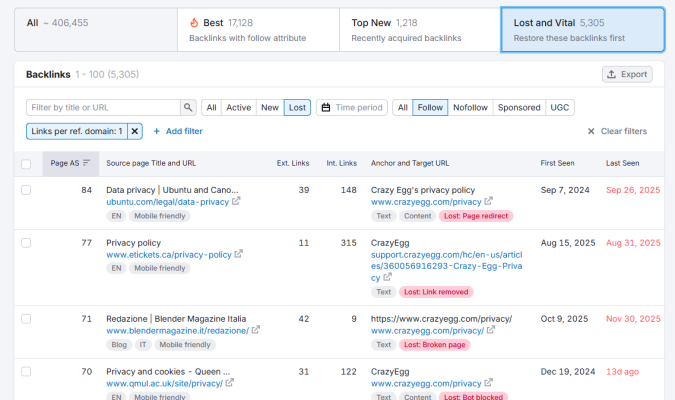
Most lost links fit into one of three scenarios:
- The link is broken. This usually happens when the URL on your site changes. Set up a redirect on your end, if possible. If the link is broken on their end, send a short note sharing the correct URL.
- The link was removed. This usually happens when people update their content and the link is removed as part of a revision. Read the page. If it still references your brand or data, send a quick note with the correct URL for them to link to. If there’s no reason to link to your page after the revision, just let it go.
- The entire page is gone. You can look for a new page that covers the same topic as the old page and try to convince them to add a link to the new one. But this is going to be a tough sell.
In cases where the link is broken or removed, you may have a good shot at reclaiming it. Reach out to the site owner with a brief, polite email that points out the issue and includes the correct link.
To ensure you stay white hat while reclaiming lost links, avoid:
- Offering anything in exchange for the reclaimed link.
- Trying to optimize the anchor text for SEO purposes.
- Asking for more links on other pages.
8. Contribute guest posts
Guest posting is when you write an article for a publication in your industry and you get a byline that links back to your site. This is a solid tactic that works really well in small, intentional doses, but quickly drifts into a gray area (or outright black hat tactic) when you do it at scale.
You want to find sites with a lot of traffic, that publish quality content, and speak to an audience that aligns with yours. Some common places to look for guest posting opportunities include:
- Trusted blogs about your industry
- Trade publications
- Media organizations covering your space
- Company blogs of non-competitors in your space
A single, well-placed guest post is worth a lot more than 10 guest posts on random blogs. If you can pitch and deliver a genuinely helpful article, you are going to gain exposure and build trust with a relevant audience. That’s great. And getting a solid backlink in the process? Even better.
Since guest posting is an exchange (you write a free article to get a link) you have to be very careful with this tactic, which has been spammed relentlessly over the years.
To ensure that you stay white hat as you guest post, avoid:
- Writing for sites that only exist to sell guest post placements.
- Submitting the same content to multiple outlets.
- Keyword-optimizing your author bio or inserting unnatural links in your content.
How To Set Up a White Hat Link Building System: 4 Steps
This section focuses on the operational side of link building, which is a time-consuming process if you go about it honestly.
This system will save you time and help you build efficiencies into your workflows. It can be adjusted to pursue any of the white hat link building strategies we just covered.
1. Determine your backlink profile and link velocity
In order to know how to best spend your time link building, you need to know two things:
- What is my current backlink profile?
- What is my average link velocity?
Taken together, these two factors will give you a good sense of how search engines perceive your site and if it is trending in a healthy direction.
Let’s go through both factors, how to determine each, and how they help you prioritize your link building efforts.
Your backlink profile is the complete picture of all the sites that link to you. Think of it as your entire site’s reputation in the eyes of Google, Bing, and other search engines.
A strong backlink profile will have lots of inbound links from authoritative sites in your industry. A weak backlink profile will have lots of links from sketchy sites and spammy directories that aren’t connected to your industry.
Backlink profile factors heavily into a search engine’s decision about whether or not to show your pages in search results or reference your content in an AI overview.
With a solid backlink profile, search engines are more likely to trust your site, ranking your site higher and referencing your content more, which increases the traffic on your site
Key components of a backlink profile include:
- The total number of links coming into your site
- The number of referring domains (unique websites) that link to your site
- The domain authority of referring domains
- The relevance of referring domains
- The diversity of link sources
- The makeup of anchor text (the text of the clickable links)
A final key component of your backlink profile is link velocity, which is a measurement of how quickly you are gaining or losing links.
Search engines are reassured when your site has a positive link velocity that is growing consistently. When links are coming from a diverse range of authoritative sources, it signals that your site has valuable content that a growing number of people genuinely want to share.
On the other hand, sudden spikes in link velocity can signal manipulation.
For example, say your site has typically gained 10-15 links per month and then suddenly gains 500 in a few days, it’s a big red flag. If those new links are all from sketchy sources, such rapid and unnatural link acquisition will most likely lead to a penalty.
You can easily determine both your backlink profile and link velocity using an SEO tool like SEMRush (pictured below):
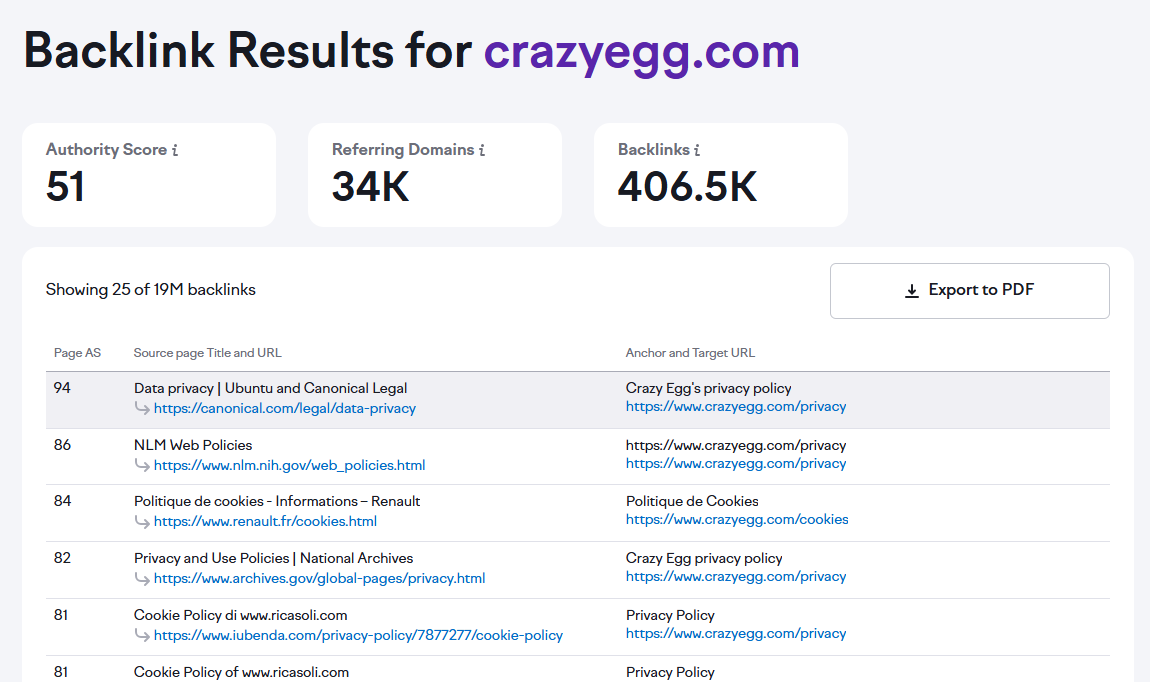
Knowing your backlink profile will help you understand the ground you need to cover with your link building efforts. You will have a good sense of where the biggest gaps in your current profile are.
For example, you may find that you have a high number of links but they are not from a diverse or authoritative enough collection of referring domains.
Knowing your link velocity gives you a sense of how quickly you can build links without triggering a penalty. You want to show consistent backlink growth versus causing a sudden spike, and you want that growth in velocity to come from high authority, relevant domains.
2. Build a list of valuable backlink opportunities
Now that you know the work to be done, the next step is finding good domains to link to you that will improve your backlink profile.
To build your list
There are an infinite number of ways to approach this, but what I have done in the past is to use an SEO tool to pull the backlink profiles of 3-5 of my closest competitors.
In SEMRush, for example, I enter the domains would use its Backlink Gap analysis tool:
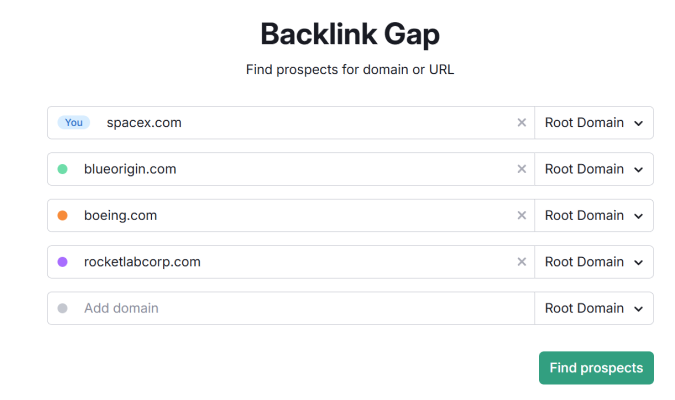
Then click “Find prospects”, and I’d get a list of all the links on all of those sites.
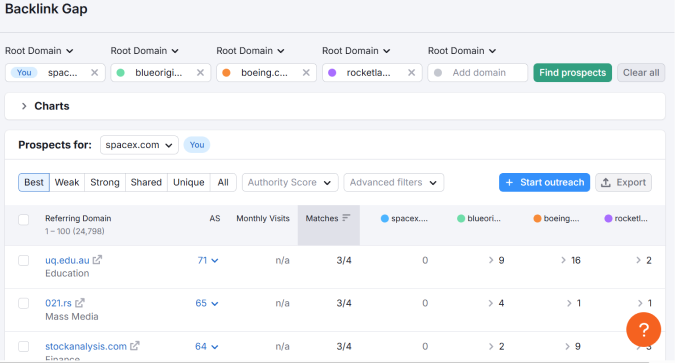
There will be tons more links than you want. I would filter out low authority domains, those that have nothing to do with your industry, ones in countries you don’t do business, and so on.
You are looking for reputable, relevant domains that link to your competitors but not to you (yet). Any sort of backlink analysis tool is going to give you a lot of ways to filter the data to find what you need.
Export this list into a spreadsheet and look for overlap between the competitor profiles. Sites that link to multiple competitors are good targets for backlinks because they clearly have an interest in your specific market or niche.
You should also look at which competitor pages are attracting the most links. Pages with a high total link count are good, but you should dig into which pages attract links from sites with a high domain authority vs those that seem to be magnets for spam links.
At this point, you have a solid list of potential sources, but I would add to it by doing some research of your own.
Use search engines to discover the leading blogs and sites in your niche. For example, you could search Google for “[your topic] + resources” or “best [your topic] blogs”. This will surface sites that Google thinks are authoritative, which are good backlink opportunities, and the topics covered by those sites will be good topics for you to create content about.
There is a lot more you can do, but this should be more than enough to get started.
To qualify backlink opportunities
At this point you will have a massive list of potential sites. Not every site deserves your time. To focus on the most high value opportunities with your limited resources, filter your list by:
- Domain authority and traffic: prioritize authoritative sites with lots of real traffic.
- Editorial standards: look for high quality content vs. keyword stuffed blogs with thin content.
- Topical relevance: score sites based on how closely their audience aligns with yours.
- Link placements: ensure that the site has outbound links in their body content.
- Link quantity: check whether the site has a million outbound links already, which would make their backlinks less powerful for you.
- Spam signals: avoid pursuing sites with red flags like an unnatural link velocity or undisclosed paid links.
With a long list of qualified opportunities, you are ready to start the next step.
3. Create and refine link-worthy assets
Before you reach out to your opportunities, you’ll want to have a strong collection of assets on your site that people will want to link to.
First, you should refine what you have published already, then you will know the gaps you need to fill in with new content.
Audit your existing content for linkable assets
During your competitor and market research to find opportunities, you probably uncovered a number of topics that you already have content about. The question here is: does this content need a light revision, a quick upgrade, or a total rewrite.
Run through your existing posts to find:
- Competitive quality: Do the topics you cover lag, meet, or exceed the quality of your competitors posts on the same topic?
- Outdated statistics and examples: Do you have posts with old data or content that need to be refreshed?
- Broken links: Are there internal links on your site that lead to a 404 page, or external links that lead to invalid URLs or questionable sites?
The goal is to make sure that when you pitch a link to an opportunity that your content is fresh, original, and credible. Old content, thin coverage, comparatively fewer visuals than your competitors, and broken links do not send a good signal to potential partners.
To refine your existing content:
- Add original research, fresh data, expert quotes, and new insights
- Build custom graphics and charts that other sites will want to embed
- Expand shallow sections of content to cover the most vital aspects for today’s readers.
- Update examples to reference current brands and products
- Update statistics to reflect the current year
- Fix all broken and aged links
- Ensure formatting and typography elements help readers scan and understand quickly.
Build new assets
During your research, you likely identified some content gaps where you need to create new posts from scratch. Prioritize new content creation based on:
- Topics and which attracted the most and highest authority links
- Gaps in competitor coverage where you can easily do better
- Formats that work consistently well in your niche
- Assets that align with your highest value opportunities
The key is matching the format to the opportunities you found. If you noticed that troubleshooting guides were getting lots of links, that’s where to focus. Or maybe you want to spend your energy creating an original industry survey because data-driven posts were attracting the most valuable links in your niche.
At the end of this step, you should have a content roadmap that covers the required revisions to existing posts and new posts to start working on.
4. Execute your link building campaign
You have a list of targets to pursue based on their potential link value and content that is worth pitching to them. Now comes the challenging part: outreach to site owners and securing new link placements.
This is tough, slow, manual work. Along with persistence and a knack for nurturing relationships, there are two things you need to have in place to run an effective link building campaign.
A personalized outreach template
Start by creating a soft pitch email template that you can customize based on the opportunity. You will have better luck truly personalizing emails with real details versus using the same “Hello {{NAME}}” boilerplate email.
Spend some time creating a base template that gives your outreach team the ability to quickly draft emails that show:
- You know who the prospect is and what they do
- You actually read their content
- How a link to your content would genuinely benefit their audience
Keep the outreach email brief, like 3-4 short paragraphs max. Lead with a compliment about their work that references an actual article or section. Explain how your content adds value for their readers. Make the request clear, polite, and low-pressure.
Don’t go in thinking that you are going to get an immediate yes. Most often, the soft pitch is the beginning of a longer conversation.
Email marketing tools
You cannot conduct outreach at scale using Gmail. You need a good email marketing service, which lets you send tons of emails without getting your account flagged for spam. Tools like Constant Contact, Omnisend, Beehiiv, and others automate lots of the busy work and make it easier to track your progress.
Whatever you decide to use should let your team:
- Send personalized emails in batches
- Monitor email marketing metrics like sends, opens, and replies
- Set up follow-up sequences for people who don’t respond
- Track prospects as they move through stages
Link building outreach is like a mini pipeline or sales funnel where you move prospects from cold outreach → active conversations → closed deals. Without proper tracking, it’s impossible to manage all of these ongoing conversations or see which tactics are working.
Tips for managing your link building campaign
Once you have the template and email system set up, it’s time to start reaching out to prospects. Here are some tips to help you run effective campaigns:
- Start with your highest-value prospects where you have a strong content match and clear relationship potential.
- Adapt your approach based on the opportunity type. Link prospecting for a statistics page requires a different pitch than a thought leadership post.
- Set realistic weekly goals. Balance the quantity of emails sent with their quality.
- Track conversion rates for each stage to understand what’s working.
- Clean up your list regularly. Archive prospects who have explicitly said no so you are not wasting sends or harassing people.
One final reminder: you cannot offer anything in exchange for the link. No money, no trades, no swaps of any kind.
Yes, this is a super slow and often frustrating process. Sending people a gift card would certainly increase your response/success rate. So would a link exchange or any other type of favor.
But the moment you add some sort of incentive to the deal, you are no longer white hat link building. Google’s guidelines are crystal clear about this.
Black Hat Link Building Tactics To Avoid
If you want to stay firmly within the boundaries of white hat linkbuilding, stay away from these black hat tactics:
- Link schemes: Coordinating activity to use links to manipulate rankings or artificially inflate domain authority. Examples include link exchanges (you link to me, I link to you) or A→B→C exchanges (using three or more sites in a “link ring”) . .
- Private blog networks (PBNs): Using a network of sites to pass link equity to another site in order to inflate its authority. PBNs are typically created on expired domains or new websites for the sole purposes of linking to the target site.
- Paid links: Exchanging money or another form of value for a link without qualifying the link using a rel=”nofollow” or rel=”sponsored” attribute value to the <a> tag. You can have paid links on your site, but you must qualify them as such.
- Comment spam: Adding links to comments on blogs, Q&A sites, etc, or including them in your signature.
- Mass directory submissions: Submitting your site to hundreds of low-quality directory or bookmark link sites, or submitting your site to directories that have no relevance to your brand.
- Hidden links: Putting links on your site that crawlers can see but not human readers. Examples include using CSS to hide links or using white link text on a white background)
Most of these tactics are covered under the Link Spam section of Google’s Spam Policies. Using these will get your site penalized.
Even if you see big brands doing these tactics, even if you see SEOs on 𝕏 promoting them, I would stay away. Google has gotten very good at detecting link spam and rankings manipulation.
Are There Legitimate White Hat Link Building Services?
The short answer is yes, but be careful if you outsource link building to a third party.
Here’s a basic lay of the land:
- There are true white hat link building services that help you build great content, conduct honest outreach, and help your brand secure great links in the best possible places.
- There are shady services that promise white hat links, but in reality they are just link farms of websites that link to each other to manipulate results.
- There are services and agencies that fall between these two extremes that do honest work sometimes and push into gray/black hat tactics at other times.
If you are going to hire help with link building, take time to seriously vet the company.
Check their backlink profile, for sure, and look for any signs that they participate in spammy networks. Do they practice white hat link building themselves?
Ask to see examples of outreach emails. Request the names of brands they’ve worked with before. Check those brands’ backlink profiles.
The truth is that a white hat backlink service has nothing to hide. An agency that’s not playing by the rules cannot afford to be as transparent.
If you run into people guaranteeing instant results, I would be very skeptical.
Now that you know how much time and effort goes into building links the right way, you should be suspect of anyone advertising a cheap and fast white hat link building service.
Whether you go with a good service or start building links with an in-house team, go into the process knowing that it takes time. There are other things you can do to increase your site’s performance in search results while you build links.
Good luck.