Fear marketing is not scaring customers into making a purchase. That’s a terrible strategy. What works is identifying fears your audience already feels and showing them how your product can help.
This post explains how to use fear marketing honestly, effectively, and in a way that serves the people you’re trying to reach.
Fear Marketing: What It Is (and What It’s Not)
Fear marketing highlights real risks or potential losses your target audience cares about. It draws attention to problems they already feel, and it’s always paired with a positive, clear path forward.
That’s the right way to use fear marketing. You’re addressing:
- Genuine fears and pain points
- Specific anxieties relevant to your audience
- Problems your product actually solves
Done right, you can tap into something that’s been nagging at potential customers, and position your brand as a viable path to relief.
When used poorly, fear marketing crosses the line into manipulation. This is bad. Bad for your customers, bad for your brand, and bad for society.
Fear marketing is NOT frightening your audience into action
If you can take away one thing from this post, it’s this:
Fear marketing ≠ fear mongering.
With fear marketing, you’re tapping into a worry, anxiety, or problem that already exists. It’s an emotional hook that helps you frame the real value of your product or service. Your goal is to offer help, and you use fear to stand out from a crowded market.
Fear mongering, on the other hand, is a manipulative way to incite panic in your audience or exaggerate the risks they actually face in service of your own agenda.
I didn’t want to throw any real advertisers under the bus, so I asked Google Gemini to create a fake screengrab of a fear mongering ad for a disinfectant brand, and it totally nailed it:
Keeping your house clean and free of germs is important, but “SILENT KILLER IN HOME” paired with a CCTV style image of a young person clutching their stomach in pain? That’s over the top, and my hunch is that 99.99% of people would not take this ad seriously or trust this brand.

The goal of fear marketing is NOT to scare prospective buyers into making a purchase. I don’t think that works, and neither do any of the expert advertisers, marketers, or psychologists that I encountered during my research for this post.
How Fear Marketing Works
It’s hard to get people to take action. Every advertiser knows this. People tend to stick with what they know, even when it’s not working for them.
They don’t want to switch products or try a new service. They’re definitely not going to hand over their credit card info to a brand they just heard about.
Fear marketing breaks through that inertia. It’s effective because it takes a real threat, and offers to make it go away.
So long as you are activating a real, genuine fear in their mind, you will have your potential customers’ attention. Your product becomes the bridge: from anxiety to relief, from doubt to confidence, and from worry to peace of mind.
The science behind fear-based appeals
If you want to dive deep into the behavioral psychology of fear and decision-making, I’m the wrong person to talk to. But there are plenty of highly-qualified people who’ve published on the subject.
I’d recommend reading Daniel Kahneman and Amos Tversky’s research on loss aversion, which explains why we’re wired to avoid losses more strongly than we seek gains. The Decision Lab has an excellent, accessible summary of loss aversion and how it influences everyday decision-making.
Psychology Professor Cassie Howard also has a good rundown of how fear-appeal advertising works. This is a short, readable article that highlights the ways advertisers mess up when they try to employ fear in ads.
If you want something in-depth, check out this 2015 meta-analysis that reviewed more than 100 studies on fear appeals. It found that fear works when two things are present: a credible threat and a clear action people can take to reduce that threat. You can find a much shorter summary of the paper on the American Psychological Association’s website.
The common sense side of fear marketing
I’m not a neuroscientist, so I won’t pretend to explain brain chemistry. But you really don’t need a psychology degree to understand why fear marketing is effective.
What I learned after a deep dive on the subject boils down to common sense.
People pay attention to threats.
It’s a survival instinct. When someone highlights a genuine risk we’re facing, we stop scrolling.
Losing money, falling behind competitors, or health risks? These threats get our attention.
And if that same message offers a clear way to eliminate the threat? There’s a good chance we’ll click through.
That’s why studies consistently show fear-based ads get higher click-through rates and conversions than positive messaging. It cuts through the noise and makes inaction feel more painful than taking action.
5-Step Framework for Ethical Fear Marketing + Examples
Like most tactics in advertising, the use of fear is simple and seems obvious once you’ve seen it broken down into its component parts.
I’ll provide a short overview of how it works here, and we’ll spend the rest of the post fleshing out the methods and tactics you can use to employ it responsibly, along with plenty of fear advertising examples from real companies.
The basic mechanics of fear marketing are as follows:
- Identify an existing fear in the mind of your audience
- Activate the fear with your advertising
- Present your solution as a way out
- Contrast the fear with a positive outcome
- Make taking action as easier than staying afraid
As crisp as these elements look in a list, each one must be handled with care.
1. Identify an existing fear in the mind of your audience
Let’s start by looking at the opening to the best book ever written on the subject of direct response copywriting, Breakthrough Advertising, by Eugene M. Schwartz. These are the first sentences of the first chapter:
Let’s get right down to the heart of the matter. The power, the force, the overwhelming urge to own that makes advertising work, come from the market itself, and not from the copy. Copy cannot create desire for a product. It can only take the hopes, dreams, fears and desires that already exist in the hearts of millions of people, and focus those already-existing desires onto a particular product. This is the copy writer’s task: not to create this mass desire—but to channel and direct it. (p. 3 emphasis original)
Even if you were to stop reading the book right here, you would be better off than the vast majority of people who try to write advertising copy who imagine that they are going to create a new desire or fear inside the mind of a prospective buyer. It’s impossible.
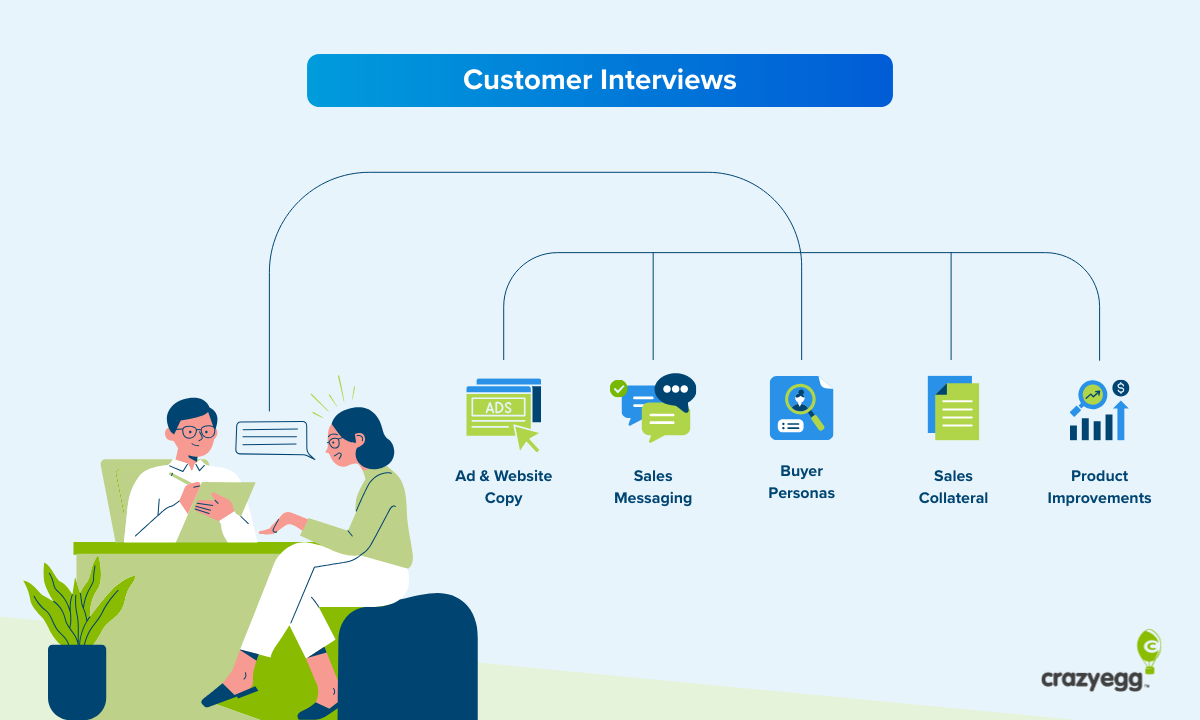
No, your best strategies for fear marketing will be rooted in understanding your target market at a deep level. What keeps them up at night? What’s keeping them from living the life they want? What are they desperate to avoid at all costs?
Above all else, you are focused on real fears. There is no sense in trying to make up something for people to be afraid of. You are trying to activate (bring to mind) a fear that they already have.
Common types of fear appeals
Here are some the most common types of fears used by advertisers, along with example copywriting in italics demonstrating their use:
- Fear of loss (loss aversion): The anxiety of losing something you already have. Without proper backups, you could lose years of customer data overnight.
- Fear of missing out (FOMO): The worry that others are accessing opportunities or experiences you’re being excluded from. Our lightning sale ends in 3 hours.
- Fear of uncertainty: The discomfort of not knowing what happens next or lacking control over outcomes. Will your current SEO strategy still work in the age of AI search?
- Fear of failure: The concern that your decisions or actions won’t deliver results and will damage your reputation. What if your next campaign flops in front of the entire executive team?
- Fear of social rejection: The anxiety of being left behind, looking foolish, or not fitting in with your peer group. Your friends post homemade dinners every night while you’re reheating leftovers or ordering DoorDash again.
- Fear of physical harm or health consequences: Concerns about threats to personal safety or the well-being of loved ones. With the wrong desk chair, you’re risking chronic back pain.
- Fear of financial instability: The worry of running out of money or facing unexpected costs. Can your budget handle a $6,500 emergency vet visit without pet insurance?
- Fear of wasted time or effort: The concern that you’re investing resources into something that won’t deliver results. Is your team spending 10 hours per pay period fixing payroll mistakes instead of growing your business?
- Fear of being taken advantage of: The anxiety of getting scammed, overpaying, or being manipulated by those with more information. How do you know your agency isn’t just pumping up the vanity metrics?
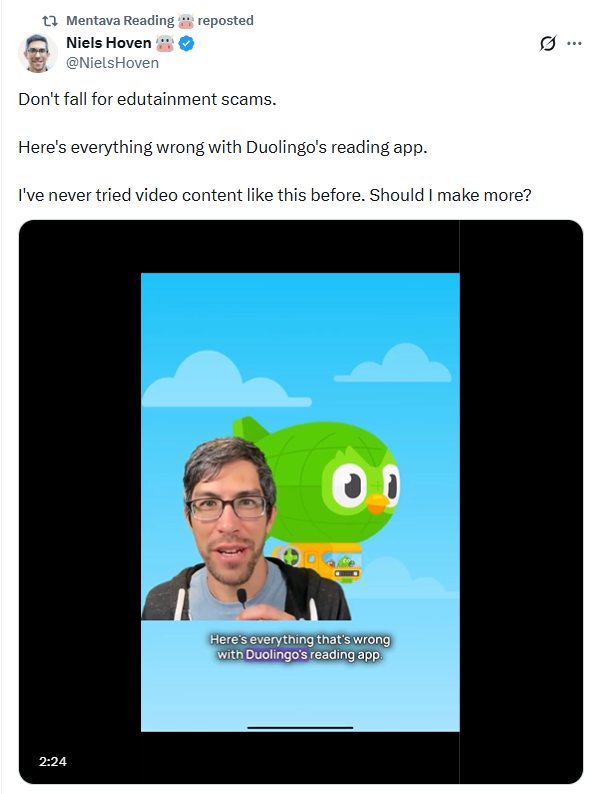
Here’s an example of an effective fear-appeal from Niels Hoven, the founder of Mentava, an app that helps pre-schoolers learn how to read.
“Don’t fall for edutainment scams,” the post begins, “Here’s everything that’s wrong with Duolingo’s reading app.” You can see how he’s tapping into a parent’s fear of their child falling behind, but also their fear of being taken advantage of by what he describes as “edutainment” apps.
Regardless of your industry, there is no shortage of very real fear for you to tap into. Talk to your customers, run surveys, read reviews, and scour the internet.
With a little bit of research into your target market and your competitors, it will be easy to surface authentic concerns that your product can address.
2. Activate the fear in your ad
Once you have identified a real fear that exists in the mind of your audience which your product can solve, you have to distill it down into an ad. This boils down to a headline, a few lines of copy, and an image that will support them.
If you are trying to reach people on social media, you might only have the headline and ad creative to work with, so you have to get right to the point. Consider this Facebook post by PetLink, a company that sells GPS trackers for cats and dogs.
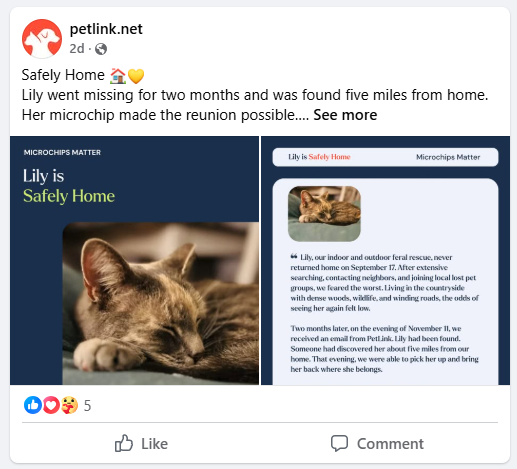
This is about the cutest fear-based marketing you are likely to see, and amazingly the company is able to get the entire fear and solution into the preview text of their post. “Lily went missing for two months and was found five miles from home. Her microchip made the reunion possible.”
Anyone with a pet has the fear that they’ll run away, so PetLink is hardly inventing a worry for owners. And they’ve framed the fear as a solvable problem, titling the post, “Safely Home 🏠💛”
Here are some tactics for doing this well in your own ads:
- Empathize and validate: Show your audience that you understand what they are experiencing. Use language that mirrors how they talk and think about the problem. Pet insurance brands do this well, writing things like, “You shouldn’t have to choose between your dog’s health and paying rent.”
- Make it specific: Use concrete details as opposed to vague concerns to articulate the fear. For example, describing technical security risks isn’t going to resonate the same way as a story about how “a hacker gains access to your database at 2AM, and by breakfast, your customer’s credit card info is for sale on the dark web.”
- Make it personal: Use language that reflects how your audience experiences the fear. If you are marketing to CFOs, for example, you might use the situation like, “explaining to the board why costs are up 15% on the year with no revenue to show for it.” Or, if you are selling to SMBs, you might talk about, “logging into dwindling bank accounts while invoices pile up.”
- Make it urgent: Show them that the fear is already affecting them, or just around the corner. It shouldn’t be theoretical, or off in the distant future. A meal-kit service might highlight that, “Food prices jumped 12% this year,” or, “Families are now spending $130 more per month on food than last year.”
- Don’t overdo it: Stay grounded in reality. There’s no need to invent catastrophic scenarios. Instead of “home invaders will terrorize your family,” stick to facts like “the average burglary takes 8 minutes.” For car insurance, don’t say “one accident will financially destroy you forever.” Stay with real outcomes like “without proper coverage, a fender-bender can cost you $2,500 out of pocket.”
- Use real customer stories: Make the fear feel concrete instead of hypothetical by referencing real stories from people you have helped. An ID theft company might say “Maria spent 18 months and over $3,300 to recover from a single fraudulent account opened up in her name.” Or a fitness app might share that, “John realized he was winded after walking up two flights of stairs to his daughter’s apartment.”
In practice, you are not going to have a ton of space to get the reader’s attention. An email subject line, a social ad, or a search headline only gives you around 8-12 words to work with.
Pick one of these tactics and go all-in on the fear. You just need to get their attention. Don’t try to sell your solution here.
Some examples:
- One data breach exposed 212 million records last year.
- 60% of SMBs close within 6 months of a data breach.
- Your dog ate a sock. The surgery cost $3,800.
- Chest pain at 2 a.m. isn’t something to Google
- One missed payment can drop your credit score 100 points
- Termites eat a pound of wood a day
Once they get to your landing page, great, you can go to town with images and compelling copywriting that make the fear real and your solution appealing.
3. Present your solution as a way out
Now that you have activated the fear in the mind of the customer, you can position your solution as a way to remedy that fear. They have clicked through from your ad to a landing page where you have more space to work.
That said, you don’t have any room to waste and the attention you won will evaporate if you lose momentum.
The key is drawing a straight line from the fear you introduced to your product. If the fear is “spending 6 months resolving a tax audit,” your solution is “software that flags errors before you file.”
If the fear is “an emergency vet bill that costs $2,800,” then the headline on your site is that your brand’s pet insurance “covers 90% of emergency procedures.”
Nationwide does a good job with this, offering a clear example of how much money people could save by insuring their pet before an accident happens.
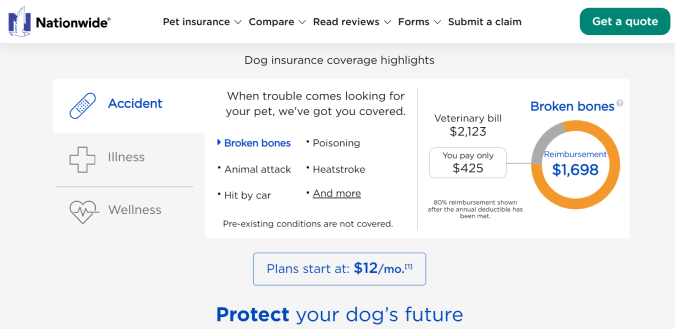
Readers here can look at what the vet bill would be, and how much more they’d pay out of pocket without insurance. Below the four-figure cost is an easy button to click with the price of $12 per month, which seems like nothing compared to the $2,123 average vet bill they’d otherwise be forced to pay.
This is not the place to get into technical details, but you do have to give enough evidence to support your headline claim. Some of the best forms of proof to use here are:
- Data on success rates or outcomes
- Customer testimonials that reference the fear
- Before-and-after photos or scenarios
- Third-party verification, awards, or trust badges from credible sources
- Case studies that walk through how your product eliminated the threat
The more specific your proof and the more tightly connected it is with the fear, the easier it will be for people to believe in your solution. Using social proof like testimonials is ideal. Show how individuals who match your target audience have benefited from using your product to solve the problem that’s dogging your readers today.
A good example of using of this comes from Volvo, the safety-focused car company, who links to videos of people saved by its three-point safety belt technology:

Keep everything as simple as possible. Avoid jargon and don’t make your readers work through long chains of thought. The more complex your solution sounds to access or implement, the harder it will be for your audience to believe it’s going to work for them.
Even in highly technical fields like cybersecurity or cloud infrastructure, the top performing brands make accessing the solution seem easy. They offload the deep, nitty-gritty technical explanation to whitepapers, long-form case studies, and resource hubs, which are linked from the landing page rather than a main focus.
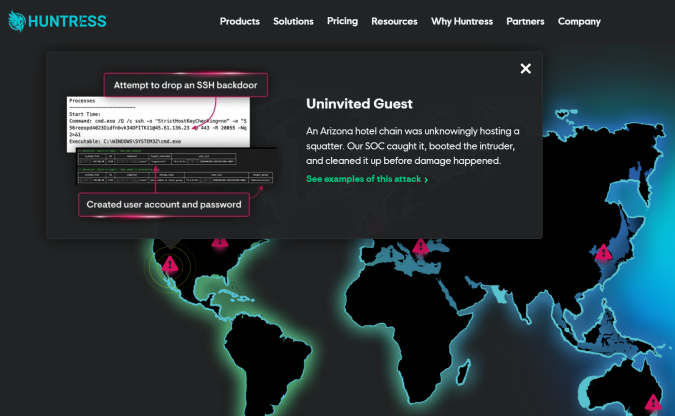
Here’s an interactive map on the website of Huntress, the managed security provider that showcases some of their work from around the globe.
Huntress pairs exciting visuals with short, pithy explanations of how they foiled hackers with a link to more detailed information for those who want it.
4. Contrast your fear with a positive outcome
At this point, you have shown your audience that your product is capable of solving their problem and alleviating their fear, but there are a few things still standing in between them and making a purchase.
You’ve opened the door to a new idea for your audience (like pet insurance, automated payroll, etc.). Perhaps you’ve reframed something they already knew about in enough of a positive light to really have their attention.
Some people might buy or sign up right now. But most people are in consideration mode. Maybe they want to Google your competitors or go read reviews of your product. Others are second-guessing whether or not they really need this solution.
If you keep hammering on the fear at this point, you will lose people. If you simply try to intensify the appeal of your solution, it’s not going to work. People don’t crave pet insurance, they want peace of mind. They don’t want automated payroll, they want more time each week.
They are willing to pay for your product, but it’s the outcome they desire.
This is the critical shift: from fear to aspiration. Your job is to paint a picture of their desired future. Yes, your product helps them get there, but it’s the future free of threats, risks, and uncertainties that they really desire.
I liked this example from Life360, the family-tracking app, that shifts from fears of what could go wrong to how they’re product delivers “Roadside coverage at your fingertips.”
The reassuring copy is paired with an image of a happy, handsome tow truck driver showing up to save the day. There’s undoubtedly a lot of fear driving people to consider purchasing an app like Life360, but what they really desire is knowing that things are going to be okay.
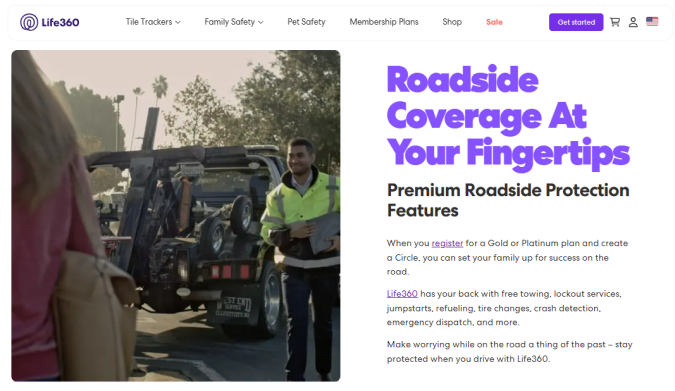
“Make worrying while on the road a thing of the past,” the copy says, “stay protected when you drive with Life360.”
At this step, you’re giving people a reason to move forward that is focused on the gain. Yes, preventing a loss gets people to pay attention, but hope gets them to take action.
5. Make taking action as easier than staying afraid
You have done the hard work of getting your audience to believe in your product and picture life on the other side. But the reality of the situation is that doing nothing is still an easy and appealing option.
Even when people know they should act and want to, they default to “Let me think about this,” or “I’ll do this later.” And then they are gone.
Great fear marketing shifts the audience’s perception, so that taking action appears easier than continuing to live with the fears and anxieties that brought them this far.
Nailing this step is a mix of hitting the conversion rate optimization (CRO) fundamentals and subtly reminding people how their current fearful situation is making their life harder.
Use this CRO checklist to make sure you have made your site as easy and appealing as possible to use. It should be fast-loading, free of errors, display clear trust signals, and forms should have as few fields as possible. Hit those basics, for sure.
And then, near all of your calls-to-action (CTAs), weave in the subtle reminders of the fearful world they can leave behind. Some ideas:
- A little bit of copy just before the CTA like, “Stop checking your bank account every morning and Start your free trial today”
- Testimonials that feature people saying things like, “If I had [your product] before, it would have saved me $3,000.”
- Use unique CTA button text that foregrounds relief, like “Sleep better tonight,” or “Yes, I want to stop manually tracking expenses,” instead of generic text like “Sign up”.
- Add a little copy that reinforces the consequences of delaying action, like “1 in 5 consumers face identity theft every year.”
Put simply, the goal in this step is to make moving forward with your brand seem the path of least resistance.
The easier you make your signup/purchase process, the more believable it will be that staying afraid and continuing to deal with the problem is the harder option in front of them.
Fear Marketing: What’s Legal?
In the United States, the Federal Trade Commission (FTC) regulates advertisements and is not shy about cracking down on bad actors. If you stretch the truth about what your product can do, exaggerate risks, or make unsubstantiated claims, you can get into big trouble.
Here are some of the most important rules you should follow:
- Your ads must be clearly identifiable as advertising. Don’t use formats, graphics, or language that could mislead people into thinking they’re watching a news report, public service announcement, or government warning. If your fear-based ad looks like editorial content or an official alert, you’re on dangerous ground.
- Scare tactics that cause harm can be considered unfair practices. If your ad highlights risks in a way that could lead people to make dangerous decisions (like stopping prescription medication without consulting a doctor), the FTC may consider that an unfair practice.
- Every claim you make must be backed by evidence. This is especially true for health and safety claims. If you say a competitor’s product is dangerous, that your product prevents specific problems, or that certain risks are increasing, you need solid evidence to support it. Testimonials must be truthful and representative of typical outcomes, not cherry-picked extreme cases.
- Don’t fake urgency, scarcity, or risk levels. Exaggerating the severity or likelihood of a threat, manufacturing fake deadlines, or creating artificial scarcity all violate FTC guidelines. Your messaging must reflect reality, not invented scenarios designed to pressure people into buying.
Err on the side of caution. I think where people get into trouble is when they come up with really great copywriting that stretches the truth about their products or their competitors.
If you are at all worried that your campaigns are crossing the line, visit the FTC’s resources about Truth in Advertising.
Tips for Keeping Fear Marketing Ethical
You’ve probably encountered advertising that uses fear in a cringy or exploitative way. Don’t do that, even if it’s technically legal to do so. It’s not going to strike a good chord with the market and almost certainly winds up costing your brand in the long run.
Your goal here should be to empower buyers to solve real world problems. Here are a few tips to help you stay on the right side of your audience.
- Conduct deep audience research. Talk to customers, run surveys, and base your messaging on the real fears your audience faces today. Don’t guess at what scares people or copy what your competitors are doing.
- Speak to real fears. Fear marketing is not always going to be the best approach. If research gives you a good fear to work with, great. If not, don’t manufacture something.
- Be honest about what your product can deliver. If your solution helps with part of the problem, say that. Don’t promise complete elimination or otherwise create false expectations about your product’s efficacy.
- Be transparent about your evidence. Link to sources for stats you cite. Do not use fake testimonials, which is against the law.
- Emphasize the positive outcome. Highlight the problems people face, but spend equal or more time showing them the better future your product creates.
Really, these are things you should be doing for any marketing campaign you run. But when you are using a fear-based appeal, these ground rules are even more important.
The last thing I want to say is that you should monitor these campaigns closely. Fear marketing is touchy, for sure, and I think it’s easy to recognize the danger of going overboard.
But there’s also the risk that you don’t sharpen the fear enough, and your ad campaign winds up getting lost in the mix.
Either way, you want to keep a close eye on your web analytics: are the ads and creatives drawing more traffic? Are you increasing conversion rates?
If you can, dig a little deeper with session recordings and heatmaps to see how users are interacting with your fear-based campaigns.
Another good strategy is to run A/B testing. You can see how well fear-based appeals work compared to your existing marketing campaigns. You can also test different types of fear-based appeals to find which angles work the best with your audience.
Ideally, you’ll be able to validate your strategy and hone in on a new sweetspot for your messaging that gets people’s attention and helps them reduce or eliminate a problem that’s been giving them anxiety.