The buyer journey is a practical way for marketers to describe how people discover a brand and decide to make a purchase.
It doesn’t accurately capture every twist and turn of the real-world buying process. But it can help you figure out where your brand needs to show up, and what you need to say in order to win the sale.
In this post, I’ll cover the fundamentals, and then we’ll take a close look at content from two brands that successfully meet the needs of potential buyers, every step of the way.
Buyer Journey: Overview
The buyer journey is a simplified model of how people move from recognizing a need to choosing a solution. It answers the question: what steps do potential customers take along their path to purchase?
In the buyer journey model I favor, there are four discrete stages that buyers move through.
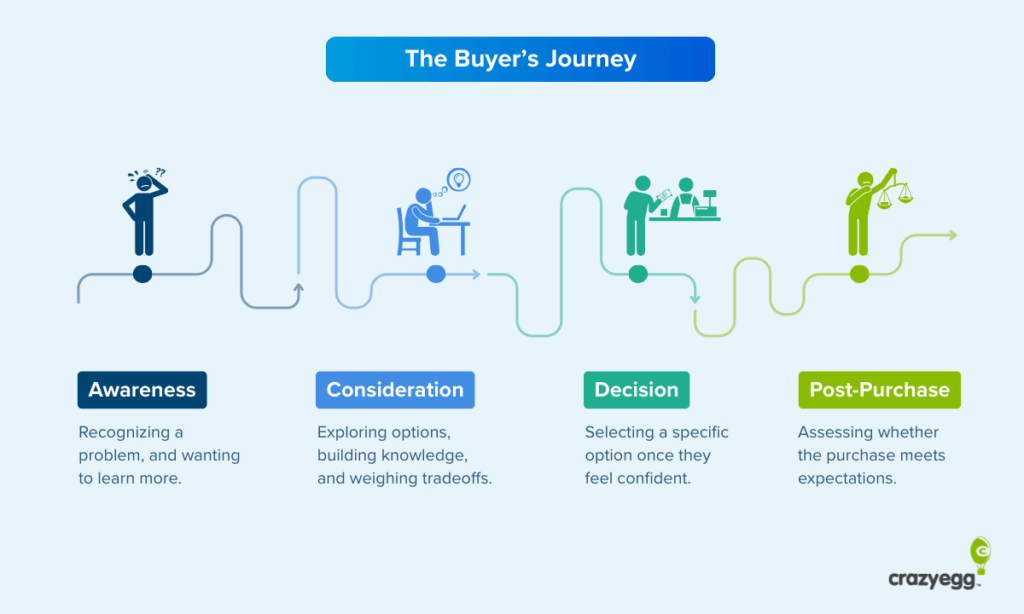
We’ll cover each stage in greater depth later in the post, but at a glance, buyers move through:
- Awareness: Recognizing a problem, desire, or opportunity, and wanting to learn more.
- Consideration: Exploring available options, building knowledge, and weighing tradeoffs.
- Decision: Selecting a specific option once they feel confident.
- Post-purchase: Assessing whether the purchase meets expectations.
The purpose of mapping out a buyer journey is to understand what’s going on in a buyer’s head at different points in the process. Where do they go for information? What are their motivations, questions, and pain points? How do these factors evolve at different stages of the journey?
Early on, potential buyers are figuring out if they have a problem that’s really worth addressing. At later stages in the process, they may be actively comparing options and weighing tradeoffs based on what they’ve learned along the way.
A detailed buyer journey can help you answer questions like:
- Which channels are important for gaining visibility with your target market?
- What questions do you need to answer at each touchpoint?
- What types of evidence and social proof matter most at each stage?
- What do buyers already know by the time they engage your brand?
The better a brand can understand how people move through this process, the better they can design content and messaging that make the buying decision easier.
Buying decisions form across many small interactions
The buying process is rarely a straight line from problem → solution.
More often, people gather information, set it aside, revisit it, and reinterpret it based on what they discover.
These days, the volume and quality of information people can find out on their own is staggering. Search engines, customer reviews, marketplaces, and AI tools allow buyers to do serious due diligence before they ever engage with a brand.
In an excellent blog post, Rand Fishken, CEO of Sparktoro and co-founder of Moz, described the modern buying experience as the “pinball customer journey,” where the average user bounces between dozens of different information sources.
“The person might start their journey in a WhatsApp group conversation, a Substack newsletter, a browse of Instagram’s Discover page, a scroll through their personalized Google News feed, LinkedIn feed, Reddit feed, YouTube homepage, or a dozen others,” writes Fishken.
“Then they move to searching Google, asking ChatGPT, pinging friends, scouring Reddit, DM’ing experts they follow on LinkedIn or Threads.”
I don’t even feel like he’s exaggerating here. I’ve made plenty of purchases in the last year that map pretty well to the chaotic path Fishken painted.
So yes, the buyer journey is messy. It’s always been messy, but there are more potential touchpoints along the way than ever before. “That’s not a process any funnel-based analogy captures well,” writes Fishken, and I agree.
Buyer Journeys vs. funnels
There’s some crossover between a buyer journey and a conversion funnel. They both track how potential customers become paying ones.
The major difference is that the buyer journey considers the experience from the potential customer’s perspective, whereas funnels focus on what the brand is trying to do.
A buyer journey is:
- Influenced by everything buyers see, not just your content
- Shaped by forces outside a brand’s control like organic reviews and social trends
- Follows how people actually research and decide
The purpose of mapping a buyer journey is to enable brands to align their content and messaging with what real buyers experience in the open market.
A funnel is:
- Built from the touchpoints you directly control
- Driven by ads, emails, landing pages, and sales steps
- Focused on how well your brand guides people toward conversion
The purpose of a funnel is to help brands optimize the touchpoints they control, with the goal of increasing conversion rates (getting more sales, signups, activations, etc.).
Funnels are still incredibly useful, but they do a poor job capturing the non-linear, real-world landscape in which your potential customers are making decisions.
Buyer journey vs customer journey
You’ll often see a distinction drawn between the buyer journey and the customer journey.
According to this framework, the buyer journey covers what happens before purchase, while the customer journey begins after someone becomes a customer.
In real life, though, why draw a line here?
For the vast majority of brands, I don’t think this is a useful distinction to make.
Real people don’t experience any transformation after purchase. In many cases, the most emotionally intense moments happen after the purchase. People second-guess whether they made the right choice, even for small purchases.
When it is a big purchase like an annual SaaS subscription, buyers will continue evaluating your brand. Are you delivering on what was promised? Are they getting the results they want?
Your buyer journey should take the post-purchase experience into account to avoid setting bad expectations.
Does the difference ever really matter?
In specific situations, yes. In enterprise B2B sales, for example, the buyer, user, and decision-maker are different people with different incentives.
In those cases, the “buyers” are one set of people who make decisions based on consensus, risk reduction, or compliance. The “customers” are a separate set of people who actually use the product.
So if you have distinct sales teams (who handle the buyers) and customer success teams (that work with the users), then maybe you will get value out of creating two separate journeys.
But for many brands, I think it makes sense to include post-purchase as part of the buyer journey. That is why I have done so here.
An In-Depth Look at Buyer Journey Stages
In this post, I’ve broken the buyer journey down into four discrete stages with recognizable boundaries between them.
I’ve seen smart people divide stages differently. You should use these as a starting point and then adjust them to better fit the path your customers actually take.
For now, we’re going to cover four stages, which I think will be useful to the vast majority of brands looking to map their buyer journey. Each section covers what’s happening from a buyer’s perspective, outlines stage-specific content buyers are likely to consider, and ends with a set of research questions to start working on.
Stage 1: Awareness
Awareness starts at the moment that your buyer is jolted out of the everyday course of their life and recognizes:
- A desire they want to fulfill
- A problem they need to solve
- An opportunity they could take
Until this point, the potential buyer was content just doing what they were doing.
BUT something happened that took them out of their rut, and opened them to the possibility of doing something different.
The potential buyer may not be actively searching yet, but now they are more receptive to information that helps explain what is happening. They’re interested in alternative products and services where before offers for those options wouldn’t have appealed to them.
For example, a person may have reconnected with an old friend who was in much better shape than the last time they got together. Their friend’s newfound fitness has opened up the idea of getting in shape. They may view it as a desire (I want to get in shape), a problem (I’m not in good enough shape), or an opportunity (if they can get into shape, so can I).
Now, this person is more alert to ads and information about fitness apps, gym memberships, and healthy food. They may have been exposed to similar content in the past, but now they care.
Brands don’t have control over these desires, problems, or opportunities. They cannot create these feelings, but they can speak to the audience of people who have them.
Common awareness-stage content types:
- Ads on search, social, YouTube, TV, radio, and other channels.
- Educational blog posts and explainers
- Educational videos
- Industry reports or trend summaries
- Checklists
- Self-assessments and quizzes
Awareness-stage content helps people realize they’re dealing with a real problem. It validates their feelings, speaks to their fears, and gives them concrete language to talk about what they’re experiencing.
At this stage, brands are trying to be useful and gain visibility. They are introducing themselves versus making a sale. The goal is to show up when someone starts searching, scrolling, or asking basic questions, and position their brand as a resource they can trust.
Useful awareness-stage research questions:
- What triggers people to start looking for a solution?
- Where do they first go to find information?
- What misconceptions do people start off with?
- What alternatives do they consider besides buying anything at all?
- What language do they use to describe problems before they learn about solutions?
Stage 2: Consideration
Consideration starts once the buyer has defined the problem, desire, or opportunity. Now they are starting to explore ways to realize their desire, solve the problem, or seize an opportunity.
As they move through this stage, they gain literacy in the product or service category. They start to pick up on differences between products, as well as the benefits and tradeoffs that different brands offer. They want to understand how different solutions work, what they require in terms of cost and effort.
Now buyers are comparing their options, trying to develop a sense of what a “good solution” looks like for their specific situation. They are adding brands to their list of potential options, crossing off others, and constantly revising their ideas.
Common consideration-stage content types:
- High-quality product detail pages
- Customer reviews
- Buying guides
- User-generated content
- Comparison pages and charts
- Case studies and customer stories
- Product demos or interactive walkthroughs
- Webinars and live sessions
- Reviews, testimonials, and third-party validation
- FAQ pages that address objections
The goal of consideration stage content is to help potential buyers decide what kinds of solutions make the most sense for them. It should help people answer questions, build their knowledge, and understand the unique selling points of a particular company’s product or service.
Useful awareness-stage research questions:
- What criteria are most important as people assess a solution?
- What are the common objections to using your solution?
- What makes people feel confident in your solution?
- What questions come up repeatedly in sales or support calls?
- What are the most common complaints about your product category?
Stage 3: Decision
The decision stage starts when the person is actively ready to buy. They want clarity about specific questions related to pricing or implementation for specific products.
At this stage, they have already made up their mind about what they want. They are looking for signals that reinforce their confidence about a decision. They are alert for red flags or conflicting information that undercut that confidence.
Common decision-stage content types:
- Pricing pages
- Product demos, free trials, and free samples
- Comparison pages
- FAQ pages
- Terms of service
- Case studies and customer stories
The goal of decision-stage content is to help buyers justify choosing your brand. Ideally, you can provide clarity about their remaining concerns and potential objections, helping them resolve any lingering doubts they have.
Your content should be conscious of what competitors are saying as well as your brand’s reputation in third-party reviews. At this point, potential buyers are likely aware of the downsides and tradeoffs that come with choosing your brand. Any persuasion techniques you can use to lessen the perceived risks they have discovered are valuable.
Useful decision-stage research questions:
- Which brands are you most often compared against?
- How do your closest competitors frame your brand’s weaknesses?
- What are the common complaints about your product?
- Where do buyers most often get confused about what you offer?
- What are the biggest risks and downsides associated with your brand?
Stage 4: Post-purchase
Post-purchase begins once the transaction is complete. The order has been placed. The contract has been signed. During this phase, buyers will start using the product or service and assessing whether it delivers on expectations.
The faster that buyers perceive they are getting the value they paid for, the better. Anything the brand can do to help buyers get set up quickly and use the product successfully will make people feel more confident that they made a good decision.
Common post-purchase content types:
- Confirmation emails and order tracking
- Welcome emails
- Onboarding guides and setup instructions
- Implementation checklists
- Tutorials and troubleshooting content
- Knowledge base content
- Customer support resources
- Product updates
- Usage and care tips
The goal of post-purchase content is to ensure that customers are able to get set up and start using your product. You want to decrease confusion and potential frustration. This builds trust in your brand and reduces the load on your support staff. Every question that your post-purchase content answers is one less call to customer service.
This stage determines whether buyers make a second purchase, renew, or recommend your brand. For most businesses, customer retention is the key to long-term profitability. Understanding the steps people take after they purchase is critical to making the experience a positive one for your buyers.
Useful decision-stage research questions
- What are the outcomes customers crave most?
- What are the top reasons people contact support after purchase?
- What do customers often misinterpret about price, limits, or timelines?
- What are the most common reasons for returns or cancellation?
- What complaints show up in reviews that could be solved by better guidance?
Real Buyer Journey Examples
In this section, I want to look at the experiences of two hypothetical buyers as they journey from having a problem to finding a solution. We’ll use two brands that I feel have done a great job publishing content that helps their potential customers along their path to purchase.
I’ve picked one brand in B2C and one in B2B because there are major differences between the buyer journeys.
In B2C, buyers are usually acting alone. There may be input from friends and family, but they are rarely waiting on a signed approval to move forward with their purchase.
In B2B, buyers are rarely acting alone. One person may start the search, but others inevitably weigh in before any money is spent. This changes the type of information buyers require, the timeline to purchase, and typically leads to a much more involved post-purchase process.
Example B2C buyer journey
woom sells bikes and helmets for kids. Whereas other manufacturers shrink down their adult-sized models, woom designs their bikes specifically for children, making them lighter, easier to ride, and safer.
Let’s look at some of the content Woom publishes in order to connect with parents and position their brand favorably throughout the buyer journey.
Example buyer: Brandon has a daughter who is about to turn two. It’s he and his partner’s first kid, so they are a little unsure about when kids are supposed to start riding bikes, but it’s definitely an activity they want their daughter to learn and enjoy.
Awareness: Surfing social media one day after his daughter is asleep, Brandon sees a Facebook post from woom that resonates with his life and his aspirations for his daughter.
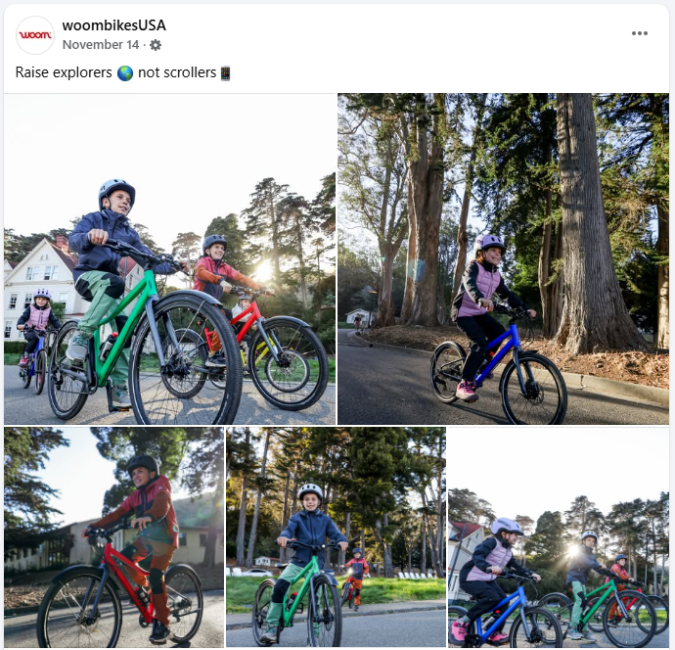
He’s never heard of woom before, but he connects with the goal in the copywriting “Raise explorers 🌎 not scrollers📱”, and the images of kids biking together brings him back to his own childhood.
He decides to visit the brand’s Facebook page and finds additional parent-focused content, eventually discovering a post that features a child much closer to his daughter’s age.
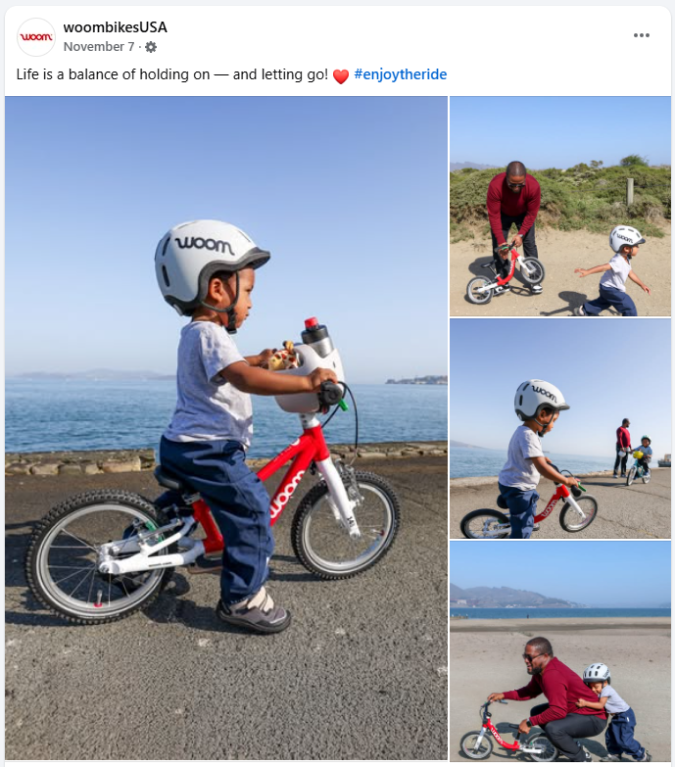
“Life is a balance of holding on — and letting go! ♥️”, says the post, showing a father having fun teaching his toddler to ride. It’s an overtly sentimental post, but in one image, the adult father sits on the bike, subtly suggesting how sturdy the bike is.
In these posts and other content on social media, woom does a great job appealing to the emotions of parents on multiple levels. Brandon follows the brand on Facebook and gets back to life.
Consideration: A few weeks later, his partner brings up the topic of bikes and Brandon can’t recall the brand’s name, but quickly finds woom’s profile on Facebook. They scroll a bit and click through to the website to learn more.
All the content aligns perfectly with the posts the parents saw on Facebook, reinforcing the brand’s key selling points with microcopy like “Lightweight for Easy Learning,” and “Built for Kids and Built to Last.”
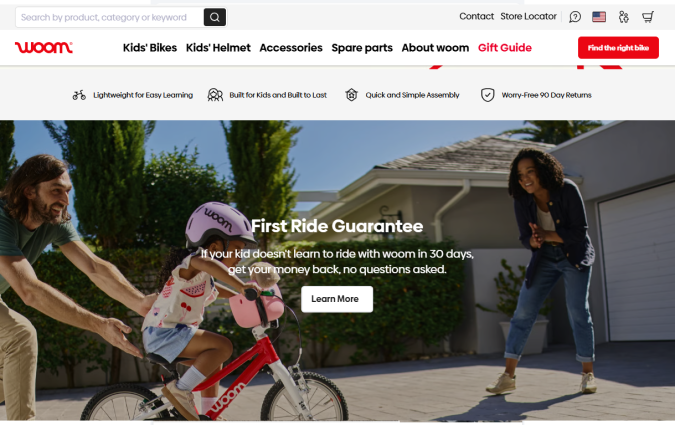
The parents gain even more confidence learning about the 30-day moneyback guarantee, and seeing an award from Wirecutter, the highly-trusted product review site owned by The New York Times. It’s no accident that woom has made these trust badges and social proof extremely prominent throughout their site.
Like many parents, Brandon has never bought a kid’s bike before. And unless his daughter falls in love with hockey or horses, it’s likely to be one of the more expensive sports equipment items that he’ll buy. He needs to know more, and woom has done a great job laying out their site so that parents can educate themselves quickly. The thoughtful website navigation, for example, uses a mega menu that breaks down product categories into age and height ranges.
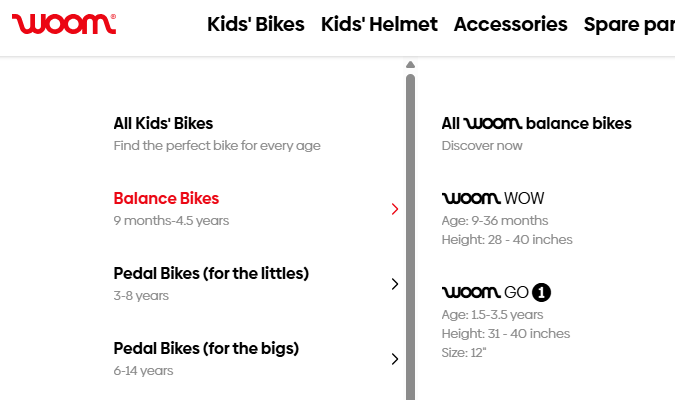
Brandon is able to find the appropriate style of bikes without knowing anything but his daughter’s age and how tall she is.
He thinks he’s found the right one, and sends a link to his partner. They want to explore a little bit more and decide to take woom’s “Bike Finder Quiz,” which helps parents select the best fit bike for their kid. It asks a few simple questions about their age, height, and how mobile they are.
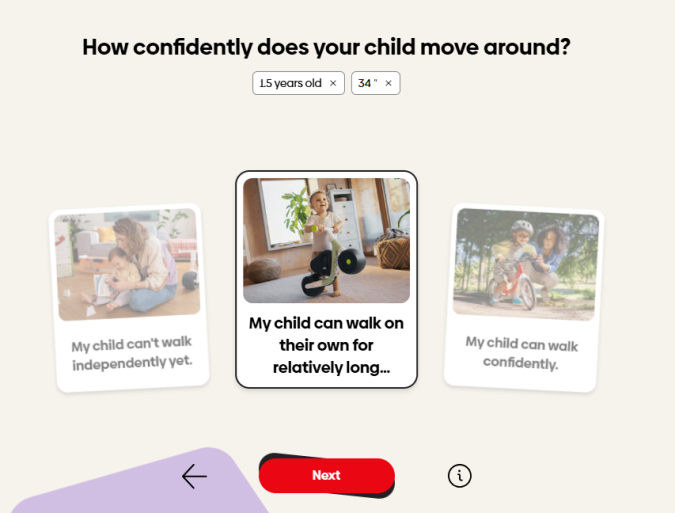
His partner really likes the quiz and feels like woom has their child’s best interests at heart. They enter their email to see the results of the quiz. This is a great lead magnet idea that only attracts potential buyers for woom. Who else would complete this quiz?
There are certainly cheaper bikes on the market, and the couple wants to feel like they’ve done their due diligence. So they don’t make a purchase this visit, but woom is definitely on their shortlist of options now.
Decision: After exploring the market for kids’ bikes over the course of a week or so, and with warm weather on the horizon, the couple decides to make their final purchase after receiving a limited time offer via email. On his phone, Brandon visits the site one last time to double-check everything.
He spends a little bit of time reading reviews from real customers. He’s sold on the bike, but he just wants to see evidence that parents like him are happy with their purchase.
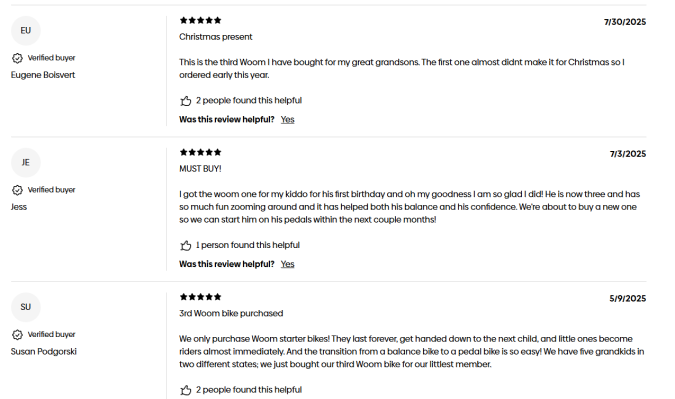
There are plenty of happy customers, some of whom have bought multiple bikes for their kids. The confidence of these parents makes Brandon feel better, as some of the reviewers acknowledged the high price tag and still felt like the value was there.
What finally pushes him and his partner over the line is the warranty and returns policy, both clearly stated in a dropdown FAQ section on the product details page.
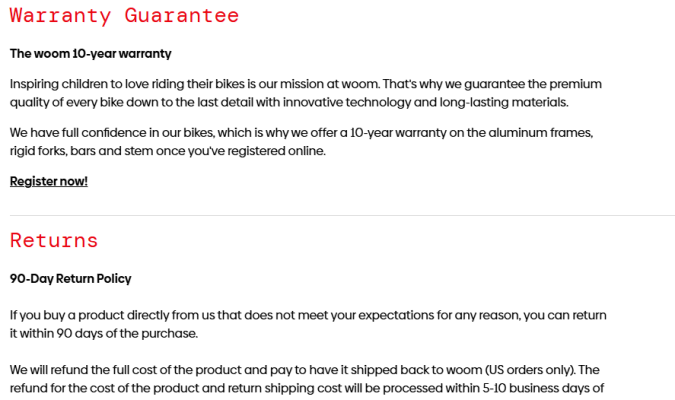
Both of these policies lower the perceived risk of making a purchase. If the bike breaks, they’re covered. If their daughter doesn’t like it, they have about 3 months to return it for a refund. In fact, woom will even pay to ship it back to their factory. This is clearly a brand that stands by their product.
Brandon and his partner feel confident that they have a lot to gain and very little risk of losing out by purchasing this bike.
Post-purchase: The couple receives tracking emails and links to support documentation about how to assemble the bike. If they lose the owner’s guide, a PDF is available on the site for download.
There are also a lot of support videos for common issues that owners face, such as replacing a flat tire.
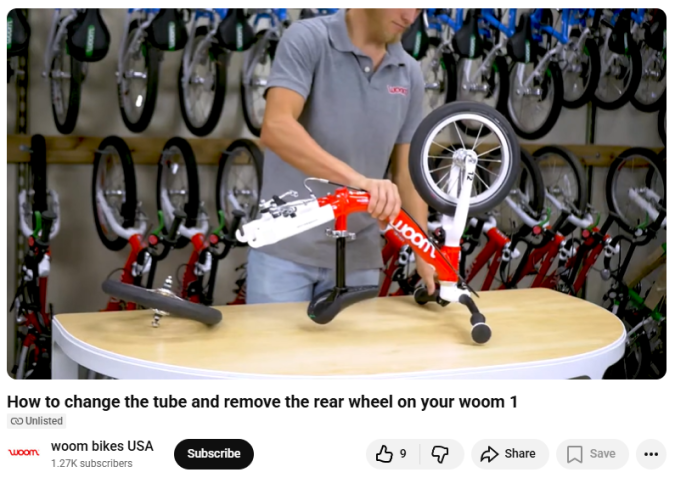
For customers who need extra assistance, woom offers virtual consultations with their tech staff.
Throughout the buyer journey, the brand has gone the extra mile to show parents that they really care about children’ s safety and making the experience of biking as positive as possible. woom has published content to answer questions and potential objections at every step.
Example B2B SaaS buyer journey
ClickUp is a project management tool designed to centralize work activities and reduce the need for teams to use dozens of apps. Let’s take a quick look at some of the content they’ve published that hits an example buyer at key points in their journey.
Example buyer: Lisa, a marketing manager who works for an AI-curious company. She’s been prompted by her managers to look into some tools that might speed up her team’s workflow or allow them to cut down on the number of tools they currently use.
Awareness stage: She knows a little bit about what’s out there, and searches around, eventually coming to an educational blog post about “How to execute marketing campaigns with AI” from ClickUp, a popular project management tool.
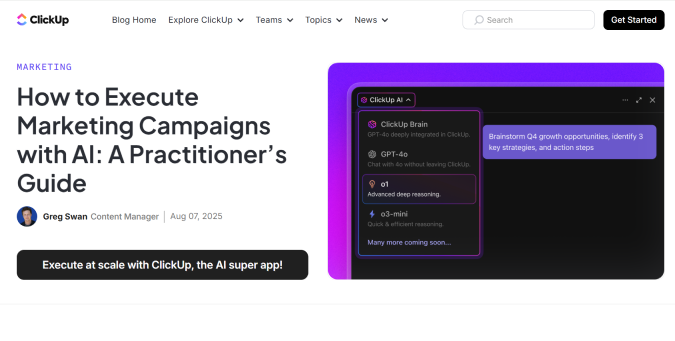
ClickUp has done a great job to even get this post on her radar. It’s full of the type of helpful content Google adores: like original, in-depth writing, tables, illustrations, videos. All of the content has been optimized for SEO, which gives the page a solid chance of getting in front of searchers like Lisa.
From Lisa’s perspective, the page is rich with information about how AI could help her launch campaigns faster. Sure, it’s all centered around ClickUp, but the copywriting speaks directly to someone in her position. Some excerpts:
- “With deadlines tightening and expectations growing, the traditional approach to marketing campaigns just isn’t cutting it.”
- “AI-driven campaign execution isn’t here to replace marketers . . . AI empowers marketing teams to focus more on creativity and the strategy side of things!”
- “Spreadsheets might be your go-to tool for campaign management, but they’re limiting your team’s potential.”
Throughout the post, the copy consistently speaks to the person reading it, their fears, goals, desires, and reservations. There is a lot of attention to ClickUp and its features, but it’s all within the context of deadlines, expectations, or the fear of AI taking someone’s job.
Consideration: Lisa adds ClickUp to a short list of tools that she wants to learn more about and keeps searching for more options. Once she’s ready to take a closer look at the tool, she returns to the site and explores their content related to marketing and automation.
There is lots to find. She’s able to watch videos that show the tools in action and see images of exactly what she’d be doing on the platform. The email AI-automation builder is especially appealing, as these campaigns are vital for her company, but extremely time-consuming.
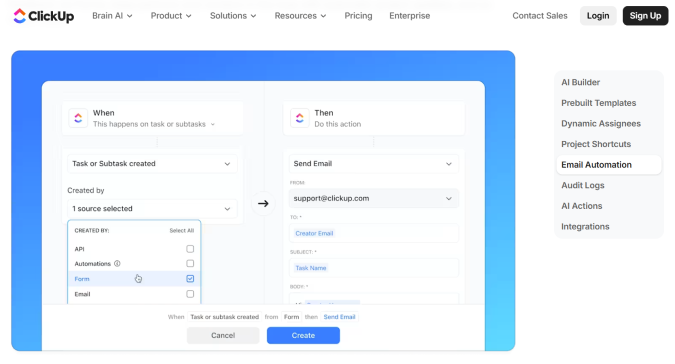
She feels pretty good about ClickUp, but with other products on her shortlist, she isn’t ready to rule them out yet. In the footer of the same page, she sees a host of comparison content that includes some of the other project management software she’s looking at.
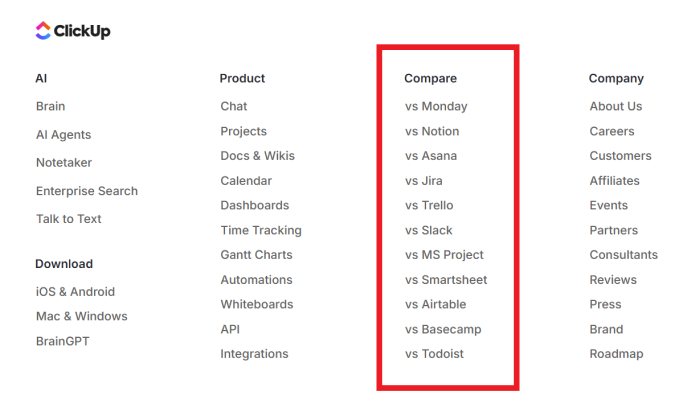
She’s quickly able to read several comparisons between ClickUp and Monday, Notion, Trello, and Smartsheet. Each one of these pages contains a clear comparison chart that frames ClickUp in the best possible terms against the rival software.
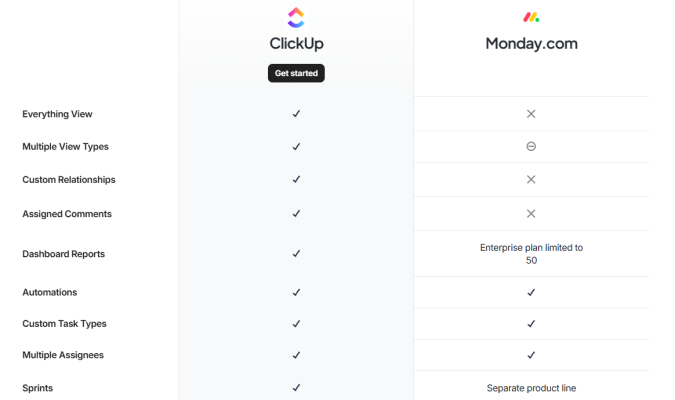
Lisa feels better and better about making the right decision with ClickUp. The comparison content speaks directly to the strengths and tradeoffs she’s been considering.
Decision: Lisa is confident that ClickUp is her #1 choice, but now she has to sell this decision to the leadership at her company. She digs into the costs to make sure she has a clear idea.
As far as SaaS pricing pages go, ClickUp is hitting all the standard features that help buyers understand what they are getting into, such as pricing tiers with clear feature checklists that show what’s included with each, a helpful FAQ section, and links to long-form customer testimonials (a key type of social proof for software).
There’s also prominently displayed trust signals, like brand logos of companies that trust ClickUp, and microcopy that reads “✔ 100% Money-back Guarantee”.
One unique feature on their pricing page is a cost comparison that shows how much a 500 person company would save by replacing popular tools with ClickUp.

It’s one thing for Lisa to pitch to her bosses that they could, in theory, cut down on the number of tools they use. But here Lisa can select from 20 popular tools, enter her company size, and automatically calculate how much they would save by switching.
Sure, it’s a back-of-the-envelope calculation, but it only takes a few seconds to completely reframe the decision to switch to ClickUp as a viable cost-savings play.
Post purchase: The digital ink has dried and now it’s time for Lisa to get her team set up. She gets an onboarding email sequence to help her with migrating from her old tools and learning the most important features for her use-case.
To help her out even more, ClickUp has published an extensive knowledge base, the ClickUp Help Center.
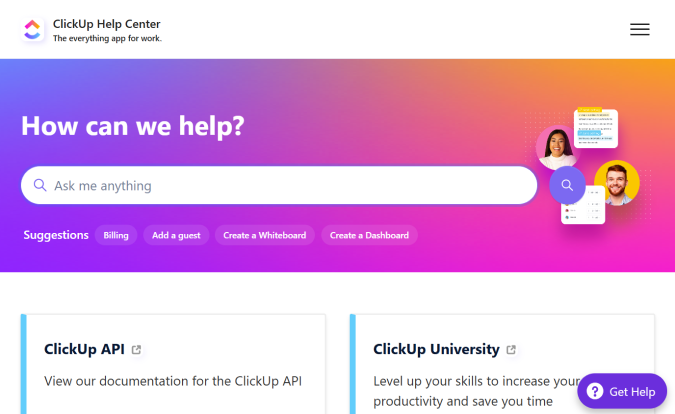
Here, Lisa can use the search bar to look for particular information or just navigate around the knowledge base to find templates, webinars, communities, and additional documentation.
This will help her get a sense of the platform, but it also makes it easy for her to link to resources when teammates ask her questions about getting started.Onboarding new users is such a critical step in the SaaS sales funnel. The nightmare situation is where buyers get tons of attention right up until the sale, and then neglected after. ClickUp has published tons of content to help their new users get the most out of the platform.