Ecommerce platforms are the backbone of online stores—you won’t get very far selling online without one.
A solid ecommerce platform is essential for anyone selling online. Brick-and-mortar businesses can open up a new revenue stream, and new businesses can use a web store to start selling their products or services ASAP.
Today, there’s a multitude of online selling solutions. Some are website builders with built-in store tools; others are full-stack commerce engines that cover everything from storefronts to payments, shipping, analytics, and more.
If you’re starting from scratch or aren’t familiar with coding, an all-in-one ecommerce site builder is your best friend. It’s the fastest way to go from nothing to a full-fledged web store.
If you already have a site you love, or you have specific needs (like selling digital products or subscriptions), consider the excellent WordPress plugins that add just the functionality you need.
Even if you’re not 100% ready to start selling, you can still set things up, generate traffic, and build hype in preparation for launch.
After testing 20 different ecommerce platforms and comparing monthly fees, transaction fees, supported business models, and plan limitations, Bluehost is our top pick for most users.
It’s a simple and affordable way to start selling online with virtually any business model, and it’s packed with the features you need to succeed.
There are other great options, too, in case Bluehost isn’t the perfect fit for your needs.
Below, we’ve included additional companies to compare that are also excellent choices for your ecommerce platform.
The Top 11 Best Ecommerce Platforms in 2026
- Bluehost – Best for automatic WooCommerce store setup
- Shopify – Best all-in-one ecommerce platform
- Wix – Best ecommerce platform for beginners
- Squarespace – Best portfolio-based ecommerce builder
- BigCommerce – Best for multichannel sales
- Shift4Shop – Best ecommerce platform for developers
- Ecwid – Best low-cost shopping cart extension for existing sites
- WooCommerce – Best ecommerce plugin for WordPress
- Easy Digital Downloads – Best WordPress plugin for digital products
- Volusion – Best ecommerce platform for large product catalogs
- Magento – Best enterprise ecommerce platform
Read on for in-depth reviews of each platform on our list.
#1 – Bluehost — The Best for Automatic WooCommerce Store Setup

Bluehost
Best for Automatic WooCommerce Store Setup
Take the guesswork and learning curve off your plate with Bluehost's dedicated WooCommerce hosting. Get a customizable site builder, included plugins, and much more, as well as Bluehost's best-in-class hosting and support.
Bluehost is one of the few hosting providers recommended on WordPress.org. The company is well-versed in all things WordPress and building websites of all shapes and sizes—including online stores.
This is one of several reasons Bluehost is our top recommendation for ecommerce sites.
It makes setting up your store simple. At checkout, Bluehost’s guided store creator can install WooCommerce along with a set of helpful extensions, so you’re ready to sell faster.

Bluehost offers a dedicated package for online stores—WooCommerce hosting. WooCommerce itself is a WordPress plugin that adds ecommerce functionality to your site; Bluehost supplies the secure, optimized hosting and helps you get the best-practice stack in place.
You can use any host for WooCommerce, but Bluehost’s WooCommerce plans streamline the process and reduce the usual setup curve.
Both plans include ecommerce-focused onboarding, 24/7 support, and a bundle of store tools that’s designed to get you selling quickly.
Even better, Bluehost doesn’t skimp on store features. Depending on the plan and selected add-ons, you’ll typically get support for unlimited products, product variations, discount codes, product reviews, and the core WooCommerce functionality most stores need to launch.
The biggest perk for newcomers is the included plugin bundle. Instead of researching and testing dozens of add-ons, you get a curated stack—often including premium extensions that would otherwise cost extra if purchased individually.
Value-wise, hosting your WooCommerce store with Bluehost is hard to beat.
On the hosting side, you’ll typically get a free SSL certificate via Let’s Encrypt, CDN features, DDoS protection, unmetered bandwidth on most plans, and a free domain for the first year.
Higher tiers can add ecommerce upgrades like subscriptions/recurring billing, bookings/appointments, and other store enhancements through bundled extensions or optional add-ons.
Bluehost’s current pricing for online stores powered by WooCommerce changes often because of promotions. Introductory rates are usually far lower than renewal rates, so check the renewal price before you commit.
If you’re new to running a WooCommerce store—or just want a trusted WordPress host with a guided store setup—head over to Bluehost and get started today.
#2 – Shopify — The Best All-in-One Ecommerce Platform

Shopify
Best All-in-One Ecommerce Platform
Supports dropshipping, in-person sales, and multi-channel sales. Plus, it comes with everything you need to start and scale, including a drag-and-drop website builder, marketing tools, shipping management solutions, and online marketplace support. Suitable for businesses of all sizes.
Shopify is loaded with the features you need to attract customers and sell online. Millions of businesses use it—so you’ll be in good company.
As an all-in-one solution, Shopify covers everything from building your website and listing products to marketing, shipping, inventory, taxes, and customer conversations—all managed from a single dashboard.
You get dozens of free and premium themes so you don’t have to start from scratch, plus built-in marketing tools to grow traffic and sales. It’s easy to customize with Shopify’s drag-and-drop editor.

Getting started takes minutes: choose a theme, tailor it to your brand, add products, and publish.
You also get 24/7 support and a deep knowledge base covering nearly any situation you’ll encounter.
Beyond your website, Shopify supports sales on marketplaces and social media, and it offers POS for in-person sales. Consolidate every channel into one account to keep operations centralized.
Shopify’s pricing includes multiple tiers for most businesses, plus an enterprise option (Shopify Plus).
There’s also a low-cost Starter option for selling through social and messaging apps without a full storefront. New users can start free and Shopify frequently runs a promo where eligible plans cost $1/month for the first three months.
#3 – Wix — Best Ecommerce Platform for Beginners

Wix
Best for Beginners
Wix is built to help turn beginners and non-technical users into web design pros with its drag-and-drop interface. Plus, it includes hundreds of ecommerce templates, an AI site builder to get you up and running in minutes, additional advanced features, and commission-free sales on every plan.
If you’ve never built a website before, Wix is an excellent beginner-friendly option. You get an intuitive drag-and-drop site builder and all the tools you need to launch and grow a store—from product variations and advanced descriptions to customizable checkout, cross-channel sales, and dropshipping integrations.
The best part: it only takes a few minutes to feel comfortable with the editor, and you can build your site free. You’ll need to upgrade to a business/ecommerce plan to accept online payments.

When you sign up, you can let Wix’s AI site builder generate a complete starter website for you in seconds—then customize content, colors, and products. It’s the fastest way to get your first store off the ground.
Prefer more control? Choose from a large library of ecommerce-ready, mobile-responsive templates and customize every section.
Despite its simplicity, Wix is flexible. You can add related product sliders, wish lists, galleries, and collections; take full design control; and extend functionality via the Wix App Market.
Security and reliability are strong points, too—24/7 monitoring, DDoS protection, modern TLS, optimized data centers, and scaling for traffic spikes.
Wix’s business/ecommerce pricing changes by region and promotions, but Core is commonly the entry point for ecommerce (often around $29/month billed annually), with Business (often around $39/month billed annually) and Business Elite (often around $159/month billed annually) for larger stores.
Wix doesn’t charge platform commissions; you only pay your payment processor’s standard rates. Take Wix for a test drive and, if you like it, follow our step-by-step guide.
#4 – Squarespace — Best Ecommerce Platform For Portfolios

Squarespace
Best Ecommerce Platform For Portfolios
Beautiful, modern designs that look premium out of the box. Ideal for artists, musicians, and photographers who want to sell directly from a portfolio.
Squarespace is a premier website builder known for stunning designs—and it’s a strong pick when your storefront needs to look as good as your work.
Its award-winning templates are perfect for artists, musicians, photographers, and other creatives who want to sell directly from a portfolio.
You can sell physical and digital products, subscriptions, gift cards, and services—and every template is modern, beautiful, and mobile-optimized.

If you’re looking for a simple way to set up a polished store, Squarespace is an excellent choice.
For very large catalogs or complex B2B needs, you may hit limits as you scale—so we mainly recommend Squarespace for creatives and smaller stores.
Squarespace offers a free trial, and ecommerce is available on Commerce plans. Commerce pricing commonly starts around $39/month billed annually for Basic Commerce, with Advanced Commerce (often around $99/month billed annually) adding more advanced selling features.
If you’re currently on a Business plan, note that Squarespace charges a transaction fee on store sales on that tier—Commerce plans are the way to go if you’re serious about selling. Try Squarespace free for 14 days.
#5 – BigCommerce — Best Ecommerce Platform For Multi-Channel Sales

BigCommerce
Best For Multi-Channel Sales
All-in-one ecommerce solution with a strong native feature set out of the box—especially for multichannel selling and scaling.
BigCommerce has been a staple for more than a decade and powers stores worldwide. Compared to many competitors, it ships with more native features out of the box.
Standout strength: multi-channel and multi-storefront selling. Connect marketplaces, social channels, and POS, and manage multiple storefronts from a single login. It also supports international selling and robust B2B capabilities.

BigCommerce is SEO-friendly, supports digital wallets, faceted search, and flexible discounting—and it doesn’t charge platform transaction fees. If you’re building from scratch, its themes and checkout are conversion-ready.
Pricing starts at $39 per month on monthly billing (Standard), with Plus and Pro at higher tiers. Plans have sales thresholds that can trigger an automatic upgrade as you grow (commonly: Standard up to $50k/year, Plus up to $180k/year, and Pro up to $400k/year in trailing 12-month online sales), so review limits before you scale.
Want more details? Check our full BigCommerce review, or try BigCommerce free for 15 days.
#6 – Shift4Shop — Best Ecommerce Platform For Developers

Shift4Shop
Best for Developers
Want an end-to-end ecommerce solution with tons of built-in features and developer tools without paying a monthly platform fee? Shift4Shop can be $0/month for U.S. merchants who use Shift4 for payment processing and meet the minimum processing requirement. You still pay standard processing fees.
Shift4Shop (formerly 3dcart) has powered merchants since 1997. It’s less mainstream because it’s geared more toward experienced users and developers.
There’s no Wix-style drag-and-drop experience here—you’ll need some technical comfort. In return, you get deep customization, strong performance, and a generous feature set.

Its standout is the End-to-End plan that can be $0/month for U.S. merchants using Shift4 for payment processing (and meeting the minimum processing requirement). You’ll still pay standard processing fees, but you can avoid a monthly platform fee—and you get a feature-rich platform built for customization.
If you need a different gateway, don’t meet the processing minimum, or you’re outside the U.S., Shift4Shop offers paid options.
Sign up to see if it fits your store.
#7 – Ecwid — Best Low-Cost Shopping Cart Extension

Ecwid
Best Low-Cost Ecommerce Extension
Shopping cart software that integrates with a wide range of CMS platforms and site builders. Great if you want to add ecommerce to an existing site without rebuilding everything.
Ecwid is a lightweight way to add ecommerce to an existing site. It’s an extension—not a full all-in-one platform—and it works with WordPress plus other site builders and CMS platforms through embeds and integrations.
It’s ideal if you want to keep your current website and bolt on a capable cart. Ecwid’s plans range from a low-cost Starter tier to higher tiers (Venture, Business, and Unlimited) that unlock more products, more channels, and more advanced selling tools like discount coupons, gift cards, and multichannel selling.
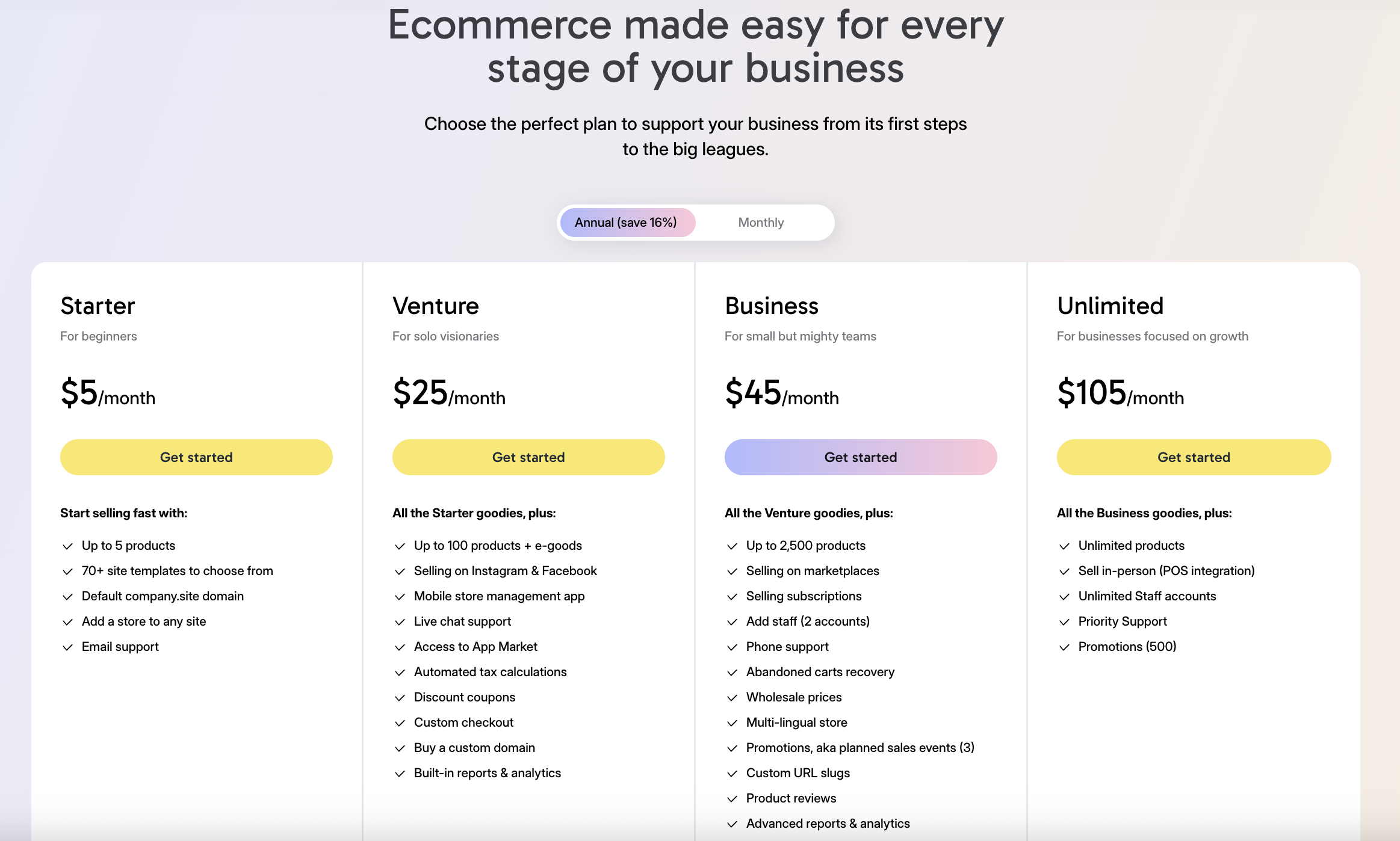
Pricing depends on billing term and region, but Unlimited is typically priced around $149/month on monthly billing (or about $119/month when paid annually). If you just need a low-cost way to add a store to your existing site, Ecwid is one of the easiest ways to do it.
#8 – WooCommerce — The Best Ecommerce Plugin For WordPress

WooCommerce
Best WordPress Plugin For Ecommerce
Add ecommerce functionality to any WordPress site. Easy to use and integrate with business tools. Free to download.
WooCommerce is a free plugin that turns any WordPress site into a store. WordPress doesn’t ship with ecommerce out of the box—that’s where WooCommerce comes in.
Install it, and you can build your catalog, manage orders, configure taxes and shipping, and customize the experience without platform constraints—all from your WordPress dashboard.

It integrates with popular tools like Yoast, Google Analytics, Stripe, PayPal, Square, Facebook/Instagram shops, Amazon FBA, and POS systems.
The plugin is free. Extensions range from free to a few hundred dollars; WooCommerce offers a 30-day money-back guarantee on extension purchases.
If you already run WordPress, installing WooCommerce is easier than migrating to a new platform. If you’re starting from scratch, an all-in-one platform may be faster to launch; otherwise, pair WooCommerce with managed WordPress hosting for a powerful, flexible stack.
#9 – Easy Digital Downloads — Best Plugin For Selling Digital Products on WordPress

Easy Digital Downloads
Best For Selling Digital Products
WordPress plugin for selling digital products online. Fully integrated shopping cart. Easy to download and install.
Easy Digital Downloads (EDD) is built specifically for selling digital goods—ebooks, software, audio, licenses, and more.
Manage access to files, restrict downloads to paying customers, issue discount codes, and get detailed sales reporting—all with a fully integrated cart.

EDD is free to install, and premium passes add advanced features. Pricing is typically structured like this:
- Personal — typically around $99.50 per year
- Extended — typically around $199.50 per year
- Professional — typically around $299.50 per year
- All Access — typically around $499.50 per year
EDD integrates with tools like Stripe, PayPal, email marketing services, automation tools, and storage/CDN options via add-ons. If your business is primarily digital products, EDD is one of the cleanest ways to sell on WordPress without forcing a “physical product store” workflow on everything.
#10 – Volusion — Best Ecommerce Platform For Extensive Product Lists

Volusion
Best For Selling Lots of Products
Hosted ecommerce platform with plans built for growing catalogs. Pricing starts around $35/month, with higher tiers for larger stores.
Volusion is a hosted ecommerce platform designed for businesses that want an all-in-one way to run an online store, especially when you have a lot of products to manage.
Like most all-in-one tools, it includes store building, product management, order management, and integrations for payments and marketing—so you can sell from scratch without piecing together a stack.
Plans typically start around $35 per month, with higher tiers for larger stores and more advanced needs.

The main drawback is customer support, which has been inconsistent over the years—something to consider if you anticipate frequent help needs. You can usually try it free for a limited period (when offered), but double-check current trial terms before you sign up.
#11 – Magento — The Best Enterprise Ecommerce Platform

Magento
Best Ecommerce Platform For Enterprises
Industry-specific ecommerce solutions. Designed for enterprises and B2B organizations. Ability to build a PWA (progressive web app).
Magento, now branded as Adobe Commerce for paid editions, is a powerful platform trusted by global brands and B2B sellers.
Adobe offers industry-specific solutions across fashion, automotive, health and beauty, food and beverage, and more. Pricing is quote-based and typically runs into the tens of thousands of dollars per year, making it best for mid-market and enterprise organizations.

If you’re a small business or bootstrapping a new store, Adobe Commerce is overkill. Larger teams, however, will appreciate its enterprise-grade features and back-end flexibility. There’s also Magento Open Source (free) for companies with in-house developers.
Adobe’s PWA Studio helps you build progressive web apps for fast, mobile-optimized storefronts alongside your main site.
Contact Adobe to request a customized demo.
Methodology For Choosing The Best Ecommerce Platform
With so many ecommerce solutions to choose from, how can you tell which one is right for you?
Here at Crazy Egg, we use a consistent methodology when recommending tools. Use the factors below to make the best decision for your specific situation.
Platform Type
Ecommerce platforms come in several flavors:
- All-in-one solutions – best for anyone starting from scratch
- Website builders – best if you already use (or prefer) a builder
- Plugins and extensions – best for self-hosted sites
All-in-one platforms bundle a shopping cart, payment methods, product listings, hosting, order management, shipping tools, and more.
If you already have a website on Wix or Squarespace, you’re usually better off upgrading to that builder’s ecommerce plan instead of migrating.
If you run a self-hosted website (like WordPress.org or Joomla), plugins/extensions are the most flexible path.
Your Business Model
Clarify what you sell and how you fulfill it:
- Are you selling digital products, physical products, or services?
- Do you have at least one brick-and-mortar location?
- Are you planning on dropshipping?
Physical products require fulfillment and shipping. Digital goods need seamless delivery and secure file storage. Services may require scheduling and pre-payment communication.
If you have a storefront, pick a platform that syncs inventory and orders across online and POS sales.
If you plan to dropship, verify native support or integrations with your dropshipping software.
Transaction Fees
Payments involve card networks, gateways, and processors. Some platforms offer their own processor; others require a third-party like Stripe or PayPal.
Shopify, for example, has Shopify Payments (typical online card rates vary by plan; roughly ~2.4%–2.9% + $0.30 in the U.S.). If you use an external gateway, Shopify adds an extra 0.5%–2% platform fee depending on plan.
Each platform handles fees differently. Confirm card rates, platform fees, and POS rates before you commit.
Plan Limitations
Most providers have tiered limits—catalog size, annual online sales, staff accounts, or which features are unlocked.
BigCommerce, for example, allows unlimited products but caps online sales per plan (e.g., $50k/year on Standard). Wix can limit certain advanced ecommerce and automation features on lower tiers. Squarespace’s Business plan carries transaction fees, while Commerce plans remove them. Ecwid limits product counts and features by tier.
Understand where you’ll hit the ceiling—and the cost of upgrading—so you’re not surprised mid-growth.
Security, Performance, and Compliance
Look for PCI-compliant checkouts, SSL included, DDoS protection, backups, CDN, and reliable uptime. If you sell internationally, confirm VAT/GST support and multi-currency. Speed and mobile performance directly impact conversion rates.
Ecosystem and Scalability
Review native features vs. apps/extensions, developer community size, and availability of experienced implementers. Make sure the platform supports your roadmap—subscriptions, B2B, headless, or multi-storefront—without forcing a replatform.
Ecommerce Platforms and Software FAQ
What is the best ecommerce platform?
Bluehost is the best starting point for most online stores using WordPress and WooCommerce. Its guided store creation makes it easier to launch quickly, and hosting-level performance and security are handled for you. Get started today.
What is the best free ecommerce platform?
WooCommerce is the best free option for WordPress sites—the core plugin is free and adds carts, catalogs, and payments (you’ll still pay for hosting and payment processing). For a hosted option, Shift4Shop can be $0/month for U.S. merchants using Shift4 for payment processing and meeting the minimum processing requirement (you still pay standard processing fees).
What is the cheapest ecommerce platform?
For a full WordPress store, Bluehost with WooCommerce often runs on heavily discounted introductory pricing, with renewals higher depending on term and plan. If you just need to add a tiny store to an existing site, Ecwid’s Starter plan is very low-cost but limits products and features. Always compare intro vs. renewal pricing and the limits of each plan.
What is the best ecommerce platform for beginners?
Wix is the easiest path for beginners—design and launch in minutes with no coding, lots of templates, and a straightforward editor. It’s perfect for small catalogs and fast setup.
For small inventories and simple operations, Wix is hard to beat for speed to launch—try it free to see if it fits.
How much do ecommerce platforms cost?
Entry-level plans typically cost $20–$40/month and include the basics to start selling. Advanced plans range from $80 to $400+ per month for larger catalogs, advanced reporting, custom checkout, and B2B features. Enterprise platforms like Adobe Commerce are quote-based and can run into the tens of thousands per year.
Summary
The first step to selling anything online is choosing the right platform. For most users, we highly recommend Bluehost or Shopify. They’re easy to use, affordable, and suitable for businesses of all sizes.
That said, no single platform fits everyone.
Use our methodology to evaluate your business model, fees, limits, and growth plans so you can pick the best ecommerce platform for you.