Not sure which tool to choose for split testing? AB Tasty is ideal for teams that want quick, flexible experimentation with robust personalization features baked in. Optimizely is best for enterprise teams that need a platform dedicated to optimizing the entire digital experience.
Let’s break down how each one compares.
AB Tasty vs. Optimizely: A Quick Snapshot
No time to read the whole piece? Here’s a table to fast-track your comparison.
| Feature | AB Tasty | Optimizely |
|---|---|---|
| Experimentation & A/B Testing | ✅ Fast, accessible testing with easy-to-use visual editor ✅ Client-side and server-side experimentation ✅ Built for quick testing and refining ⚠️ Less depth, which can be a minus for highly complex systems | ✅ Advanced experimentation (web, feature, and backend) ✅ Multi-armed bandits and deep segmentation ✅ Built for large-scale, system-wide testing ⚠️ More complex to set up and run—a minus for teams that need something quick and easy |
| Personalization & Targeting | ✅ Personalization is tightly woven into experiments ✅ AI-driven targeting with EmotionsAI ✅ Delivers tailored experiences in real time ⚠️ AI is less helpful for analysis and insights | ✅ Personalization across content, product, and experiments ✅ Reusable audience segments across different systems ✅ Strong for multi-channel strategies ⚠️ Best when using the full Optimizely ecosystem |
| Feature Management & Experimentation | ⚠️ Feature flags exist, but mostly to support experiments ✅ Easy to test and release features together ✅ Strong for cross-team workflows (product and marketing) ❌ Not a full product release system | ✅ Feature flags are core to the platform ✅ Backend experimentation + controlled rollouts ✅ Built for managing product releases at scale ⚠️ Requires engineering involvement |
| AI Features | ✅ EmotionsAI for understanding user intent ✅ Improves targeting + experiment quality ⚠️ Limited AI summaries and automation ⚠️ Less hands-on AI during crucial analysis | ✅ Opal AI assistant helps across the whole platform ✅ Summarizes results + suggests next steps ✅ Generates ideas, variations, and insights |
| Implementation & Team Requirements | ✅ Visual editor reduces engineering needs ✅ Marketers and growth teams can run tests ✅ Flexible setup ⚠️ Still requires devs for advanced use cases | ⚠️ Requires SDKs, event tracking, and dev support ✅ Strong control over backend and feature releases ✅ Built for product and engineering teams ⚠️ Higher overhead costs for setup and coordination |
Feature Breakdown: AB Tasty vs. Optimizely
1. Experimentation and A/B Testing
AB Tasty
AB Tasty is built around making experimentation both more powerful and more accessible than it is on other testing platforms. For the most part, it does succeed in this.
It offers both client-side A/B testing—with support from a visual editor—and server-side experimentation and feature testing. This gives teams the opportunity to test everything from client-facing user interface (UI) tweaks to backend logic.
One of the biggest strengths here is how AB Tasty reduces user friction when it comes to launching tests. Just the thought of getting an A/B test up and running can feel overwhelming for teams in a time crunch.
But with AB Tasty, teams can get up and running with just a few clicks. Everything—including defining your audiences, creating variations of copy or images, and tracking test performance—can be done without heavy involvement from your engineering team.
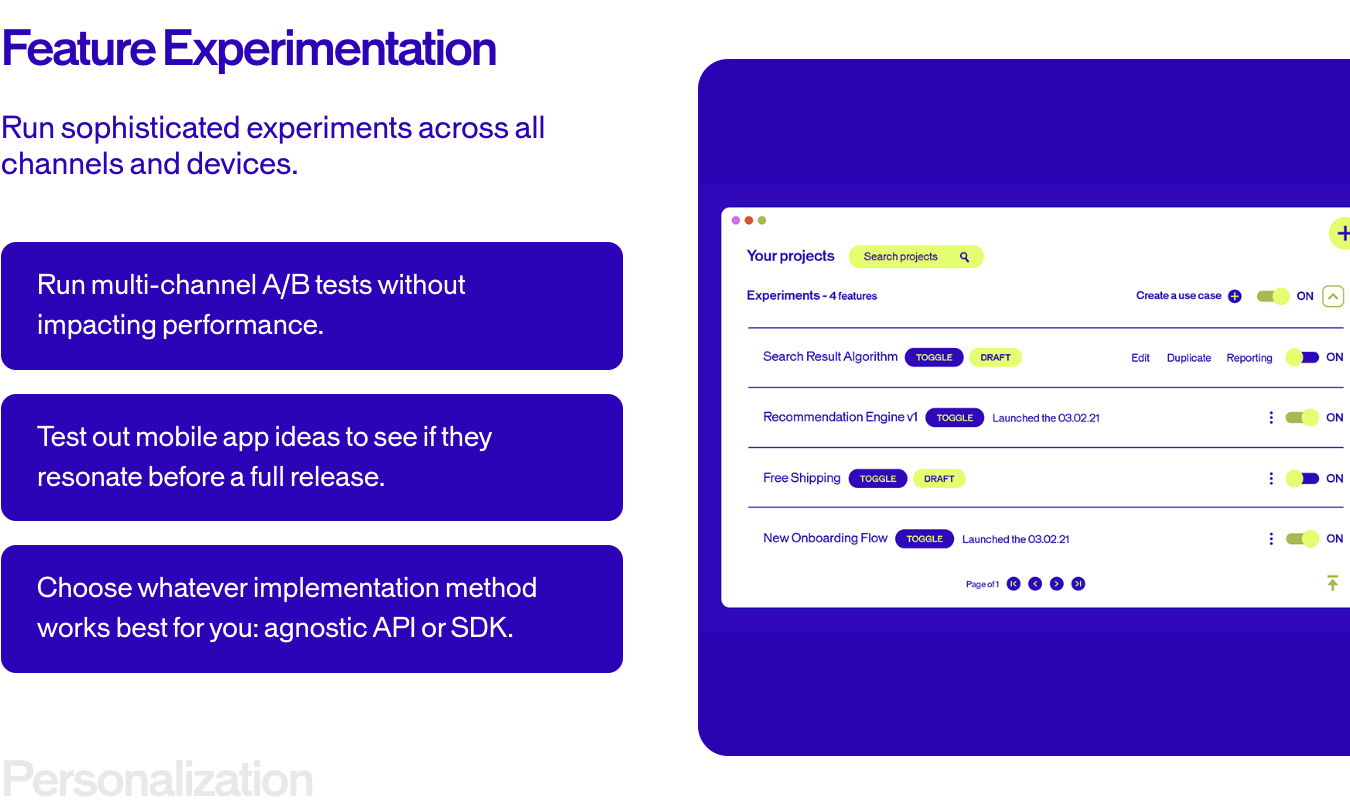
It also includes features like sequential testing alerts, which automatically flag your most underperforming variations and stops them from continuing. This helps you save time and money on the experiences that are actually giving you helpful information.
Overall, with AB Tasty, you get speedy, usable, and cross-functional experimentation for both websites and apps.
Optimizely
Optimizely approaches its experimentation features from a more enterprise, system-wide perspective than AB Tasty does.
Optimizely’s experimentation suite supports web experiments, feature experiments, and multi-armed bandit testing. The key difference between AB Tasty and Optimizely is that all of Optimizely’s testing tools are also tied into its broader digital experience platform. This platform includes a full content marketing system, content management system, and full analytics, for instance.
If you want a one-stop shop for digital enterprise content management—which includes but isn’t centered on testing—you’ve got it with Optimizely.
Plus, Optimizely prioritizes depth, scalability, and giving teams the ability to run complex experiments across both front- and back-end systems. Your team can segment audiences with the precision of a neurosurgeon and measure your results across every touchpoint your users interact with.
The tradeoff, of course, is that Optimizely is more complex than AB Tasty and is, therefore, harder to get up and running. If you have an engineering team, this won’t be a problem.
2. Personalization and Targeting
AB Tasty
Personalization is a core part of AB Tasty’s features. Instead of treating personalization as a separate tool, AB Tasty gives teams the ability to thread personalization through every aspect of experimentation.
For instance, as with many split testing tools, you can segment your users based on characteristics like behavior, purchase history, or traffic source. But then—and this goes beyond what other experimentation tools do—AB Tasty’s AI will customize the test to deliver a personalized experience in real time.
And this customization scales, too. AB Tasty uses AI and predictive modeling to apply this level of personalization across all your segments, which means everyone who lands on your site or product during a test gets a customized experience.
So basically, A/B testing identifies what’s working on your site or app, and AI-powered personalization makes sure every variation goes to the right audience.
Optimizely
Optimizely also offers personalization, but the platform applies this concept to every feature, not just experimentation. Teams also get personalization in Optimizely’s content management system.
Here’s what I mean. You can use audience segments (like returning users, location, or behavior) to show users different versions of a page, app, or content experience.
From there, these same segments and variations can be applied to your experiments, so you can measure how each personalized experience actually performs. No guesswork is required here. You get to directly test and validate every level of personalization across your whole product and all its interfaces.
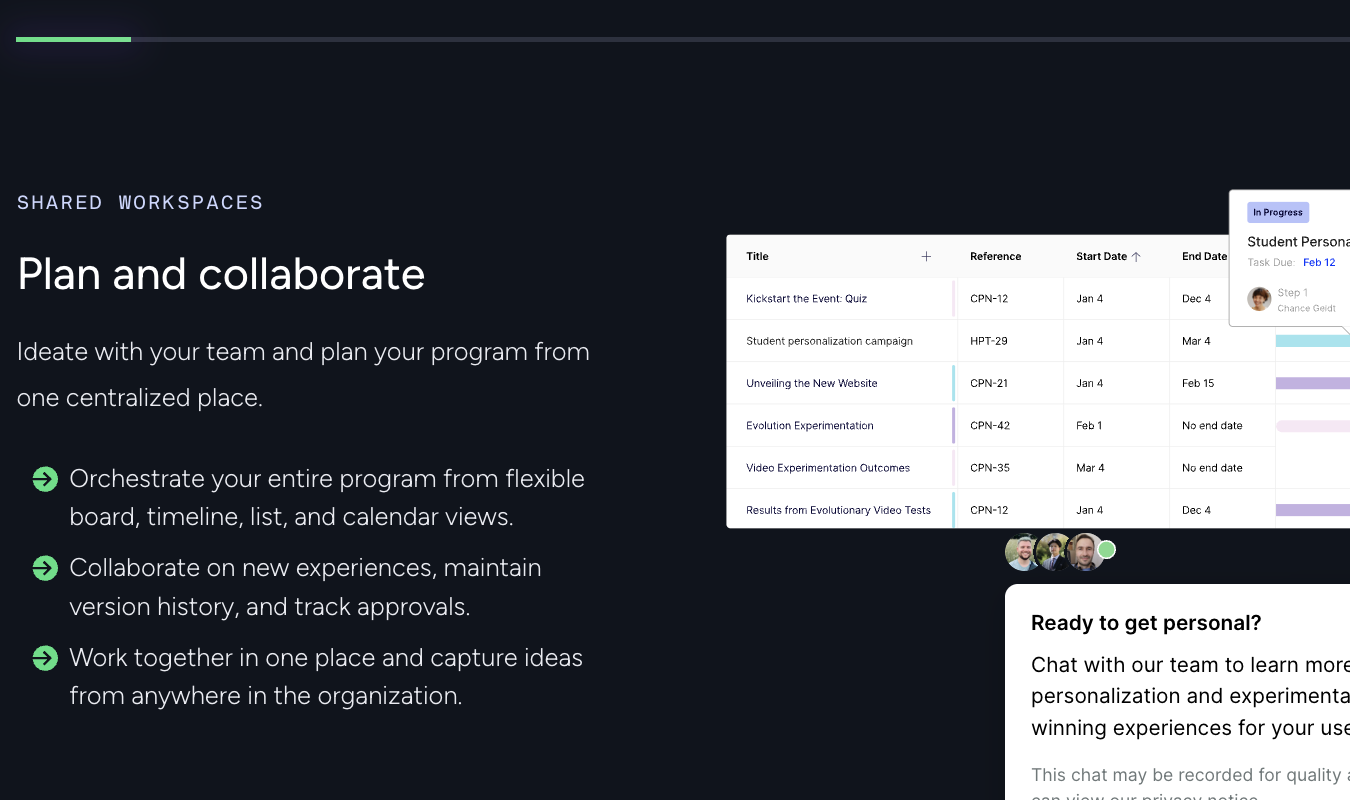
This intricate layering means Optimizely is hands-down more powerful than AB Tasty for large organizations that constantly run coordinated experiments and content strategies.
But it also means that you get the most value when you’re using all of those Optimizely features, not just experimentation. Otherwise, some of its impressive flexibility goes unused, and its personalization falls a little flat.
3. Feature Management and Experimentation
AB Tasty
AB Tasty includes both feature flagging and rollout capabilities as part of its experimentation platform, but they’re not treated as a standalone system. Instead, feature management is woven into AB Tasty’s experimentation workflow.
This means teams can gradually release a feature, test different variations of it, and then automatically roll their changes back if performance isn’t up to snuff.
In this way, AB Tasty closely connects product experimentation to marketing experimentation, which I do love. It allows teams to move easily between testing features and releasing them.
For example, a product team might want to test a new variation of a feature. Meanwhile, the marketing team might need to test how they’ll present that feature to users.
With AB Tasty, they can do both, at once, on the same platform. But feature flags here support experiments. They don’t drive product releases the way they do in more product-focused platforms—like Optimizely.
Optimizely
Feature experimentation is one of Optimizely’s strongest and most distinguishing capabilities. Unlike AB Tasty, Optimizely treats feature management as a core product development system. Its feature flagging tools let teams:
- Control releases in minute detail
- Run experiments on the backend/server side
- Gradually roll features out to specific segments of users
This gives teams a lot more control over when and how features are released. Instead of pushing changes live all at once, teams can release features incrementally, monitor how they perform, and expand them (or roll them back) based on real user data.
This shifts experimentation from something you run as you prep for a new release to something that happens during the release process itself.
And that’s how AB Tasty differs the most from Optimizely. Where AB Tasty uses feature flags to support experiments, Optimizely uses them to manage how products are built and published. Experimentation is part of the release process, not a separate step leading up to the big day.
4. AI Features
AB Tasty
AB Tasty’s AI capabilities are centered around one core product: EmotionsAI. Instead of helping you automate tasks or generate insights from your experiments, EmotionsAI is there to help your team understand why users act the way they do.
It does this by analyzing your users’ behavior patterns and sorting them into different emotional needs categories. They might be categorized as needing comfort, or urgency, or reassurance, which you can then tailor your services to provide.
A user that needs reassurance might see more messaging that’s focused on guarantees or trust signals, for instance. A more impulse-driven customer might get more urgency-based offers.
Instead of just trying to help you automate everything, AB Tasty really focuses on helping you improve the quality and depth of your experiments by giving you better inputs.
While AB Tasty does also have limited AI insights, AI-powered analysis and recommendations, and AI-assisted experiment set up, these aren’t as heavily marketed by the brand.
Optimizely
Optimizely’s AI is a lot more visible and hands-on across its entire platform than AB Tasty’s. Instead of focusing on one specific capability the way AB Tasty does, Optimizely uses its AI assistant, Opal, to help speed up your job at every stage of experimentation.
Opal can summarize the results of your experiments, explain changes between different variations, and suggest your next steps, based on the performance of each experiment.
After you run a test, you don’t have to manually interpret any of your charts and metrics. Optimizely’s AI can generate a plain-language summary of everything that happened, spot the biggest differences between variations, and point out which segments rescinded the best (or worst).
Opal can also help you earlier in the process and help you generate test ideas, draft different variations, or answer questions about your data.
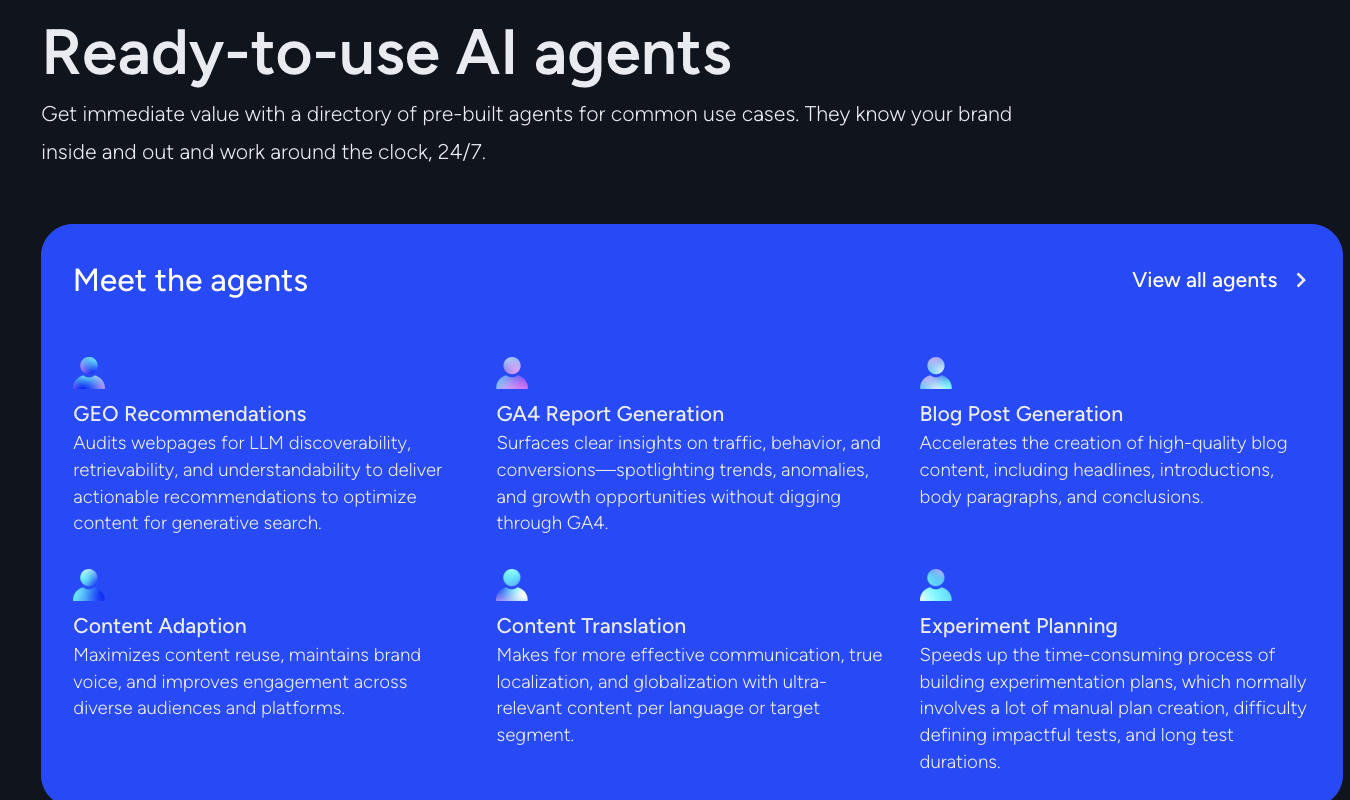
Honestly, for experimentation, I think I prefer Optimizely’s AI all-around prowess to AB Tasty’s. But other teams might want more of a tunneling in on predicting users’ emotional needs, and in that case, AB Tasty’s AI might be more attractive.
5. Implementation and Team Requirements
AB Tasty
AB Tasty is designed to reduce the amount of engineering required to launch your team’s experiments, especially on the front end. Its web experimentation feature includes a visual editor, for instance, that makes it easy to create and modify variations directly on the page without writing any code.
Because of this, AB Tasty is ideal for marketers and growth teams that want to do the work of building variations, defining audiences, and launching tests themselves, no developers needed.
Of course, if you want to do server-side experimentation with developers, you can. AB Tasty does support this.
(Need more alternatives to AB Tasty? Here are our top four AB Tasty alternatives to check out.)
Optimizely
Optimizely’s implementation is more technical, and that’s by design. Especially when you’re using its feature experimentation capabilities. Its platform relies on software development kits (SDKs) and feature flags, which require teams to integrate Optimizely into their codebase and define events before running experiments.
This lets teams run more comprehensive, deep-level experiments on backend functionality, tightly manage feature rollouts, and control which users see which features.
Optimizely’s experimentation is also part of a broader digital experience platform (DXP), which includes tools for everything from content management to behavior analytics.
Because of this, implementation is about more than just launching tests and analyzing the results. It’s also about integrating those tests into the broader Optimizely ecosystem. Your team gets more control and applicability, but it comes with a heavier technical burden.
(See our top Optimizely alternatives for even more choices.)
Pricing Breakdown: Which Has the Best Value?
How do AB Tasty and Optimizely compare when it comes to pricing? Here’s what you need to know.
| AB Tasty | Optimizely |
|---|---|
| No free plan. Pricing is custom and quote-based, depending on traffic, features, and usage. | No free plan. Pricing is fully custom and enterprise-focused, with no public tiers. |
| Typically sold as a bundled platform (experimentation + personalization + feature experimentation). | Pricing depends on which products you use (Web Experimentation, Feature Experimentation, CMS, etc.). |
| Requires going through sales to get pricing—no self-serve option. | Also requires sales conversations and contracts—no self-serve setup. |
| Designed for teams running experimentation across marketing and product, without needing heavy infrastructure. | Designed for larger organizations building a full experimentation and digital experience stack. |
| Best value for: teams that want a unified experimentation + personalization platform without stitching together multiple tools. | Best value for: enterprise teams that need deep experimentation, feature flagging, and platform-level control. |
Final Verdict: Is AB Tasty or Optimizely Right for You?
After exploring what each tool offers, here’s my takeaway:
- Go with AB Tasty if you want a flexible experimentation platform that your marketing team can start using pretty much right away, no developer team input required.
- Choose Optimizely if you need a more in-depth system for managing experimentation, especially if feature flags, backend testing, and controlled rollouts are crucial to your team’s success.
And if you want a behavior analytics tool that offers the best of both worlds with both experimentation capabilities and analytics tools like session recordings, heatmaps, surveys, and A/B testing, you can get them all together in Crazy Egg.
You can get started within minutes using Crazy Egg’s suite of free products—including surveys, instant heatmaps, web analytics—paid plans start at $29 a month. Learn more about how Crazy Egg can support experimentation, or sign up for free today.