


Just like a website, emails need hosting too. Many web hosting plans include email hosting, but that’s not always the case. And sometimes, you don’t need a full hosting package at all—you just need a reliable place to run professional email on your own domain.
Great question. Our research team spent two weeks researching and testing the best email hosting providers and narrowed hundreds of options down to our top picks.
But before we get to our top picks, do you really need email hosting?
When It Makes Sense to Invest Into Email Hosting
Email hosting providers make every effort to simplify the process of purchasing their services. But that doesn’t mean you have to buy email hosting. Below we’ve discussed three circumstances when it genuinely makes sense to invest in email hosting.
Situation 1: When You Want to Standardize Your Business Emails
You likely have more than one email address for the whole of your business—customer support emails, informational emails, and individual staff emails.
Email hosting helps match all these emails with your website domain, standardizing how all emails within your business look. In turn, this makes your business appear more professional and establishes brand consistency.
Moreover, you can create different emails for different departments within your business to organize and structure all communications. Having separate email IDs for different departments and purposes will help you keep track of every message—even if you’re the only one responding to them.
Situation 2: When You Want Better Deliverability, Control, and Credibility
Email marketing can be an invaluable (and highly profitable) marketing channel—provided your emails end up in your subscriber’s inbox.
Using a free address like Gmail or Yahoo for business outreach doesn’t automatically send you to spam, but it can make your brand look less established and gives you less control over authentication and admin settings. That matters when you’re trying to build trust and maintain consistent deliverability.
With business email hosting, you can send from your own domain and set up the records and protections that help legitimate mail land where it should. That gives your messages a more professional appearance and gives your team more control over how email is managed.
Situation 3: When You Want Greater Security for Your Sensitive Data
With data breaches increasing in recent years, email security is understandably a top priority—especially for businesses dealing with sensitive and confidential data.
Permitting employees to use free, personal email accounts presents a serious risk to your business’s data. You have less administrative control over privacy settings, access management, retention, and account recovery.
Luckily, the best email hosting providers give you stronger controls, encryption options, spam filtering, and security tools for your business, helping prevent unauthorized access and reducing the odds of important messages slipping through the cracks.
The Best Email Hosting Options to Consider
#1 — Hostinger — The Best for Most
Hostinger holds the top spot on our list of the best web hosting services, so it should come as no surprise to learn that it’s also one of our favorite email hosting providers. If you want a simple and affordable way to get a professional email address that matches your website domain, Hostinger is hard to beat.
Beyond the ability to add professionalism to your brand with a domain-specific email address, Hostinger’s email hosting includes essentials like aliases, forwarding rules, an integrated calendar and contacts, and built-in spam and virus protection. It also supports features like templates, follow-up reminders, and read receipts on eligible plans.

Pricing
Hostinger’s email hosting is still one of the more affordable options in this category.
- Business Starter — Promotional pricing can drop as low as $0.35 per mailbox per month on a 48-month term, renewing at $1.59 per month (10 GB storage, 10 aliases, 1,000 emails/day).
- Business Premium — Promotional pricing can start around $1.95 per mailbox per month on a 48-month term, renewing at $3.99 per month (50 GB storage, up to 30 aliases, 3,000 emails/day).
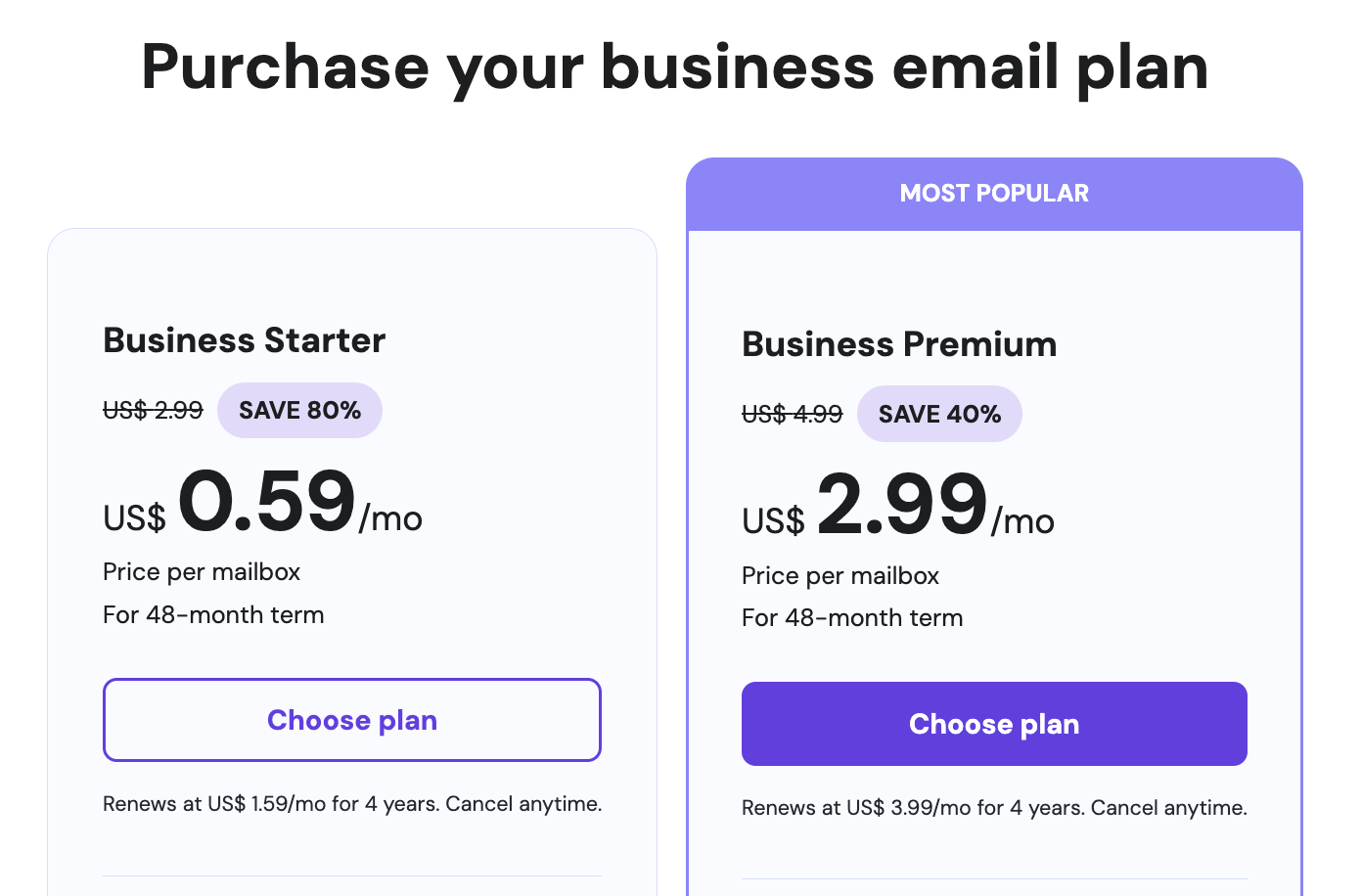
The biggest difference between the two plans is storage and the number of extras you get. Business Premium adds more room, more aliases, and access to more advanced mailbox features.
Note: These are promotional prices and can change depending on the term length and offer available when you sign up.
#2 — Google Workspace — The Best for Cloud-Based Collaboration and Communication
Formerly known as G Suite, Google Workspace combines business Gmail with Google Docs, Sheets, Slides, Meet, Calendar, Drive, and Chat. It’s a full cloud-based collaboration stack, not just an email host, which is exactly why it’s such a strong fit for teams that work together constantly.
You can create, edit, share, and store files in the cloud while managing your business email from the same ecosystem. For many businesses, the biggest selling point isn’t email alone—it’s how naturally everything ties together.
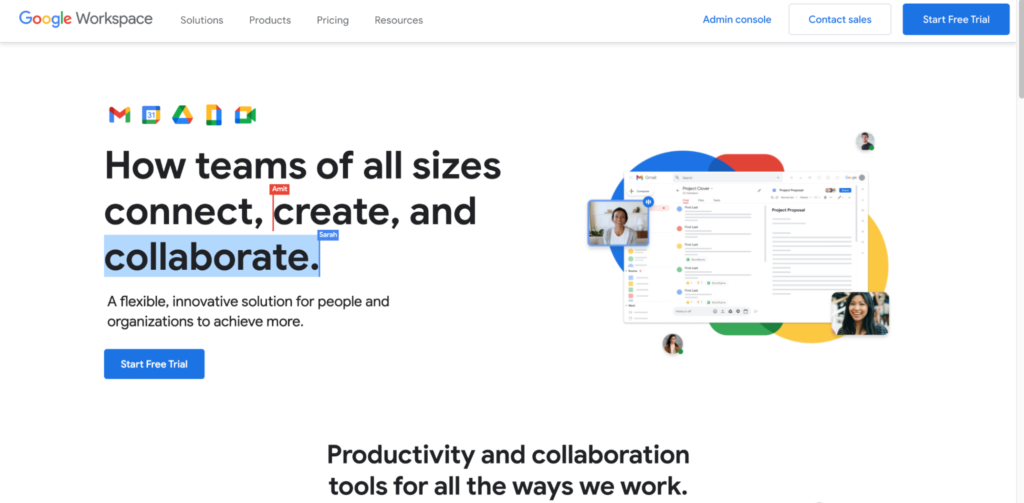
There’s also a full set of communication and admin tools, including Google Chat, Google Meet, shared drives, security controls, endpoint management, and admin controls for user access and devices. Google Workspace is backed by a 99.9% uptime SLA as well.
Pricing
Google Workspace is one of the pricier options on our list, but it offers a lot more than email hosting alone.
- Business Starter — $7 per user per month on an annual plan, or $8.40 per user per month when billed monthly (30 GB pooled storage per user).
- Business Standard — $14 per user per month on an annual plan, or $16.80 per user per month when billed monthly (2 TB pooled storage per user).
- Business Plus — $22 per user per month on an annual plan, or $26.40 per user per month when billed monthly (5 TB pooled storage per user).
There’s an Enterprise tier too if you need advanced compliance, security, or support. Google also offers a free trial for new customers.
#3 — Microsoft 365 — The Best for Microsoft Users
Microsoft 365 is an easy pick for businesses already living inside Word, Excel, Outlook, PowerPoint, Teams, and OneDrive. It gives you business-class email through Exchange plus the rest of Microsoft’s productivity stack in one subscription.
You can use custom domain email addresses, manage users centrally, collaborate in desktop and web apps, and keep everything synced across devices. It’s especially appealing if your team already knows the Microsoft ecosystem and doesn’t want to retrain around a new toolset.
Microsoft 365’s business plans include Exchange email, Teams, OneDrive storage, and business management features, with higher tiers adding desktop apps and stronger security controls. Lower tiers are web-first, while the more robust plans unlock the full desktop experience.
Pricing
For business email hosting, these are the Microsoft 365 plans that matter most:
- Microsoft 365 Business Basic — $6.00 per user per month, paid yearly
- Microsoft 365 Business Standard — $12.50 per user per month, paid yearly
- Microsoft 365 Business Premium — $22.00 per user per month, paid yearly
- Microsoft 365 Apps for Business — $8.25 per user per month, paid yearly, but this one does not include hosted business email
Microsoft also offers monthly billing at higher per-user rates, plus free trials on select business plans.
#4 — Zoho Mail — The Best Free Email Hosting
Zoho Mail may not get talked about as much as Google or Microsoft, but it remains one of the best value plays in business email. It’s clean, affordable, ad-free, and easy to pair with the rest of Zoho’s productivity ecosystem.
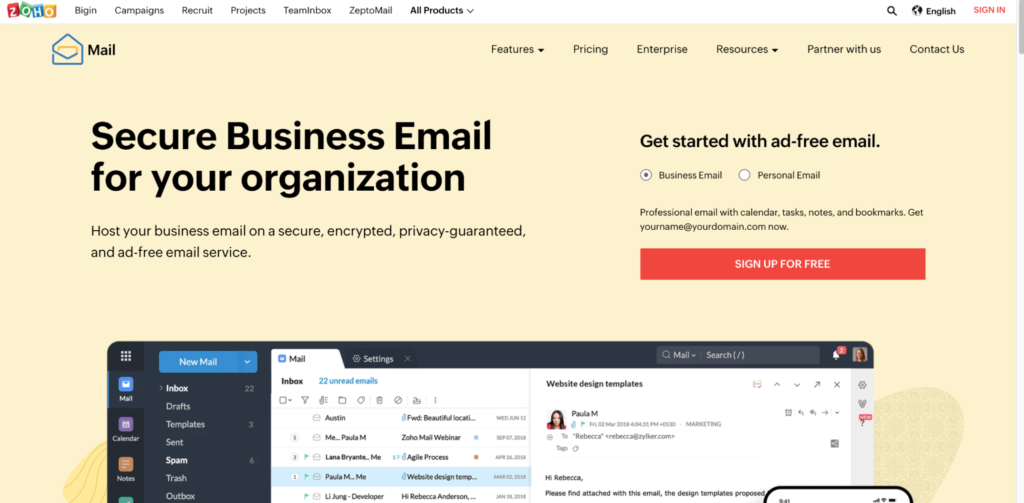
But the main reason Zoho Mail made our list is its free plan. It supports one domain for up to five users, includes 5 GB of storage per user, and is a strong option for freelancers and tiny teams that want branded email without paying on day one. The catch is that the free plan is available only in select data centers and does not include IMAP, POP, or ActiveSync.
Paid plans unlock more storage and more business-friendly features, including mobile sync, archiving, eDiscovery, S/MIME, and stronger admin controls depending on the tier.
Pricing
Zoho Mail is still one of the cheapest business email hosts you can buy.
If you only want Zoho Mail:
- Mail Lite — starts around $1 per user per month
- Mail Premium — starts around $4 per user per month
If you want Zoho Mail bundled with Zoho Workplace tools:
- Workplace Standard — starts around $3 per user per month
- Workplace Professional — starts around $6 per user per month
Zoho also lets organizations mix and match paid plans on annual subscriptions, which can help keep costs down as teams grow.
#5 — IceWarp — The Best for Creating Email Accounts for Clients
If you create and manage email accounts on behalf of clients, IceWarp is still worth a serious look. It’s built around hosted email with custom domains, plus shared calendars, chat, storage, document collaboration, and white-label-friendly options that make it appealing for agencies, IT providers, and resellers.
The company no longer presents its cloud pricing the same way it did a few years ago, but the core appeal remains the same: it’s flexible, collaboration-friendly, and well suited to teams managing multiple client environments.
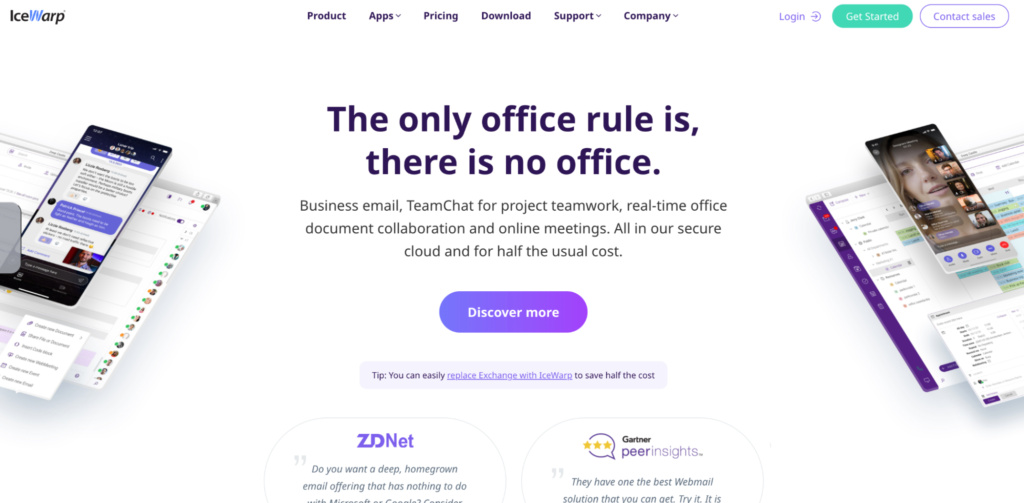
IceWarp also offers its own suite of collaboration tools. You get access to document, spreadsheet, and presentation editing, team chat, voice and video conferencing, shared contacts, and calendar functionality.
Besides this, the email hosting provider offers white labeling. You can customize the webmail for different clients with their own branding or add your company’s branding to the webmail accounts you create for clients.
Pricing
IceWarp uses custom pricing and sales-led quotes for many business deployments, so you’ll usually need to contact the company for the most accurate current rate based on users, storage, and deployment needs.
You can also opt for a free trial to test-drive features before committing.
Methodology for Choosing the Best Email Hosting Provider
We wanted you to have a list of email hosting providers that are genuinely the best of the best. Here’s the list of factors we considered to narrow down options and weed out unsuitable providers.
Level of Security
The best email hosting providers should prioritize protecting your email content from unauthorized access. Look for services that use strong authentication, spam filtering, malware protection, encryption in transit, admin controls, and data-handling safeguards that fit your business needs.
The idea here isn’t to have all the security features, but rather the right combination of security tools for your team, your workflows, and the kinds of data you handle.
Compatibility and Flexibility
Being a business owner, you may already know the importance of productivity. It’s why you need an email service that works for you and not against you.
Regardless of whether you’re a team of ten employees or over 100, you want your email to support collaboration through shared calendars, directories, tasks, and syncing across desktop, web, and mobile devices.
Additionally, you also want the flexibility to choose your email features and customize your setup. Pick an email hosting provider that offers a diverse range of features and various service levels and lets you upgrade as you and your business grow.
Storage and Attachment Limits
Your prospective email hosting provider should offer enough mailbox storage for your day-to-day needs, with clear upgrade paths if you need archiving or long-term retention. Make sure your provider also offers dependable backup, recovery, and admin tools where appropriate.
Attachment limits are another crucial consideration. While it’s reasonable to assume you cannot send huge files directly through email, the prospective service should make it easy to share larger files through cloud storage links or integrated file-sharing tools.
Customer Support Availability
Any good email hosting service should give you autonomy over your environment while also making support easy to reach when something goes wrong.
Look for the following customer support options to determine a prospective provider’s support quality and responsiveness:
- Live chat
- Self-help support through FAQs, tutorials, and online documentation
- Integrated ticketing or email-based support
- Phone support during business hours or 24/7, depending on the provider
Opt for providers that offer several support channels and make it clear how and when you can reach a human when needed.
Availability (Uptime)
Considering the online world we live in today, even an hour of downtime—email or otherwise—can cost your business time, money, and momentum. Email, in particular, is a crucial part of any business’s productivity and often contains vital company data. Therefore, it’s important to find a hosting service that guarantees at least 99.9% uptime.
This kind of guarantee can also give you recourse if a provider fails to meet its service commitments, though the exact remedy depends on the provider’s SLA terms.
Summary
With so many amazing and affordable email hosting providers on the market, it all ultimately boils down to your preferences and requirements.
So, sit down and take time to map out your requirements. Then choose a hosting provider based on your priorities and needs.
- Hostinger — Best for most
- Google Workspace — Best for cloud-based collaboration
- Microsoft 365 — Best for Microsoft users
- Zoho Mail — Best free email hosting provider
- IceWarp — Best for creating email accounts for clients


