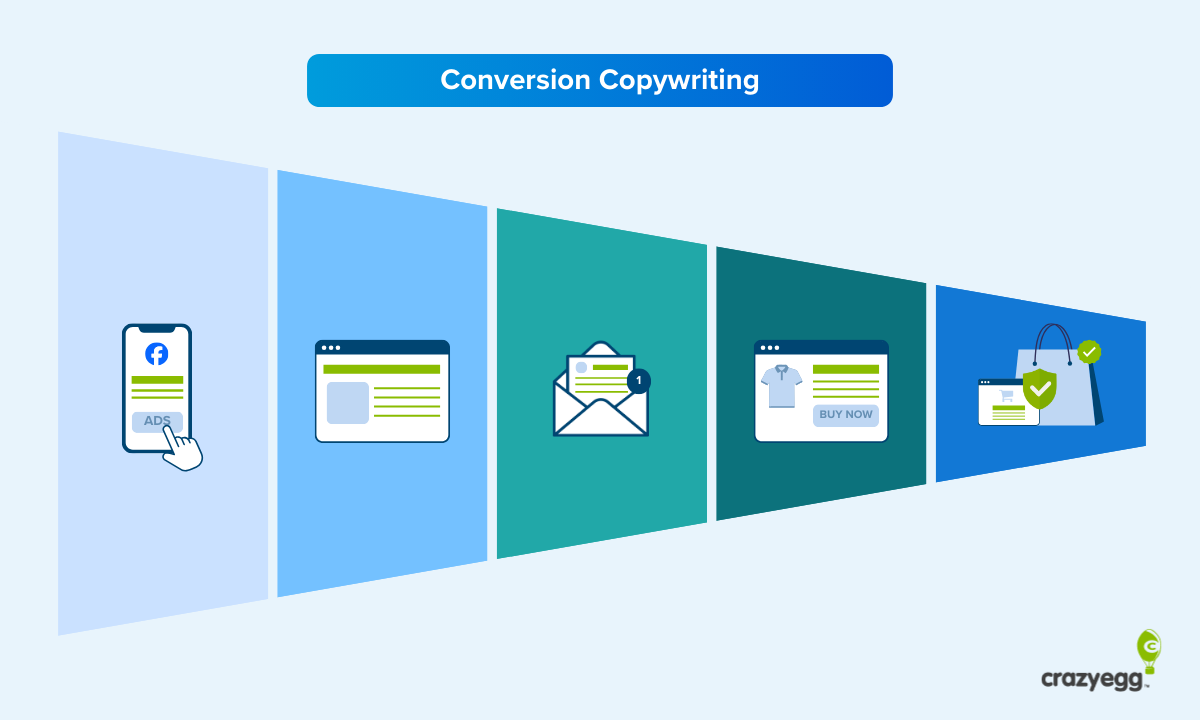
Three shifts are central to website optimization in the age of AI.
- AI-based research is replacing large portions of the multichannel buyer journey.
- When buyers do arrive on a site, it’s with greater intent. A lot of evaluation has already been done by the time they click through.
- Owned assets influence what AI chatbots say about a brand. A site that knows how to “talk” to LLMs can meaningfully affect outputs.
To give you a roadmap of how to adapt your on-site CRO strategy, I’ve looked at all the good data to build a picture of where all this is going. I’ve then filtered advice worth following from all the BS.
1. Understand Where Your Website Sits in the Buyer Journey
Buyer journeys have always been non-linear and multifaceted. Even so, many companies have successfully relied on marketing models that prioritize a small handful of channels to the exclusion of others. An overemphasis by B2B SaaS on organic search is one example that’s.
With AI-based research emerging as the norm, this approach is now untenable. LLMs draw on a wide variety of sources when making citations, combining context from their training corpus with RAG-based grounding (external search). As such, conversion optimization needs to be truly multichannel. This is the broader context in which sites now exist, and it’s important for on-site optimization for several reasons.
Recognizing the Shift to Brand Strength
AI-based tools are aggregating the multichannel journey. Instead of visiting G2 and Trustpilot, dipping into specific vendor sites to check details, skimming over reviews on Reddit, clarifying key terms via educational content where necessary, and so on, buyers are having conversations with bots.
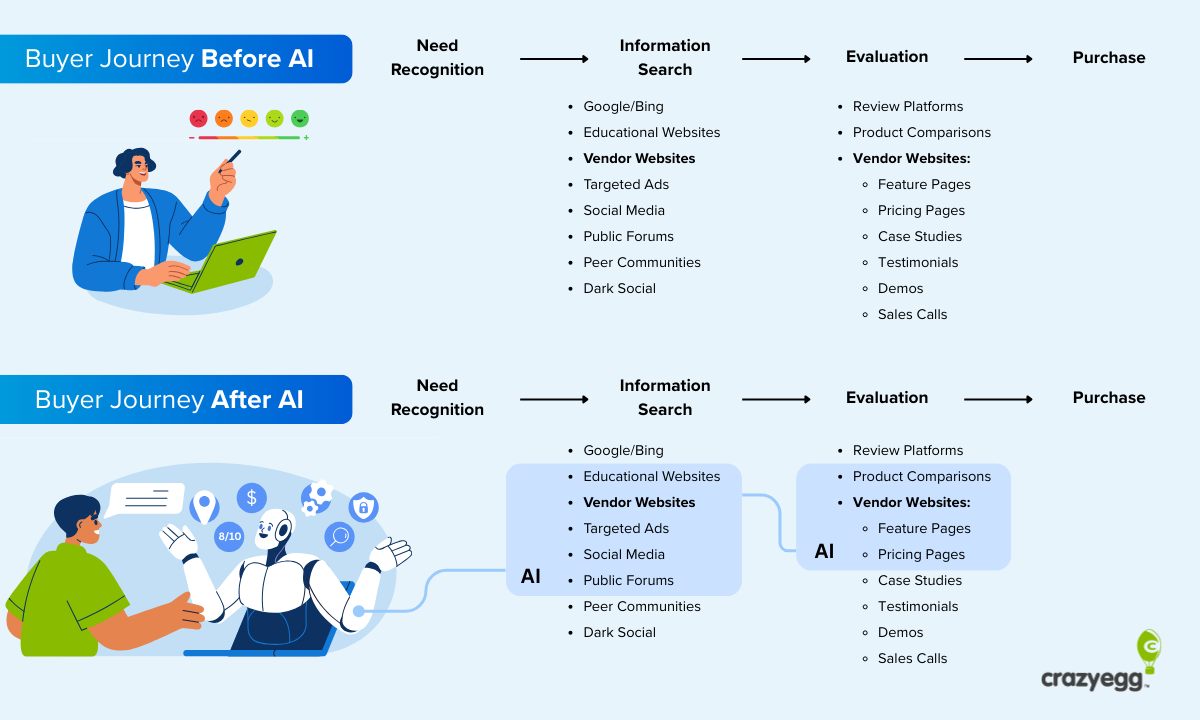
Saying AI is taking over everything is a simplification, of course. Buyer journeys are still multi-touch. The point is that AI is replacing substantial portions of information gathering, evaluation, and validation. It’s only after they’ve done much of the preliminary legwork that buyers arrive on your site.
For those businesses that have relied exclusively or primarily on one channel, this presents a problem. LLMs draw on a huge body of material, accessed via both training data and external searches (grounding) to determine the strength of a brand or related entity.
The underlying machinery of visibility has shifted. To appear in AI answers, you need to be everywhere. To appear in a persuasive way, you need to be optimized everywhere.
What the Data Says About Off-Site and AI Research
Before looking at the mechanics of how to optimize for visibility, let’s quickly review some of the data about AI-based research.
According to a survey of 2,063 senior leaders conducted by Google and NRG (National Research Group), 60% of B2B buyers use AI at some point in the purchase process. In early 2025, Capgemini found that more than half (58%) of consumers have replaced search engines with AI as their primary research tool.
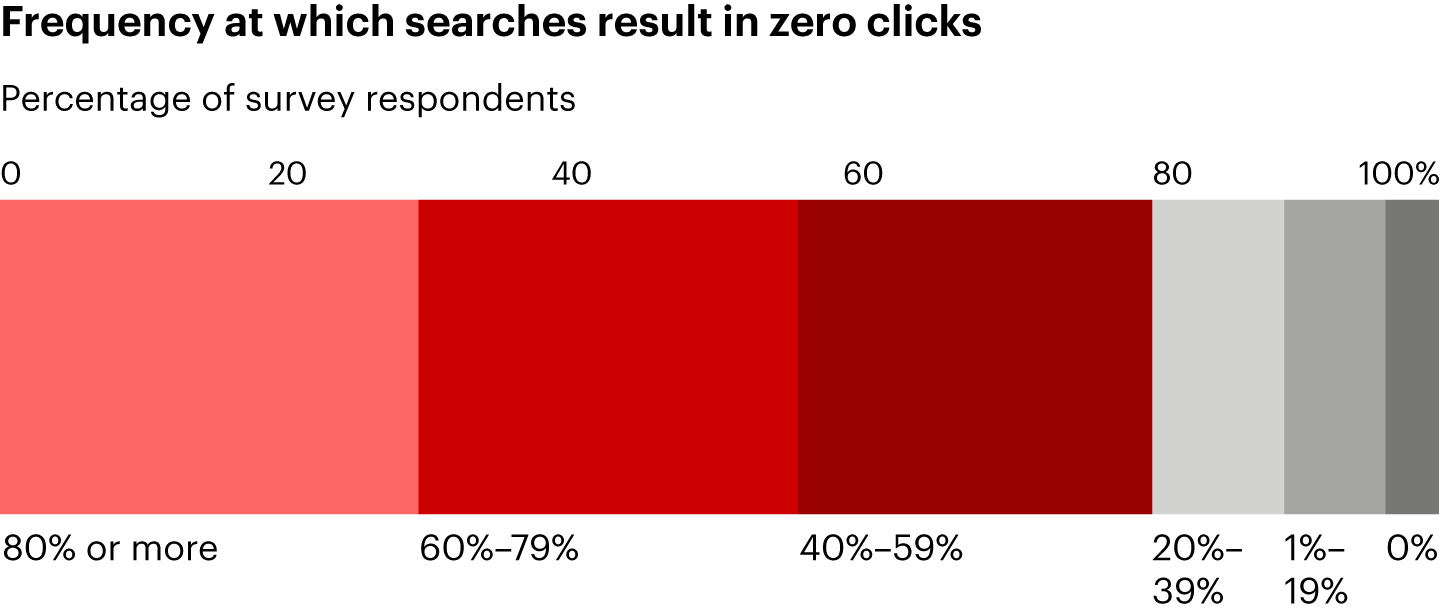
Additionally, there’s been a general decline in organic search traffic for the majority of industries. Bain and Company puts the decrease at an estimated 15% to 25% (graph below). This indicates that buyers are not visiting websites as much as they once did for information gathering (search engines being the primary means of discovery).
Research by Siege Media also backs this up. They found that while overall clicks were down across their sample of B2B sites, homepage traffic increased by 10.7%. When you factor in that homepages tend to convert higher than other pages (around 3% compared to 1%), this result fits with the broader narrative. Visitors are landing on sites via the homepage (rather than discovering sub-pages through Google), already having done a significant chunk of research.
Why On-Site Content Plays a Role in Off-Site Conversions
So, where does your website fit into all of this?
In the preceding graph that shows the buyer journey, you’ll see that vendor websites are a dominant component. They contribute to AI outputs in the information gathering and evaluation phases. And they also act as the primary point of reference for the latter stages of evaluation and validation.
This is good news. Yes, your site should be optimized to provide buyers with everything they need to validate your product when they do land on your site (we’ll get to that later). But it also plays an important role, arguably the most important role, in what information consumers see before they arrive.
If your site is optimized to provide AI with information as efficiently as possible, you gain a degree of ownership over your off-site narrative. You can provide prospects with accurate, focused information that positively influences their pre-purchase decisions.
2. Your Site Needs to “Talk” to AI
What you publish on your site influences AI visibility in both the information-gathering and evaluation phases of the buyer journey. Your site must be comprehensive while not confusing LLMs.
While artificial engine optimization (AEO) remains mostly indistinguishable from SEO on a tactical level (at least for now), understanding AI visibility at a theoretical level demands a shift in thinking. And this understanding has ramifications for how you optimize the broader buyer journey.
Moving From Rankings to Representation
Success in AI search differs from the traditional ranking mindset. It isn’t about chasing rankings.
Instead, AI visibility is more about shaping how AI engines interpret and distinguish your brand. Specifically, what AI is predisposed to say about you.
AEO focuses on both increasing how often you appear in answer engines and what is said about you. Your owned media is especially important in shaping your brand’s “AI narrative.” Some have argued that it’s the most central factor.
A study conducted by Martech that tracked responses for 1000 prompts over 29 B2B brands arrived at the following conclusion:
“Despite leaders of large AI companies promoting the authority of earned media, we found that owned media is critical in determining which B2B technology brands appear in AI answers. More than twice as many owned websites are cited as earned media sites.”
This matters for conversions. If buyers are gathering incorrect information while educating themselves about what’s on offer, you’re automatically at a disadvantage. And gaps in content on your owned assets leave the pitch wide open for competitors to come in.
Tracking Your Reach and the Issue of Prompt Tracking
There has been a surge in prompt tracking tools—Ahref’s Brand Tracker, Profound, and Peec, to name just a few. Monitoring visibility in AI search is now clearly a priority for companies. However, there are good arguments for approaching these platforms with caution.
Irina Maltseva, who runs AI SEO agency Seen, recognizes the value but adds caveats: “I think it’s important to treat visibility tracking as directional, not absolute. There’s no precise way to calculate a definitive ‘AI visibility score’ because LLM outputs are non-deterministic and highly context-dependent. They’re great for understanding relative positioning versus competitors and spotting trends over time, but not for obsessing over exact numbers.”
Mark Williams-Cook, Marketing Director at Candour, is also among those who have questioned the value of prompt tracking outright. He points to the probabilistic, non-deterministic nature of GenAI outputs, along with the fact that it’s difficult to account for personalization context. He instead advocates for “qualitative interrogation” of LLMs to give an overall impression of how a brand is represented.
A Guide to Making Your Site AI-Friendly
There’s a lot of questionable advice. Everything from going all-in on listicles to half-baked ideas of what “content chunking” entails to hosting markdown duplicates of pages.
Fortunately, most good AEO advice is still best SEO practice. And it’s fairly easy to distinguish the good from the bad.
Don’t Stop AI Crawlers From Accessing Your Content
There are a handful of basic steps you should take to make sure that AI tools can extract information from your site without any issues:
- Don’t set your robots.txt to block AI crawlers. Keep in mind that some hosting services and CDNs, like Cloudflare, block crawlers by default.
- Make content accessible (especially important text) in the initial HTML response, and don’t rely on JavaScript. AI crawlers struggle to execute it.
- If you’re using non-text content, images, videos, audio, etc., include text-based counterparts like transcripts and image alt text.
- Test your site speed so it’s up to par. In large fan-out retrieval queries, slower sites may be deprioritized or excluded if they fail to respond quickly.
Include Well-Structured Informational Content
AI will treat your site as a primary source of information, especially when asked direct questions about your brand. Because of this, it’s important for your content to be both clear and comprehensive.
Google’s EEAT criteria—experience, expertise, authoritativeness, and trustworthiness—are still a useful guide for content creation. But we can go a little deeper when putting editorial guidelines in place based on recent research.
Kevin Indig conducted a large-scale study in which he analyzed over 1.2 million ChatGPT responses. He concluded the following:
“After analyzing 1.2M verified ChatGPT citations, I found a pattern so consistent it has a P-Value of 0.0: the “ski ramp.” ChatGPT pays disproportionate attention to the top 30% of your content. Further, I found 5 clear characteristics of content that gets cited. To win in the AI era, you need to start writing like a journalist.”
The following key points stood out from his study:
- Include important details, such as key features, proof points, segment targeting, in the top 30% of your written content.
- Use specific language that balances informed opinion with an objective (but not dry) style. Business-level writing with a Flesch-Kincaid score of 16, which is around college level, did well.
- Organize content into clear headings (H2s and H3s). Question-based headings work well for orienting AI.
These suggestions align with high-quality, human-centric writing. This is always a good guide if you’re unsure about whether or not a structural change is worth making. Consider if it is valuable to a human being looking for information to complete a task or make a decision related to your product.
Use Actual Keyword Data for Your Topical Map
Keyword data is still the strongest guide to what your customers are searching for, and your website’s topical map should reflect this. It goes without saying that you shouldn’t be asking LLMs for this data (they don’t have it).
For client sites, Lars Lofgren still uses keyword research to determine which content a site should include. His argument is that queries still articulate the “underlying scope and substance of informational requests,” even if they don’t mirror chatbot inputs in an ongoing conversation exactly.
Don’t Confuse LLMs: Build Pages Around Distinct Entities
There has long been a tendency for companies to blur the lines between the entities on their sites. For LLM comprehension, this is a mistake. You should avoid giving information that can in any way be construed as competing with itself.
Instead, well-defined assets organized into a clear hierarchy give you full control over which information is likely to be picked up.
This is particularly true of feature- and audience-specific landing pages. If you’re describing defined areas of functionality, use cases, or features as relevant to market segments (enterprise vs. freelancer, for example), ensure absolute consistency across entities.
Have a bloated site with lots of similar pages? Now is a good time to consider cutting the fat.
Avoid Unproven Tactics
As with any emerging field, there’s a great deal of unproven advice.
Here’s a roundup of AEO tactics you can ignore:
- Chunking: This technique involves breaking text into small, self-contained sections, usually under individual headers. It’s based on a misunderstanding of how LLMs retrieve and organize content, and it doesn’t have any meaningful effect on outputs.
- Schema markup: There’s very little evidence that schema markup influences the information AI outputs. It’s still good SEO practice to use it, but don’t expect any miracles from LLMs.
- LLM files (llms.txt): There’s no evidence that an llms.txt file, a proposed web standard for telling LLMs about your site in markdown, has any impact on how AI crawlers navigate your site or process your content.
- Markdown (.md files): There’s a trend of website owners creating duplicate markdown versions of their pages with a view to making them easy for AI to read (markdown is a plain text machine-readable language). There’s no basis for this one, and Google and Bing have advised against it.
- Prompt injections: This involves hiding prompts on your website to influence what AI outputs. Don’t do it. It’s nonsense.
3. Visitors Are Arriving With Greater Buying Intent
What happens when visitors arrive on your site? They may have clicked on a link in a chat interface or searched for your brand in Google after adding it to their shortlist.
We’ve already seen how higher conversion rates from LLM-attributed traffic point to stronger intent. So how should these buyers be treated differently, if at all?
Mapping the Buyer Journey
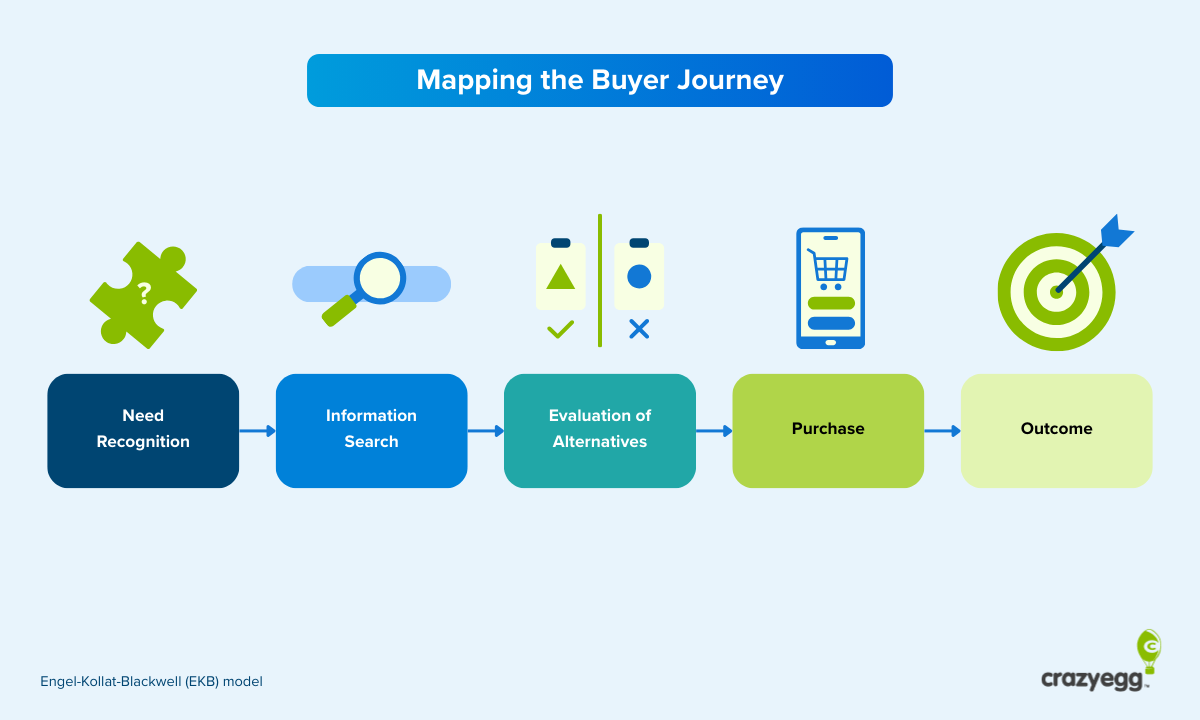
One abstraction that I like for understanding consumer journeys is the Engel–Kollat–Blackwell (EKB) model. It’s a straightforward representation that charts the path from internal or external need recognition through to purchase.
As you can see below, it’s split into need recognition, information search, pre-purchase evaluation of alternatives, purchase, and outcome.
For B2B decisions, the BuyGrid framework (Robinson, Faris and Wind) is my preferred overview. It accounts for the multi-stakeholder and often chaotic nature of the corporate decision-making process. It is particularly applicable to enterprise journeys.
Buy classes refer to the nature of the purchase—a first-time buy, a modified repurchase, or a repurchase. The presence of buy phases and buy classes varies between industries (hence why the table is empty). B2B SaaS, for example, tends not to involve the solicitation of proposals. For new tasks (purchases), the buy phases are usually present to some degree and relatively stable.
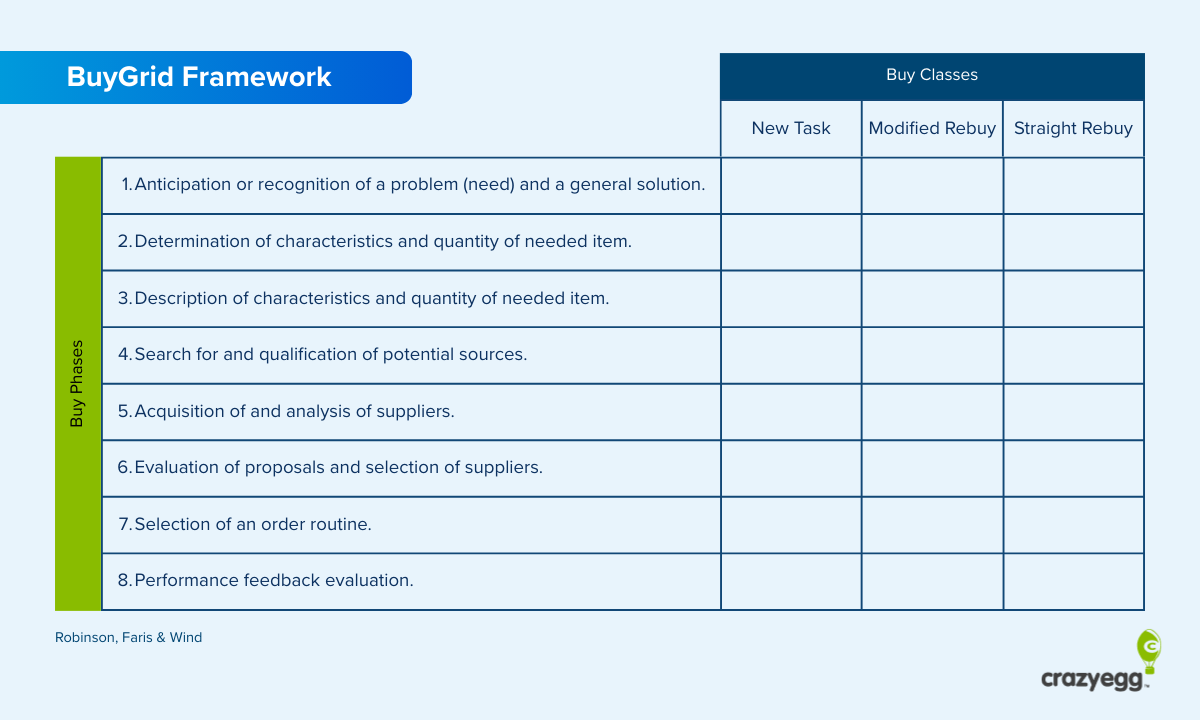
The point of using these models is to help understand where websites sit in AI-assisted journeys. In both B2B and B2C, AI can be involved right up until evaluation begins. As a result, buyers and groups of buyers are only consulting your website when they’re educated, clear about what they need, and armed with a shortlist.
For optimization purposes, this has clear significance. If you can satisfy a specific set of evaluation and selection criteria, visitors are much less likely to drop off.
Understanding the Buyer Shopping List
Talia Wolf, founder and CEO of GetUplift, has covered the topic of conversion optimization for late-stage buyers in depth. I asked her about the role websites should play in buyer journeys dominated by AI search. She argued that they have to cater to a specific, detailed set of questions.
“When people come to your website, they have a checklist. They want to make sure that you have the features that they need. They want to make sure that you’re in the pricing bracket that they’ve put down for themselves. They want to make sure that if you’re in B2B, you have the integrations that they need. They have kind of a shopping list.”
Understanding this shopping list is the key to conversion-optimizing your site. It gives you an exact template for providing the right content, proof points, and calls to action.
Tailoring Your Site to Traffic That’s (Almost) Ready to Buy
There are three steps to understanding and acting on your buyer’s “shopping list”:
- Understand the specific requirements of your late-stage buyers.
- Provide the collateral buyers require to evaluate your product and verify you are a trustworthy brand.
- Set CTAs that fit with their evaluation preferences, whether a straightforward “Buy” button, free trial, demo, or a sales call.
Listen to What Buyers Are Saying in the Middle Stages of the Buyer Journey
While AI is consuming much of the buyer journey, it’s not consuming all of it. This is important because it means you still have a window into what customers are asking about products in your category.
What’s more, evaluation criteria don’t come about in a vacuum. Peer networks and public discussion boards are venues in which prospects partially form the questions they will bring to your website.
“If you want to know how to ready your site for increased buyer readiness,” Talia says, “you need to spend time where they are, listen to their conversations, and learn. You can use those insights to optimize your website and provide the information they really care about.”
For Talia, knowing what buyers are saying is the key to providing specificity, which is essential for later-stage buyers.
“Most brands use social proof or mention generic pains or outcomes. They lack specificity that clearly mentions what their audience cares about. It doesn’t go deep. They might, for example, talk about “saving time” as an outcome but not specifically say what this means for their audience. When you act as a fly on the wall in Reddit and other platforms, you can find those specifics and use them in your content and pages.”
Make Later-Stage Content Easily Accessible
More buyers are arriving on your site ready to evaluate your solution. So you had better make sure they can access all the information they need with an absolute minimum of friction.
Jason Patterson, CEO of Jewel Content Marketing, argues that a large part of moving prospects to the deal-closing stage is about cultivating certainty. And certainty requires proof. “Proof is what B2B certainty is built by,” he says. “Proof you know your shit, proof you know your customer’s shit, and proof you’re reliable.”
This is something that AI can only provide in a limited way. If trust-building has been done prior to market entry, all the better. But when buyers arrive on your site, the most valuable thing you can do is either initiate or reinforce this trust and certainty.
All of the following content should be available on your site:
- Industry-specific case studies
- Use cases
- ROI models tailored to role and industry
- Customer testimonials (ideally with metrics)
- Detailed product specs
- Technical documentation (APIs, integrations, compliance certifications)
- Implementation timelines
- (Accurate) product comparisons
- Product walkthroughs
Transparent pricing is also advisable for two reasons. First, it’s a key part of the validation process, especially at the enterprise level, where budget can represent a logistical make-or-break. Second, if you don’t publish pricing, you run the risk of buyers using information from incorrect third-party sources.
4. The Human Element Is More Important Than Ever
Purchase decisions are built on trust and confidence. Providing obviously AI-generated content when users expect human nuance is a sure way to destroy any basis for trust.
This doesn’t mean that AI content can’t play any role in your site content. For certain types, like technical documentation, readers are relatively unbothered. Mark Williams-Cook doesn’t overcomplicate the decision for AI vs. non-AI. His test is simple: “Would a human be disappointed if they knew AI had written this?”
Here are three guidelines for when and how to use human content.
- Disclose human involvement: There is good evidence that buyers apply a favoritism bias to human content. When using AI assistance, which is suitable for highly functional informational material, always emphasize human control and oversight.
- Adopt a personal, human voice: Copywriter David Deutsch has argued that one of the most effective mechanisms for distinguishing content in the age of AI is to use a “friendly, human voice.” The particular tone you adopt will depend on your audience, but it is a good idea to include a degree of friendliness.
- Pay special attention to high-stakes content: Always disclose human involvement in high-stakes content. This might be material that is important for verifying legal compliance, for example, or securing internal buy-in. Research has shown that AI aversion is especially strong for these content types.
Wrapping Up: A Conversion Checklist for the Age of AI
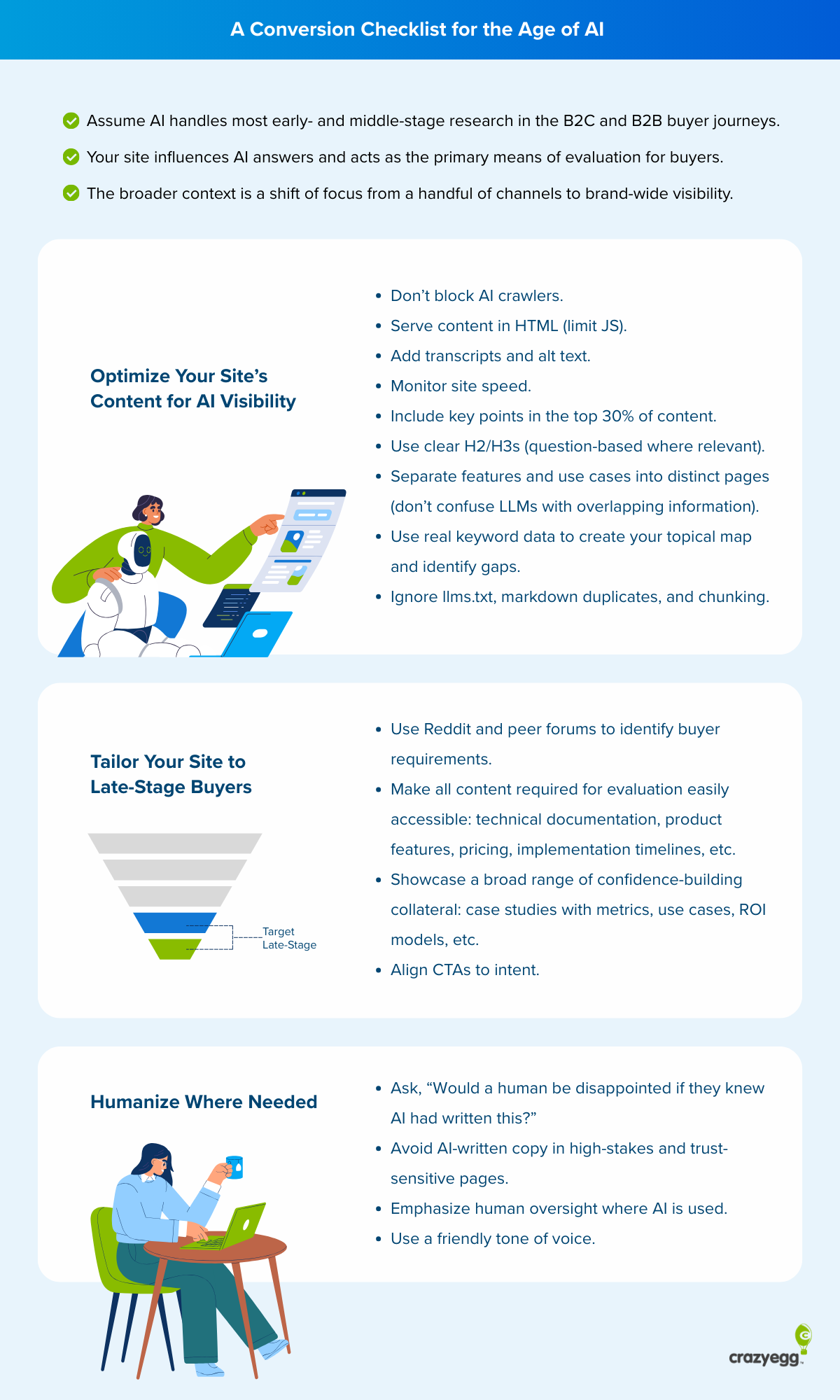
Adapting conversion practices to buyer journeys dominated by AI requires adjustments, not an overhaul. A series of small, targeted changes is usually all that is needed to future-proof your site while making it irresistible to your later-stage buyers.
Here’s a practical roundup of all the tactics and steps outlined in the preceding sections: