The conversation about AI and ecommerce often gets framed as a threat:
- Platforms like Google and social media are becoming more shoppable
- AI is intermediating more purchases (with in-platform “buy now” buttons and agentic experiences)
- Brand websites are fighting for relevance and conversions
Our survey data tells a more nuanced story, and one that’s actually quite useful for ecommerce brands that want to maintain their audience’s trust.
Yes, platforms are encroaching on your sales. Yes, AI shopping is still on the horizon (despite ChatGPT scaling back Instant Shopping).
But right now, shoppers still strongly prefer buying directly from brand websites. Their reasons reveal what ecommerce brands should be doing to protect that advantage before the window narrows.
This post breaks down what our survey of 49 online shoppers reveals about how to strengthen your direct sales channels, which features and experiences actually drive shoppers to buy from your store, and how to protect your ecommerce business in the age of AI-assisted shopping.
What the data says: Key findings for ecommerce brands
People still prefer (and trust) brand websites more than they do buying from big tech platforms like Google, social media, or AI. This means that direct sales aren’t dying.
But our survey data indicates that the loyalty propping them up is far more fragile than the headline numbers suggest. Here’s what ecommerce brands need to know:
- The brand website is still the clear first choice. 80% of shoppers prefer to complete purchases on a brand’s own website over any platform or marketplace alternative.
- Direct channel usage is growing at the moment. 20% of shoppers are visiting brand websites more often than they were a year ago.
- But the trust holding it together is largely defensive. Shoppers aren’t choosing brand websites because the experience is better. They’re choosing them because they don’t trust the alternatives (yet).
- Value is the weak spot. 51% of shoppers who prefer buying from brands believe they get better value buying direct. Many are effectively paying a premium to avoid platforms they trust less, and they know it.
- Brand connection is real, but it fades fast. 59% of shoppers feel more connected to a brand when buying directly. But that connection drops sharply after even one in-platform purchase from Google, social media, or AI.
- One in-platform purchase changes everything. Shoppers who’ve bought in-platform once are significantly more open to doing it again. They also feel more positively about shopping on other platforms, including AI and ones they haven’t tried yet.
- AI shopping has the furthest to go, but it’s closing ground. 70% of shoppers feel negatively about buying through ChatGPT today. But the gap closes quickly among shoppers with any in-platform experience at all (even if they’ve only bought through social media or Google).
For the full breakdown of how shoppers feel about buying from big tech platforms vs. direct from brands, awareness vs. purchase rates, and how attitudes differ by age and gender, see our original survey findings.
What brands should do about this data depends on their priorities. This post covers both angles: protecting the direct relationship today and preparing for AI-driven discovery tomorrow.
1. Turn trust into something you actively optimize for at every level
The main reason people buy directly from brands isn’t love for the experience, perceived value, or even brand loyalty in most cases. It’s because they distrust the alternatives.
Payment security (cited by 65% of respondents), difficulty with returns or customer service (61%), and concerns about product authenticity (61%) are doing much of the heavy lifting.
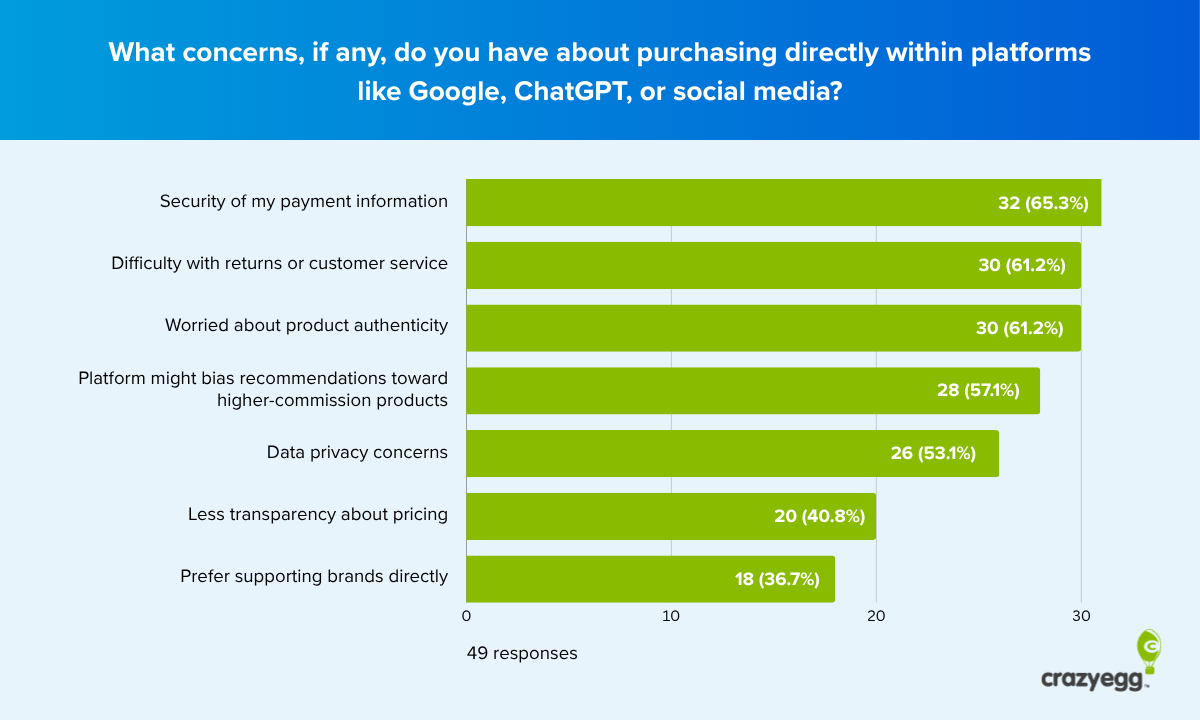
These elements are much easier for brands to offer than platforms, turning them into your trust moat.
That’s why they are the essential trust factors you need to strengthen in your shop as soon as possible.
If you’re using a platform like Shopify, many of these elements are usually handled by default.
But if not, it is worth auditing your website’s online shopping experience and how shoppers feel about buying directly from your brand online.
For example, take a look at the payment options for this online store:
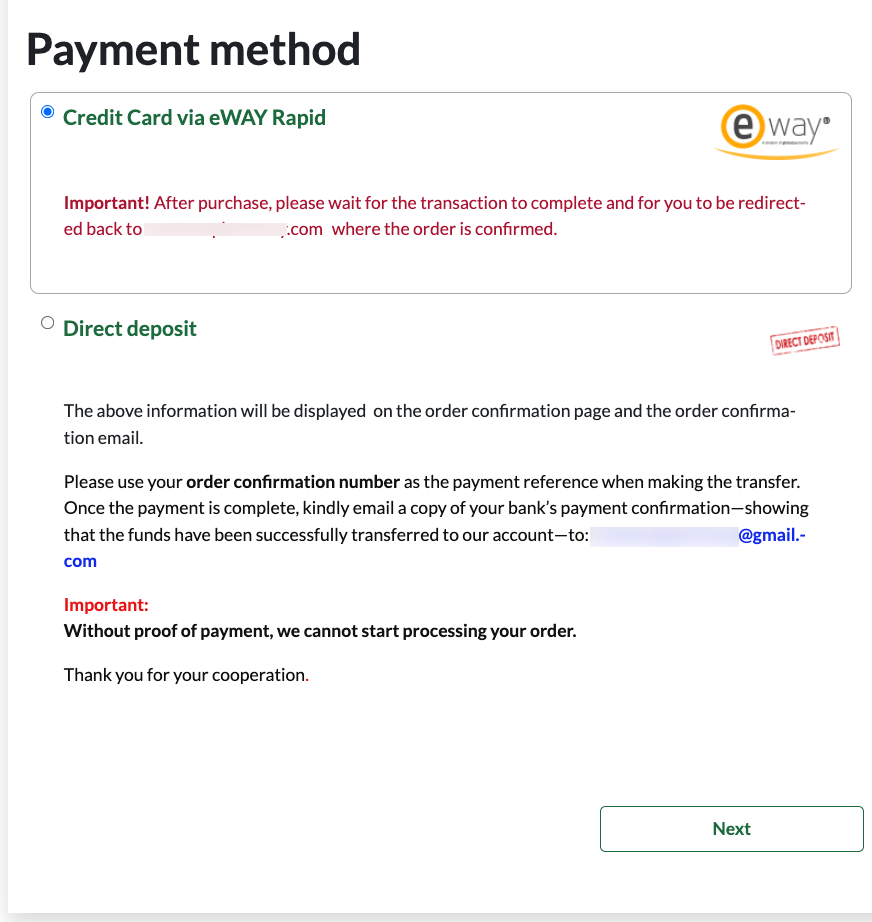
This checkout offers two payment methods: credit card via a third-party gateway and direct deposit. The direct deposit option alone has several red flags that would send most online shoppers elsewhere:
- The shopper bears the burden of proving payment: they’re required to email a bank transfer confirmation before the order is processed
- There’s no immediate order confirmation or payment verification: this means the shopper has no assurance that their purchase is secure or that their product will actually ship
- Widely trusted payment options are absent entirely: secure options like PayPal, Apple Pay, Google Pay, and buy-now-pay-later services like Afterpay or Klarna are missing
- The process relies on manual follow-up: the shopper must reach out via a Gmail address, which reads as an immediate scam signal to anyone who’s security-conscious
This isn’t a hypothetical edge case. In fact, it’s one of many legitimate stores actively selling products online today. Usually, the biggest setback for such stores is that their owners aren’t tech-savvy and don’t know that better, more secure ecommerce platforms exist.
Ultimately, if your store isn’t meeting the basic expectations modern shoppers have when buying online, you’ll be losing sales to platforms like Google, Amazon, and Instagram because they’re perceived as more trustworthy.
Trust is currently a significant defensive moat for ecommerce brands.
It’s the biggest reason why most shoppers still choose to buy directly from brands instead of big tech platforms.
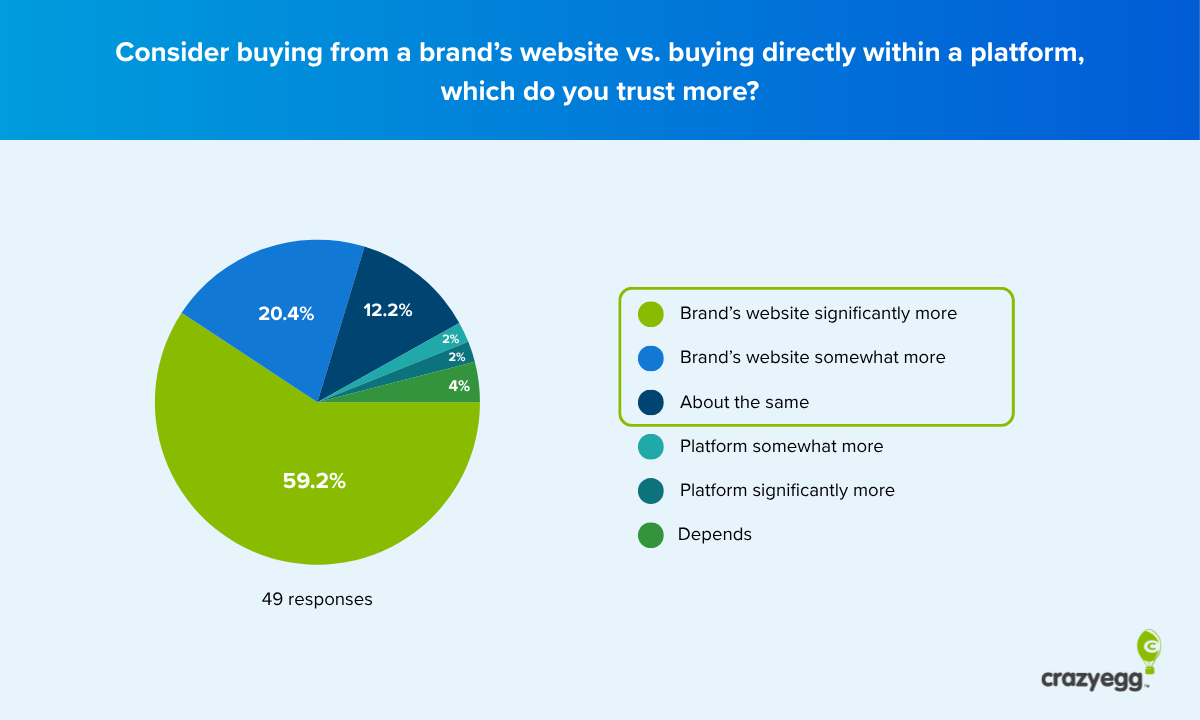
But platforms will get better at trust signals. They’re already adding verified seller badges, return guarantees, and secure checkout flows.
The opportunity for brands right now is to make trust an active, visible part of the experience, not something shoppers have to assume or go out of their way to find.
Ways to make trust signals more visible in your online store
- Surface your returns policy early. Don’t bury it in a footer. Add a plain-language statement on product pages and at checkout.
- Show verified customer reviews. Verified purchase labels, recent reviews, and responses to negative feedback all signal legitimacy to cautious shoppers.
- Be explicit about your data practices. If you’re not sharing data with ad networks, say so. One plain-language sentence beats a legal disclaimer every time.
- Make payment security visible, not assumed. Display accepted payment methods and security credentials clearly at checkout. Don’t expect shoppers to notice them passively.
- Own the authenticity signal. You’re the original source. “You’re buying directly from us, not a reseller” is obvious to you and reassuring to a shopper who’s been burned before.
- Make it clear who they’re buying from and how to reach you. A visible phone number, live chat, or named contact email signals there’s a real business behind the purchase.
- Address the scam concern directly. A short trust statement or signals proving you’re a real business run by real people behind the scenes reassures shoppers who quietly research before buying.
All of these elements were mentioned by respondents in our survey and weakened their trust in buying directly from brands.
2. Close the value gap, because it’s real and shoppers know it
Value is where brand websites are most vulnerable, and most brands aren’t doing enough about it.
Only 51% of shoppers who prefer to buy from brands believe they get better value by buying direct — a slim and volatile majority. Open-text responses from the survey were pointed:
“Brand websites strike me as more reliable but frequently don’t have the product deals of a platform or marketplace.”
“MSRP is almost always higher when you visit a brand website.”
Not to mention that 42.9% of shoppers would be more likely to switch to in-platform shopping if they were offered a better deal.
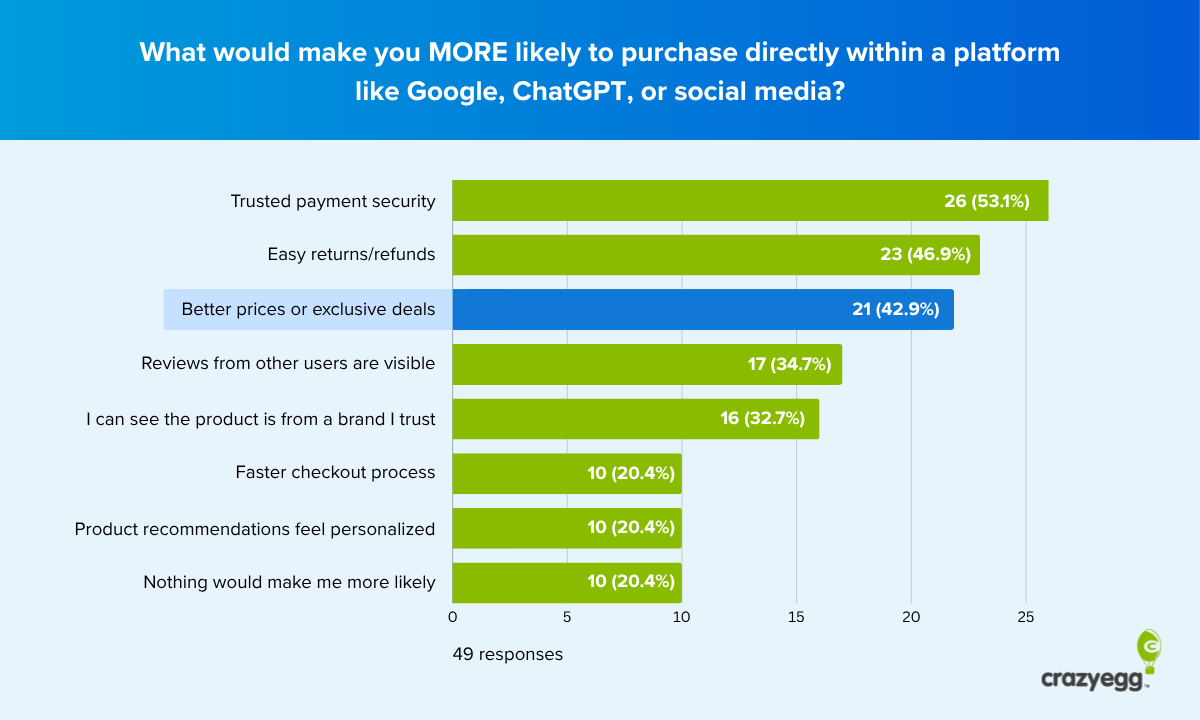
Shoppers who prefer buying direct are often doing so despite believing they might be paying more.
That’s more of a trust tax than a loyalty one. It works while trust levels are low elsewhere, but it’s not a sustainable competitive position as more shoppers become comfortable buying from big tech platforms or getting better deals from them.
The point here isn’t that brands need to match Amazon’s pricing, for instance, but they do need to consider what other value they offer customers if better deals are found elsewhere.
A few ways to close the value gap on your online store
- Offer direct-only pricing or bundles: Even a modest exclusive offer (like a “buy direct and save” deal or a bundle only available on your site) makes your store an obvious choice. It gives shoppers a concrete reason to buy from you again and again, rather than just distrusting the alternatives.
- Build a loyalty program that compounds over time. 57% of top ecommerce sites offer some form of rewards scheme on their ecommerce product pages. Loyalty programs go beyond retention by creating a value argument that platforms can’t easily replicate. A shopper with $40 in store credit from your brand has a very concrete reason to come back directly rather than search elsewhere.
- Make sure your best prices aren’t exclusive to marketplaces. If shoppers consistently find better deals on your products through Amazon or Google Shopping, you’re actively training them to use those channels first. Price parity between your store and marketplaces is the minimum, but direct-channel pricing advantage should be your ultimate goal.
- Offer free or discounted shipping on your own store. Multiple respondents said the primary reason they’d choose Amazon over a brand website is the shipping cost. If Amazon is offering free shipping on your products and you aren’t, you’re handing them the sale on shipping benefits alone (regardless of how strong your trust signals are).
- Run direct-channel promotions your customers actually know about. Several respondents noted they’d buy directly if the brand’s website offered the item at a discounted price. If you’re running promotions, make sure they’re visible and promoted to your existing audience (your email list, social following, and past customers), not just sitting on a page nobody lands on.
3. The brand connection is real but needs to be built deliberately
59% of respondents feel more connected to a brand when buying from its website directly. Among shoppers who haven’t yet made an in-platform purchase, that rises to 69%.
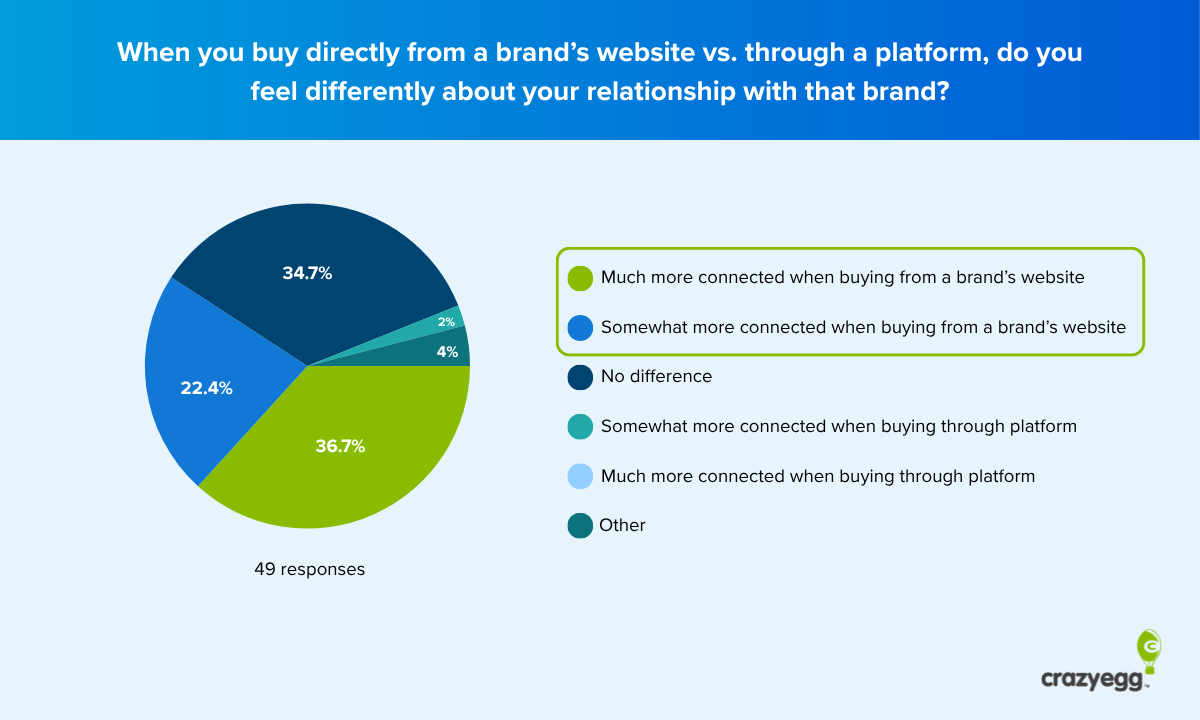
This is significant, and most brands are completely undervaluing it.
The post-purchase moment of the buyer journey is the highest-leverage touchpoint for shoppers who buy directly from brands, but it’s where most brands go quiet. An order confirmation is sent, a shipping notification goes out, and that’s largely it.
But this is exactly when the emotional connection people associate with buying direct is most available.
What happens after the sale matters as much as the sale itself
Brand loyalty and customer retention don’t come from a single great product. They come from what you do in the moments between purchases, starting immediately after the first one.
For example, Freshly Cosmetics is a natural skincare brand.
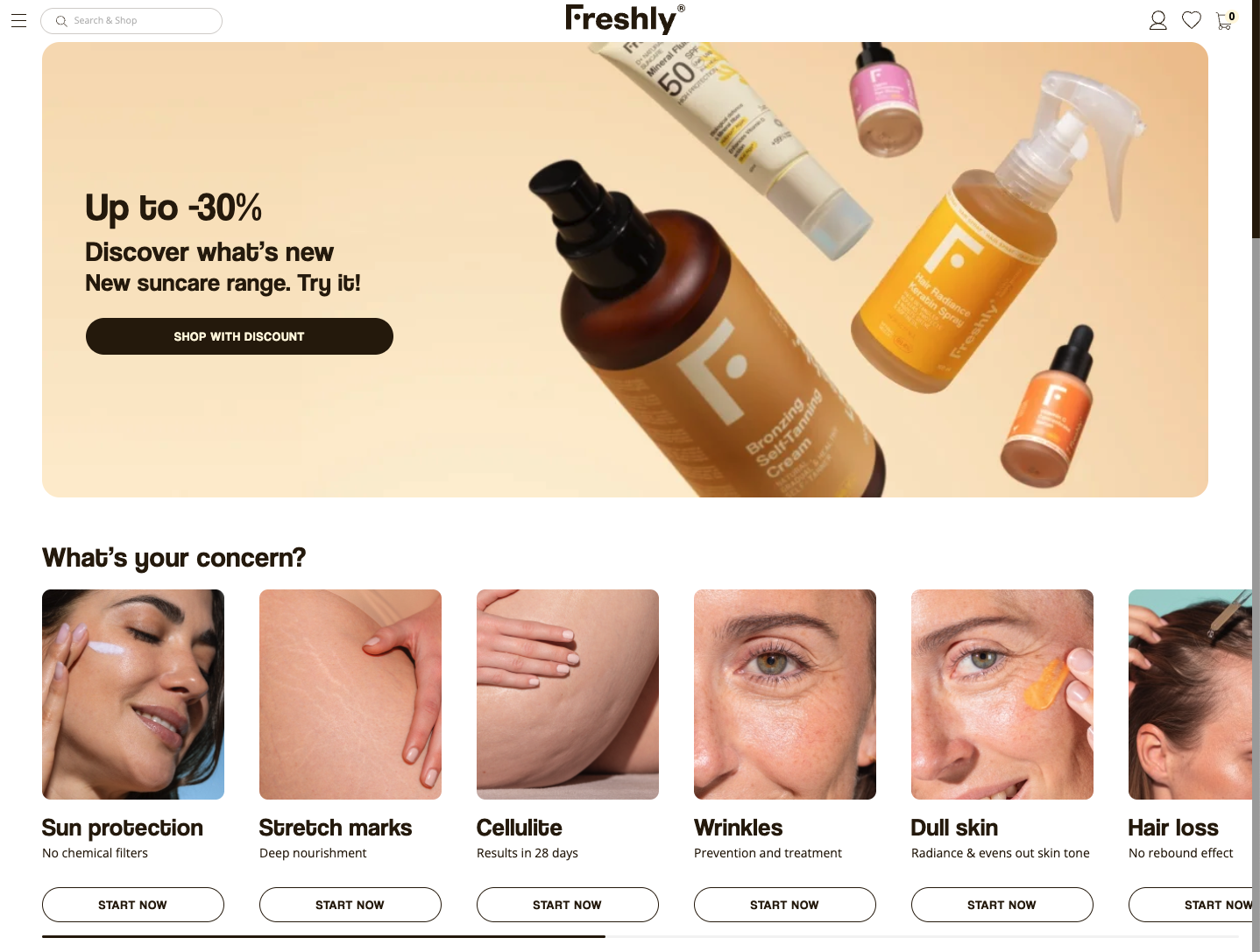
After each sale, instead of sending a generic thank-you, the team built a post-purchase flow that starts with a spotlight on their values, then follows up with emails tailored by purchase stage, like:
- Recommending best-sellers
- Inviting customers to explore new product categories
- Offering skincare tips
- Providing product application guidance.
They also built a separate product-specific flow that tells first-time buyers exactly how to get the most from what they just purchased.
The result was a 136% increase in revenue from repeat customers.
The throughline in Freshly’s approach is that every email answers the question a new customer implicitly asks: Did I make the right choice by buying from this brand?
That’s the question brand websites are uniquely positioned to answer, helping them strengthen their connection with customers (and that big-tech platforms structurally cannot).
How to turn the post-purchase moment into a genuine brand connection
A good post-purchase flow doesn’t need to be long or complex. Even three to four emails over the first two weeks can do meaningful work. Here’s a simple sequence to follow:
- Email 1 — Confirm and reassure. Send immediately after purchase. Confirm the order, set delivery expectations, and include a plain-language line about your returns process. The goal is to eliminate any doubt that they made a safe purchase.
- Email 2 — Tell them who they bought from. Send one to two days later. This is your brand story email. Mention the product’s origin, who makes it, and what you stand for. Keep it short and write it like a person, not a marketing department.
- Email 3 — Help them get value from what they bought. Send three to five days later, ideally tied to the specific product purchased. Usage tips, care instructions, or styling advice (anything that makes the product feel worth what they paid).
- Email 4 — Invite them deeper, don’t push them to buy. Send seven to fourteen days later. Introduce a complementary product, invite them to join a loyalty program, or ask for a review. The goal here is relationship, not conversion.
4. Don’t underestimate how quickly shopper loyalty can shift to platforms
Shoppers prefer buying from you today, but the bar for losing them tomorrow is lower than you think.
The most predictive variable in our survey’s dataset is whether someone has made even one in-platform purchase.
That single experience significantly changes attitudes across every subsequent question, indicating that people who have bought in-platform at least once are:
- Less likely to trust brand websites more than platforms, dropping from 74% to 23%
- Less likely to feel more connected to brands, dropping from 71% to 33%
- More likely to reduce how often they visit brand websites, 23% are visiting less frequently, vs just 6% of non-buyers
- More open to buying on Google, 69% are positive or open to it, vs 20% of non-buyers
- More open to buying on social media, 46% are positive or open to it, vs just 3% of non-buyers
- Significantly more open to buying through ChatGPT, 54% are positive or open to it, vs just 6% of non-buyers
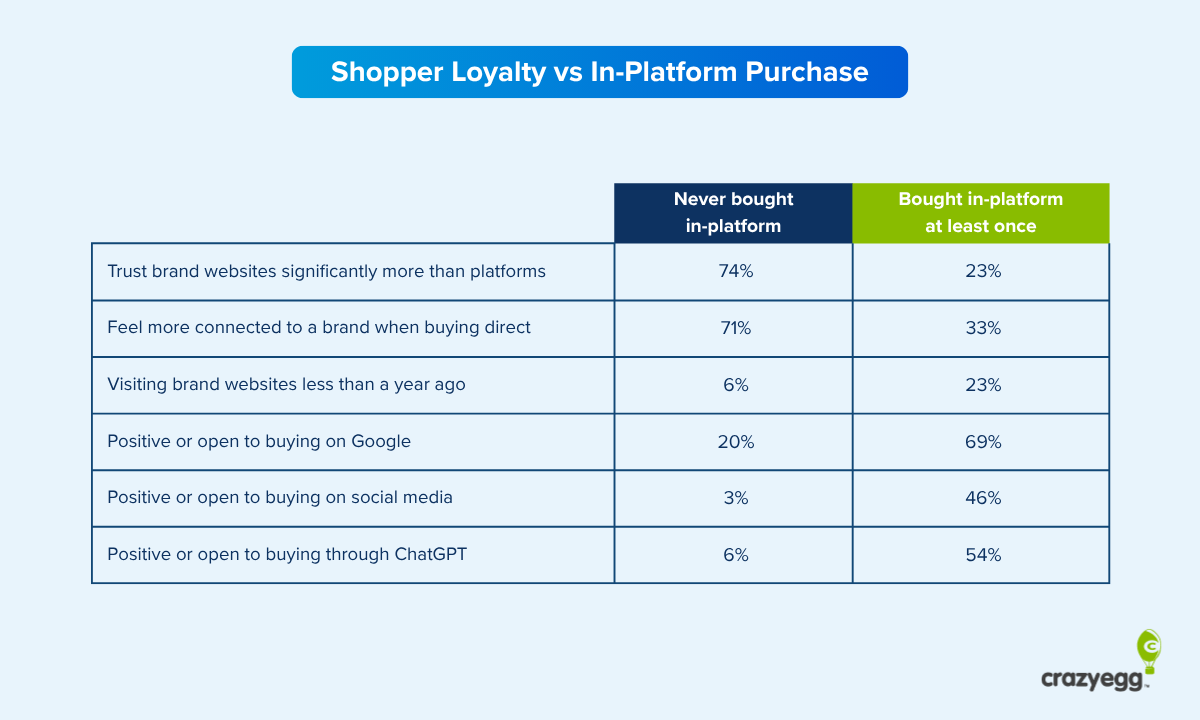
What’s worse is that the bar for that first in-platform purchase is low. Uncomfortably low.
Right now, 71% of shoppers are uncomfortable buying in-platform. But discomfort fades with familiarity.
As more platforms integrate shopping experiences, AI interfaces become more capable and trusted, and a new generation of shoppers grows up treating TikTok Shop and ChatGPT as default purchase channels, that discomfort will erode faster than most ecommerce stores can catch up.
This threat is already underway.
AI tools are rapidly taking over the discovery and research phase of shopping (the moment when consideration sets are formed, and brand preferences begin to solidify) before a shopper ever visits a website.
The brands that show up in those AI-generated shortlists will get considered. The ones that don’t, won’t.
The good news is that the three strategies above (building trust, closing the value gap, and deepening brand connection) give you a real foundation. But they only protect what you already have. They don’t help you reach shoppers who never make it to your store in the first place.
That’s the second half of the problem. And it requires a different kind of response.
What you can do about it now
The shift in loyalty after a single in-platform purchase isn’t something you can prevent entirely, but you can build a direct relationship strong enough to survive it, and act early enough so your brand isn’t caught flat-footed when platforms close the gap.
- Audit where your customers are most at risk of a first platform purchase. If your products are discoverable on Instagram, Google Shopping, or through AI tools but not easily purchasable there, a competitor who is shoppable on those platforms is one recommendation away from intercepting your customer. Know where the gaps are before they cost you.
- Identify your highest-risk customer segment. Based on our survey data, younger shoppers, those less price-conscious, and those already active on social media are most likely to buy in-platform. If that describes a meaningful share of your audience, the urgency to deepen direct channel loyalty is higher than the headline numbers suggest.
- Track your direct channel health as a leading indicator. Don’t wait for sales to drop before you act. Monitor metrics like repeat purchase rate, email open rates, and direct traffic trends. If those are softening, it’s often an early sign that shoppers are starting to buy elsewhere.
- Use your owned channels to protect against platform encroachment. Your email list, SMS subscribers, and loyalty program members are the shoppers least likely to be intercepted by a platform recommendation. Investing in those relationships now is the highest-return activity most ecommerce brands can do in the next 12 months.
5. Prepare for AI shopping by optimizing for visibility everywhere, not just on your store
Whether this section applies to you depends on what kind of ecommerce brand you are.
If brand connection is central to your business because your customers buy from you because of who you are, not just what you sell, your priority is the first three strategies above.
Deepening the direct relationship is your competitive advantage, and being an early adopter on AI platforms may not be worth the brand affinity trade-off. Some D2C brands deliberately avoid Amazon for exactly this reason, and the same logic applies to AI shopping channels.
But if you’re a more product or price-led brand (where the transaction or omnipresence matters more than the relationship), the calculus is different.
Getting in front of shoppers earlier in the AI discovery phase may matter more than protecting the direct channel, and the cost of being absent from those platforms is higher than the cost of showing up on them.
For that second type of brand, the instinct to double down exclusively on the direct channel is understandable but incomplete.
If a shopper asks an AI tool for a recommendation in your product category and your brand doesn’t appear, it doesn’t matter how good your website is. The consideration set was formed without you. And if a competitor’s product is shoppable directly within that interface and yours isn’t, the platform won’t wait. It will route the sale to whoever is available.
This isn’t an argument for abandoning the direct channel. It’s an argument for not ceding the discovery layer to competitors who are paying attention.
Most of this comes down to making sure search engines and AI tools can read, understand, and recommend your products:
- Make your product data machine-readable. Structured data markup is essential for your product visibility, showing your pricing, availability, and reviews directly in AI and search results. It’s the foundation for how AI and search platforms retrieve and surface products.
- Write for questions, not just keywords. AI tools respond to natural language queries like “what’s a good [product] for [use case]”, not just “best [product] 2026.” Your product descriptions, category pages, and content should answer these questions directly and clearly.
- Use platform presence to protect your direct channel, not replace it. The goal isn’t to shift sales to platforms. Rather, it’s to ensure your brand stays in the consideration set regardless of where discovery happens, so that shoppers who want to buy direct still find you first, and those who buy through a platform at least buy from you rather than a competitor.
The brands that win will be found everywhere while making the direct relationship worth coming back to
Platform visibility protects you from being invisible, but it doesn’t protect you from being interchangeable with a competitor.
The brands that hold onto direct channel loyalty over the next few years will be the ones who give shoppers a reason to seek them out directly, because the experience, value, and connection they offer can’t be replicated by a platform recommendation or a one-tap AI checkout.
That’s ultimately what this post has been about.
The trust advantage brand websites currently hold is real. The brand connection shoppers feel when buying direct is real. But neither is guaranteed to last. Both need to be earned, maintained, and made visible at every touchpoint, before the AI, search, and social media platforms close the gap.
The window is wide open right now. The question is what you will choose to do with it.